I’ve got something very exciting to tell you today.
Someone gets a book*! (cue cheering)
I’m giving away a copy of Great Philosophers Who Failed at Love to some lucky person who leaves a comment. Philosophy is all about questioning life, so I’d like you to ask me a question in said comment. Who knows? Maybe I’ll even answer it in a future missive.
For the next week (until midnight on Wednesday, March 27th), if you leave a comment on this post with a question for me, you have a chance at getting the book. I’ll pick someone at random and announce the winner on Thursday the 28th.
*So it’s not a car. Allow me my Oprah moment anyway. If this goes well, who knows what future give-aways may hold…
I was introduced to the works of Andrew Shaffer when Naked Girls Reading did a nationwide event tied to the launch of his book Great Philosophers Who Failed at Love. The Boston chapter was fortunate enough to have an appearance by the author himself. We were surprised and delighted to learn of a thank you in the acknowledgements of his new book and decided it was only right to include a selection in our next salon (little did we know at the time that it would be the last).
Literary Rogues follows a similar format to Great Philosophers: short, entertaining profiles of bad boys (and girls) of literature, focusing on said bad behavior. The book proceeds chronologically from the Marquis de Sade through The Romantics, The Decadents, The Lost Generation, The Beat Generation, and on to Gen X. There’s lots of drugs, drinking, sexual shenanigans, mental illness, and general misbehaving from some of the greatest writers in western literature. Many of the stories end in suicide — intentional or gradual.
The book is well researched, with a section of endnotes to prove it, and a selected bibliography for further reading. Lest the dread word “research” frighten you off, the writing is light and conversational and the stories both funny and horrifying. Shaffer makes no excuses for his subjects’ behavior, but nor does he moralize. His commentary is frequently irreverent, but he never belittles the talents of the writer in question.
I think of this as a good nightstand book, a chapter or two a night is a nice treat before bed. And you’ll probably want to look up the works of some of these talented, troubled writers.
Please vote for The Boston Babydolls once a day every day! Voting closes on Friday!
This Saturday night, Naked Girls Reading Boston will present Green and Bare It, our last salon. Yes, you heard me right. Naked Girls Reading HQ has decided not to renew our license. They “just aren’t convinced that the Boston chapter is positioned to remain a viable part of Naked Girls Reading moving forward”. I’m not quite sure what that means.
As befits Boston, we’re going out on an Irish note! All the readings celebrate the Emerald Isle in some way. We’re going to have another Choose Your Own Adventure reading with audience voting. And there will be a selection from Andrew Shaffer’s new book, Literary Rogues: A Scandalous History of Wayward Authors. Personally, I’ll be reading from Frank McCourt’s Angela’s Ashes and some poetry by W.B. Yeats.
You can buy tickets here to see myself, Lady Gray, Vikki Likkerish, and Jena Kitten reading naked for the last time.
If you think Boston deserves to continue to have a chapter of Naked Girls Reading, drop a note to the new managers, Elly & A.J., at nakedgirlsreading@gmail.com. Maybe, just maybe, with enough support, they’ll change their minds.
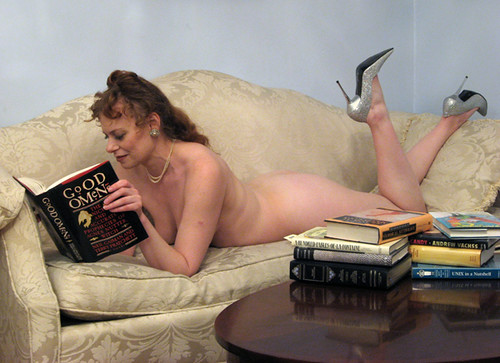
As a thanks for your support of Naked Girls Reading (and for voting yet again) here is my favorite naked reading picture.
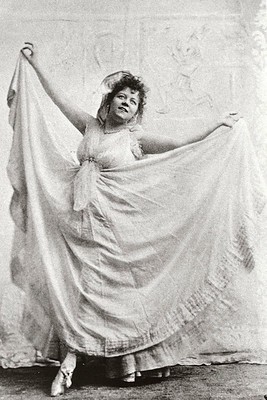
Loie Fuller (née Marie Louise Fuller in 1862) was stage struck from a very early age. It’s said that at 2 years old she unexpectedly joined the recitation group at church and lisped her way through “Now I lay me down to sleep”. She strived for stardom as an actress and singer, but it wasn’t until she turned to dance that her fortunes turned. She took a popular music hall dance style — the skirt dance — and turned it into a dramatic swirl of fabric, dubbed the Serpentine Dance.
After a lukewarm reception in the US, Loie took her dance to Paris in 1892 and became a sensation. La Loïe, as the French quickly dubbed her, mesmerized audiences with her dances of flowing fabric, highlighted with colored light. In some of her dances she manipulated the folds of fabric with long sticks, creating the form of a butterfly, a flower, rippling waves. In “Le Lis du Nil” she was draped in 500 yards of silk.
When theatres were still using gas footlights and limelight, Loie took advantage of the new electrical arc lights for her performances and created her own colored gels to get just the right effect. Sometimes she danced on a platform of glass, lit from below, and used mirrors in some of her dances. She took advantage of new technologies, projecting images on her draperies with magic lanterns and later, making moving pictures,
Her swirling form was a hallmark of Art Nouveau and many artists depicted her, on paper and in sculpture, including Rodin and Toulouse-Lautrec. She inspired fashions in clothing, jewelry, and home decor. She can also be given credit for paving the way for modern dancers, like Isadora Duncan (in whose career she took an interest), and Fokine’s Ballets Russes.
Many of her tours and other ventures were mismanaged and lost money, despite her critical acclaim. By all accounts she was charming, generous, and childlike. Loie was constantly in debt and relied on her many friends to help her out. She wrote a hasty memoir which was eventually published in English as Fifteen Years of a Dancer’s Life, With Some Account of her Distinguished Friends.
To give you an idea of the serpentine dance, here’s a montage of films shot during Loie’s lifetime. I don’t know if the dancers include Loie herself, students of hers, or just imitators. The colored footage was hand tinted, frame by frame.
So, where do we come into this? After Betty Blaize saw dancer Jody Spurling present a program inspired by Loie Fuller, she saw the possibilities for using huge swirls of fabric to captivate and tease. She got a vast quantity of silk and sewed herself a cape à la Loie.
Her first act “Lost at Sea” involved a slideshow telling a tragic love story projected onto her costume as she danced.
“Someone to Watch Over Me” was originally done behind a large Venetian blind, to give the audience a voyeuristic thrill and create a film noir look. Later, we used lighting effects to give the same atmosphere without having to worry about sightlines.
Unlucky in Love, February 2012 (Photo by Chris McIntosh)
In “Snowfall” Betty appeared in a blizzard made from tiny points of light, and then an actual blizzard of paper snow falling from the ceiling.
And while you’re doing that, please also vote for Jennifer Pelland for Best Author. She is a science fiction writer (and belly dancer), author of the novel Machine & the short story collection Unwelcome Bodies, and her fiction has appeared in numerous anthologies. She’s lost the Nebula award twice (once to Harlan Ellison), so let’s stop that nonsense. Besides, what’s that Lehane guy done lately?
I’m very happy with Vintage Hairstyling: Retro Styles with Step-by-Step Techniques, so I was pleased to see Ms. Rennells had a new book. Once again she has produced a book full of fabulous photographs and step by step instructions. Retro Makeup contains information about all the basics of applying makeup, like contouring, grooming brows, and lining lips, and information on the tools of the trade. There’s even a section on the best lipstick colors for your skin tone.
Her scope is the 1920’s through the 1950’s. There’s a great deal of historical information on makeup styles and cosmetics. You’ll learn about tanning, war-time makeup rationing, and why the most popular shade of powder was called “Rachel”. Not only is there a guide to applying false lashes, she shows the appropriate style for each decade. The book is peppered with photos of vintage cosmetic packaging and tools. The beauty fad sidebars are fun — will rouged earlobes ever come back into fashion?
The decade by decade chapters highlight brow and lip shapes as well as hallmark colors. There are only a few “looks” in each chapter, which may be initially disappointing, but it’s really an excuse for experimentation. Makeup is so intensely personal, dependent on skin coloration and face shape. There’s more than enough instruction for the reader to make up her own face in a historically accurate way that flatters her.
Yesterday was Mardi Gras, so today is Ash Wednesday. For your humble correspondent, that means 40 days until… The Expo1!
Although it’s Wednesday, I don’t have a book review for you. Instead, here are some books for you to consider reading that I haven’t read yet, because they’re hot off the press (so to speak). I’m fortunate to know a number of talented writers (much more so than I) and several of them have brand new books out!
Andrew Kirschbaum has just released the second novel in his Fifth World series, Monday and the Counterfeit Corpse. Zack Monday is a hard-boiled detective in a city where magic is as common as technology and he’s apt to use a spell as often as his fists to solve a mystery. If you want to catch up, the first book in the series is Monday and the Murdered Man.
I bought the first edition of Vintage Hairstyling when it first came out and was quite happy with it. When the author asked for feedback for a second edition, I jumped at the chance, especially since she was offering a copy of the new version as thanks.
The first edition was the best book on retro styles around, head and shoulders above the once-much-sought-after Daniela Turudich book. Lauren Rennells shows how to create hairstyles using modern equipment like curling irons and velcro rollers. Even a hair dunce like myself was able to produce some great looks. With clear and beautiful photographs she demonstrates the styling basics, like finger waves, victory rolls, and pin curls before turning you loose on a vast array on styles, growing ever more challenging as you move deeper into the book. As an added bonus there is a section on finishing touches, like hair ornaments, makeup, and nails.
The second edition has even more details on the basics. I notice she added steam rollers and soft rollers to the arsenal of equipment. She has extended her time period and included some ’50’s and even ’60’s hairdos (with the popularity of Mad Men how could one not). I was particularly pleased to see that the hairdo staple, the French Twist, was taught as a stand-alone ‘do before being used as the basis of other styles, like “Beehive” and “Golightly”.
Some of the styles from the first edition have been rewritten. “Film Noir”, a style I liked, but hadn’t tried because it involved numerous wet-set pincurls, has been redone using velcro and soft rollers. She did edit out a couple of hairstyles, like “Casino Owner’s Wife”, from the first edition, so that volume will be staying on my bookshelf. She has introduced some new techniques, like working with fake hair and making marcel waves, and has expanded the “extra” information.
I do have one gripe with this book. It’s has a very attractive design and a lot of lovely photographs, illustrating each technique or style step-by-step, as promised. But it’s a poor workbook. It doesn’t lie flat while one is styling one’s hair. The perfect binding makes it look like a “real” book, but sometimes I wish it was spiral bound, so I could have it open on my vanity while my hands are busy with curling paraphernalia and pins.
This slim volume is a gem. Subtitled “The one ‘How To’ book no woman should be without”, it covers all the basics a budding stripper could want in a mere 80 pages and boasts of “step-by-step, fully illustrated instructions by one of the most famous practitioners of the art, Libby Jones”. Published in 1967, it has the aesthetic of the era. There’s just something about the typeface of the headers that says “groovy” to me.
Ms. Jones starts off with, as promised, step-by-step instructions for stripping out of specific garments (gloves, dress, chemise, stockings, garter belt, bra, and panties). Each garment section is accompanied by line drawings showing how to remove it. Best of all is that each one is a convenient 2-page spread, for easy reference. Remember what I mentioned about the aesthetic? The illustration for “the dress” shows a maxi-dress with an empire waist with a floral slip (“the chemise”) worn underneath.
After you’ve learned to take it off, come “The Actions”: tassel twirling (the instant gratification method), breast bounce (a way of faking pectoral control a la Carrie Finnel or Donna Denise), shimmy (quivering the bum), bump (which “isn’t really one of life’s classiest gestures”), grind, floorwork, lunge, walks, and props (a pillow and earrings). All are again illustrated and each one is only on one or two pages. There are a couple of different floorwork poses and three walks, from coy to aggressive. I was quite thrilled to see some underutilized props. Now I’m inspired to try an earring remove — it could be quite seductive.
There’s even a section for making your own g-string and pasties. Remember, in 1967 there was no Etsy. ; ) The techniques are remarkably similar to the ones many people use today — if it ain’t broke…
The remaining 20-odd pages are on “beauty”. There are toning exercises for all parts of the body, like “firming and developing the bust”, “slimming the hips and buttocks”, and “reducing thick ankles”. Lastly, there are make up tips, such as conturing the face, making up eyes and lips, and “beauty hints”. Much of this section makes me think of the Virginia Slim’s motto, because we have come a long way.
I like it, part because it is a good how-to (the stripping part), and part because it is a window into its time period.
That’s the last burlesque book on my shelf! Do you have any suggestions for what I should review next?
Previously I reviewed Tease, the first novel from burlesque superstar Immodesty Blaize.
Immodesty’s second book focuses on Sienna Starr, striving for fame and fortune in Las Vegas on her own merits, rather than riding the coattails of her famous name. When the book begins, she has it all — a role as a showgirl in the fabulous revue “Venus in Furs”, Tiger’s luxurious mansion to nest in, a billionaire boyfriend, and loyal friends.
It’s not as good as the first one. Although I want to give it one bit of praise right off: April March, The First Lady of Burlesque is name-dropped alongside Lili St. Cyr and Tiger Starr.
I think my biggest gripe it that here is no mystery surrounding Sienna, unless you count the mystery of when she will open her eyes and see that she’s surrounded by liars and backstabbers. The lavish descriptions of costumes and acts that filled the the previous book are lacking. Some of the characters border on ridiculous (near-identical brother-sister twins?) and the Americans hilariously talk like Brits (bedsit, holdalls, trash skip, &c.). Everything is tidily wrapped up in the last couple of chapters with the virtuous rewarded and the wicked getting what they deserve.
As my friend Red would say, I read this so you don’t have to. I do wonder what happened between books; the first one was fun, but the second is lackluster.
My apologies, this goes out a day late, but your faithful correspondent was at the dentist yesterday and her entire schedule went keflewie (that’s a technical term) as a result.
A very happy 102* to the greatest Lady of Burlesque, Gypsy Rose Lee!
For your pleasure, here’s a little picture of Gypsy:
This is the program from her 1949 tour, from The Boston Babydoll Collection. And here’s a photo of her autographing one of those very same programs!
And just for fun, here’s Devora Darling, all dressed up for her Gypsy tribute act, “A Stripteaser’s Education” during the Madame Burlesque tour and the photo that inspired the costume.**
Not bad for someone who described herself as “no talent”!
*Probably. Her mother had a fluid relationship with the truth and thought nothing of forging birth certificates to raise or lower her daughters’ ages when the situation arose.
**That’s not actually Gypsy; it’s Burgundy Brixx as Gypsy. Our costumer didn’t look too closely…
 I’m giving away a copy of Great Philosophers Who Failed at Love to some lucky person who leaves a comment. Philosophy is all about questioning life, so I’d like you to ask me a question in said comment. Who knows? Maybe I’ll even answer it in a future missive.





 Oh, The Glamourous Life!