Review: Honey

Dear Constant Reader,
Here’s another one of these books I was sure I had reviewed long ago…

Honey: The Life and Loves of Lenny’s Shady Lady by Honey Bruce with Dana Benenson, 1976.

I first read this book as a teenager* when I was obsessed with Lenny Bruce and didn’t know the first thing about burlesque. Reading it again now from the perspective of a performer and historian brought new details into focus.

As with so many of our Legends, Honey Bruce (née Harriet Jolliff) began her performance career as a teenager escaping a miserable home life. Her stepfather was strict and physically abusive and on her third attempt to run away, she, a girlfriend, and two Army draftees made it from Detroit to Florida. Her first taste of show business came when she was hired as a topless showgirl at the Tropics Club at in Miami. Billed as The Blue Bird, she lasted all of one night, hustling drinks and being groped by patrons. Unfortunately, their transport to Florida had been a series of stolen cars and, at 17, she was sent to prison for a year. She reunited with her mother and sister who were working during the summer in a traveling carnival, where she was introduced to the girl show.

After a miserable, but brief, marriage, she ran back to the carnival and performed in the girl show as The Flame, named for her long red hair. Jean Hanley, the former lion tamer who owned the show, taught her hula and “shim-sham-shimmy”. She returned to Miami and, as Hot Honey Harlow, became a featured dancer in nightclubs. There’s a section about how she learned to command the stage from Bobbi Blake, a flamboyant female impersonator.

Then there was that fateful visit to an all-night diner in Baltimore where she met the not-yet-legendary comedian Lenny Bruce, fell madly in love, and became his shiksa** goddess. And this is where the narrative changes — Lenny dominates the story.

Early on in their relationship, Lenny wanted Honey to stop stripping. He brought her into his act, doing comedy routines, dancing, and singing. They sold her yellow convertible (with the cartoon of her in g-string and pasties on the side) and bought a black Chevy. However, after their move to California when gigs were hard to come by, she went back to stripping, landing at the Colony Club. Lenny was also working in burlesque, developing his routines as the MC at Strip City. [Warning: a bunch of the jokes she quotes are hideously racist]

After the birth of their daughter Kitty, both Lenny and Honey start using heroin heavily. From here on, the book is a cautionary tale. Honey goes to prison for two year and loses custody of her daughter. Lenny divorces her. Although they get back together (and break up and get back together and break up..), their love for each other is equalled by their love of getting high. Lenny periodically kicks his heroin use, but Honey is hooked completely. She’s harassed by the police, who want to bust her for possession.  Lenny sends her and Kitty to Europe, hoping to keep her away from the police, but that trip turns into a never-ending quest for a fix. She is robbed, assaulted, questioned by local police, and kicked out of hotel after hotel — and the entire country of Italy. Later she’ll be forced to leave Canada as an “undesirable.” She is estranged from her daughter. She finally gets clean in 1971, after being an addict for 16 years. The book ends with her tentative reconnection with Kitty.

It’s not all grim choices and bad decisions — she’s a fairly creative person. When she and Lenny are first married, she teaches herself to sew (with a rented machine!) and decorates their house. Stuck in Honolulu on a pending federal marijuana charge, she begins sewing custom bikinis out of her motel room and creates “Harriet’s of Hawaii”. The business grows until she’s designing all sorts of clothes and so busy she’s employing two seamstresses — she had no time for drugs, she says. One of her customers was singer Herb Jeffries, who would later marry Tempest Storm. While in prison, she uses WWII surplus parachutes to make lingerie for the other inmates. Later, back in Los Angeles, she opens “Hattie’s in the Hills”, a custom clothing salon in Hollywood.

Not surprising for a book published by Playboy Press there’s a lot of sex and a lot of physical descriptions of people (especially herself and Lenny) intended to be titillating. Although I know that it wasn’t the focus of the book, I wish there had been more details about her burlesquing. She mentions performing “squat-bumps” and that she had costumes with hoopskirts, but not much else and almost nothing about the other performers with whom she shared a stage.

It’s interesting to compare her story with her portrayal in the movie Lenny, which I shall review next.

M2

*Shout out to the Westport Public Library for having it on their shelves and never even commenting on the weird stuff I checked out.
** Yiddish for a non-Jewish woman. Implies the kind of girl you wouldn’t want to bring home to Mother.

These writings and other creative projects are supported by my 18 Patrons. Thank you so much! To become a Patron, go to my Patreon page.

Published in: on 29 April 2026 at 9:07 pm  Leave a Comment  
Tags: ,

Book Review: Holmes & Watson

Dear Constant Reader,

You might recall that I thoroughly enjoyed the Giblet and Belle series by Robert Lay. His new series, Holmes & Watson, stars two of the characters we met in The Case of the Vendetta, Holmes, the superior orange cat and Tyler Watson, exonerated ex-con. It’s five years after the events of that book and the two of them, along with young genius Cassidy Macgregor (now grown), form a detective agency.

In the first book, The Case of the Dubious Daughter, a missing persons case becomes something more complex, sinister, and far-reaching. When Isabella De León’s parents hire the detectives to track down their daughter, the case leads them from Connecticut to St. Louis, where they discover wide ranging crimes involving a Colombian cartel, the FBI, and a shadowy organization that controls more than you might imagine. There is also romance and some of Holmes’ backstory.

I was privileged to be a beta reader on the second installment, The Case of the Bridge Too Far, which was recently published. When the agency looks into an art theft, they ultimately come face to face with their nemesis. Does he know that they are on to him? While the investigation goes on, Cassidy is preparing for her wedding and Holmes must deal with a cat from his past. There is excitement and tragedy, as well as humor and love.

The ending left me wanting to know what happens next. Fortunately The Case of the Enemy of My Enemy is due out next autumn. I have inside information that this book will conclude this series of thrillers, but there will be more books featuring the cast of cats!

As has become customary, each book has a bonus short story and a selection of recipes from the paw of Chef Hamilton A. Cat. The Dubious Daughter has recipes submitted by readers and tested to be selected by Hamilton (disclosure: one of them is mine) while The Bridge Too Far supplements the story with three recipes served during the course of the tale.

If you want a sample, I did a reading of the bonus story from The Case of the Bridge Too Far, “Lily and the Great Vampire Hunt”. It’s a Giblet & Belle story, starring Belle’s kitten.

You can follow these links to buy all of Robert’s books at Bookshop.org*:
Giblet & Belle –
The Case Of The Missing Ring
The Case Of The One Still Too Many
The Case Of The Vendetta

Holmes & Watson –
The Case Of The Diabolical Daughter
The Case Of The One Bridge Too Far

They make great holiday gifts!

M2

* Yes, you can get them on Amazon and B&N, but Bookshop.org supports small bookstores and I’m an affiliate, so you’re supporting my endeavors as well.

These writings and other creative projects are supported by my 18 Patrons. Thank you so much! To become a Patron, go to my Patreon page. Or you can just tip me if you liked this.

Published in: on 1 December 2025 at 2:00 pm  Leave a Comment  
Tags: ,

Review: Girl Show

Dear Constant Reader,

In May (on Toni Elling’s birthday, in fact) I took “The History of Cooch Tent Sideshows”, an on-line class from the Chocolate City Burlesque Academy, taught by founder (and dear friend) Bebe Bardeaux. The class was excellent, as were the others I took, and it reminded me that I never reviewed this book in my collection.

Girl Show: Into the Canvas World of Bump and Grind by A. W.  Stencell, 1999.

As long as there have been carnivals, there have been girl shows. This history covers the early days, starting with the 1893 Columbia Exposition through the decline in the 1980s. The many photographs illustrate all aspects of the carnival: girls in action and backstage, advertisements, posters, show fronts, and more. In the back there’s a glossary for some of the carney terms used throughout book, like single-O (a show with only one attraction), blow off (a final act for an additional fee), and bally (a free taste of the show inside).

Some of the biggest names in burlesque worked carnival girl shows: Gypsy Rose Lee, Sally Rand, and Lili St. Cyr, to name a few. Many of the shows were big production revues with relatively elaborate sets and lavish costumes. But there was a lot of grit behind the glitz. There were plenty of cooch shows where the girls worked nude and allowed the patrons to grope them… and more*. And this went on for 10, 12, 14 shows a day.

The book spotlights some of the great names in the carnival biz, some of whom are well known to burlesque fans and some who are more obscure. There’s a fabulous section all about Tirza the Wine Bath Girl and the evolution of her act, with photos. And there’s a mention of that girl who set her tits on fire. Sound like anyone you know?

Besides the girls, the book covers other people who worked these shows. There were talkers, who were not, as you might suppose, hosts or MCs. They stood out front with some of the girls from the show to entice the audience in. A good talker was an entertainer in his** own right as well as persuasive. The best needed only a few girls around him to advertise the show — his patter did most of the work. There’s a brief mention of Leon Claxton’s Harlem in Havana show in this chapter. You can learn more about it in Leslie Cunningham’s book, Brown Skin Showgirls. There were the candy butchers technically sold boxes of candy, but also worked a con to get people to buy by promising fabulous or risqué prizes. They were found in burlesque theatres as well and could have very entertaining pitches. There are also sections on producers, show families, and general carnival life.

It’s a good overview of the traveling show — a fine companion to Carnival Strippers and Brown Skin Showgirls.

*There are photos of this. Just a friendly warning.
**There were female talkers but they were in the minority

M2These writings and other creative projects are supported by my 18 Patrons. Thank you so much! To become a Patron, go to my Patreon page. Or you can just tip me if you liked this.

Published in: on 24 July 2025 at 4:46 pm  Leave a Comment  
Tags: , ,

Review: Tempest Storm

Dear Constant Reader,

I first saw this documentary in 2018 at a local theatre, but it took me this long to write up my thoughts. I know Tempest never would have seen this little blog, but I didn’t feel comfortable writing this while she was alive. The audience at the screening was sparse and I though that was sad. Harvey Robbins, Tempest’s manger, who I can’t stand (let’s just leave it at that) introduced the film and did a Q &A at the end, all of which I remember thinking we could have done without.

Tempest Storm movie poster

Tempest Storm directed by Nimisha Mukerji, 2016.

I won’t rehash Tempest’s amazing career here. Read The Lady is a Vamp if you want to know more. The film covers some of her glory days and some of her personal life, with interviews with Tempest, her family members, manager, and people in the neo-burlesque scene. There’s archival images and footage of Tempest, but also some artsy, mood-setting scenes, like actresses playing younger Tempest and little girl Tempest that I didn’t think was so necessary. 

Throughout Tempest is glamorous. They focus on a number of her triumphs: headlining at a burlesque festival, a photoshoot, signing her clothing line deal with Tatyana, greeting her adoring fans at conventions, performing at BHoF. 

The documentary follows Tempest as she attempts to reconnect with her family. She calls her daughter and leaves messages several times without response. Her father abandoned Tempest when she was a baby and she never knew him or why he left. After a genealogist traces him, Tempest goes back to Georgia to visit his grave. It feels a bit like a farewell tour as she sees her siblings and their families. She continues by going to Los Angeles to see her ex-husband Herb Jeffries (who died not long after their reunion). Marrying Herb, a Black singing cowboy, caused damage to her career and to her relationship with her family. Ultimately she chose her career over the marriage and their daughter. 

Then she flew to met with her estranged daughter. Who refused to see her. The film maker clearly had this plan for a redemption arc, with a mother-daughter reunion, which was foiled by people not acting like characters in a script.

She never seems to realize that she repeated history by leaving her daughter and husband, like her father abandoned her. When her daughter challenges Tempest over the phone for not being there for her and her granddaughter, Tempest tries to explain how busy she’s been with festivals and appearances, but never apologizes for her absence in their lives. It’s sad and I feel like her sorrow is exploited.

The film ends (not a spoiler) with footage of Tempest in a diaphanous white gown at dusk, dancing in a field of Georgia cotton, the kind she had to pick as a little girl. She worked so hard to get away and yet much of this film is about her return.

The documentary is a chance to hear her story from her and that is absolutely worth it. You can watch the entire film on YouTube.

M2These writings and other creative projects are supported by my 19 Patrons. Thank you so much! To become a Patron, go to my Patreon page. Or you can just tip me if you liked this.

Published in: on 26 June 2025 at 8:21 pm  Leave a Comment  
Tags: , ,

Review: Your Beauty Mark

Dear Constant Reader,

Here’s another book that’s been hanging around my shelves for far too long without a review.

Your Beauty Mark: The Ultimate Guide to Eccentric Glamour by Dita Von Tease with Rose Apodaca, 2015.

I’ll be perfectly honest; I did not have high hopes for this book. I thought Dita’s first book, Burlesque and the Art of the Teese/Fetish and the Art of the Teese, while very pretty, was a bit superficial and self-indulgant.

I was very pleasantly surprised that this book is packed with useful information. As to be expected, it’s full of glamourous pictures of Dita, but also some more practical demonstration ones. Besides just Dita, her co-author also offers beauty advice and there are sidebars from a number of other experts and eccentrics in the world of glamour.

There are a lot of topics in each section, but broken into bite-sized bits. As one would expect, the book covers makeup and hair styling, both of which are illustrated with photos of Dita demonstrating. I thought it very impressive that someone whose brand is based on artifice was willing to appear “undone”.

The first part is the most eclectic, covering skin care, fitness, nutrition, bathing, the bosom, hair removal, and perfume. Dita demonstrates her pilates-style workouts in photographs and shares her recipe for a green smoothie.

The second part is on cosmetics. She starts at the base with foundation and powder. The eye chapter has a lot about the cat eye, but also lashes, including false ones. Brows have their own chapter, as does blush, beauty marks (hers is a tattoo), lipstick, and manicures, including how to do Dita’s half-moon style, courtesy of “Mom Von Teese”. Throughout there are photos of Dita putting on her makeup. The last chapter of this section is a bit different, called “Striking Below the Waist”, it has very little to do with cosmetics. Instead, it discusses care for the waist, bum, legs and feet. There is the expected how-to for a pedicure, but also a discussion of stockings and a little about corsets. Lastly there are several pages on pubic hair and the styling thereof.

The third part is on hair. You’ll learn about cleaning and conditioning hair and hair tools and products. Of course there is a discussion of hair coloring; Dita is quite open that her blue-black locks come from a bottle. As with the makeup section, Dita demonstrates a number of her favored hairstyles, including her signature ‘do, in photographs

The fourth and last part is extreme forms of beauty — cosmetic surgery and stage makeup. Dita is quite honest about her breast augmentation. She is in favor of having work done, if it’s right for you and if you do a lot of research to find the doctor that’s right for you. And, she does point out that embracing your “flaws” make you unique. She outlines the lengths she goes to to create a flawless façade on stage, including covering herself neck to toe in body makeup that she blends herself. Having handled one of her costumes, I can confirm that the inside was daubed with pale foundation. She also gives tips for removing makeup, both the stray smudges and flecks that could mar your handiwork and how to get it all off afterwards.

As I said above, I was surprised and quite delighted about the amount of useful information in this rather weighty tome. Yes, Dita does take opportunities to shill her products, but one expects the reader to already be a Dita fan. Although she shows her signature styles and discusses her beauty regimines in detail, she does encourage the reader to find their own style of glamour — thus Your Beauty Mark.

M2These writings and other creative projects are supported by my 19 Patrons. Thank you so much! To become a Patron, go to my Patreon page. Or you can just tip me if you liked this.

Published in: on 11 December 2024 at 1:36 pm  Leave a Comment  
Tags: , , , ,

Review: Banned in Boston

Dear Constant Reader,

This is one of those books I was sure I reviewed ages ago, but didn’t…

Banned in Boston: The Watch and Ward Society’s Crusade against Books, Burlesque, and the Societal Evil by Neil Miller, 2010.

“Banned in Boston”. Anyone who is a fan of classic burlesque knows that phrase. But who did the banning? Professor Miller presents the history of the New England Watch and Ward Society, founded in 1878 as the New England Society for the Suppression of Vice, the first branch of Anthony Comstock’s New York organization. The Society was a volunteer organization dedicated to keeping Boston, the Athens of America, as well as the rest of New England, clean and moral. Essentially vigilantes, the Society used quasi-legal methods to expose and punish immoral crimes, such as gambling, drug use, and prostitution. Sometimes they worked with local police and sometimes they set up their own raids and stings. But ultimately the Society was about censorship.

Any book, play, or motion picture that did not meet with the Watch and Ward’s approval could be banned. At the height of the Society’s power, there was a gentleman’s agreement between them and the booksellers. Banned books would quietly be taken off the shelves and the bookstore owners would then not be prosecuted for selling obscene material. Eventually the “Banned in Boston” label was used as a selling point in the rest of the country.

There’s one chapter in the book on burlesque and the Watch and Ward. The Society objected to profanity and suggestive language, costumes that showed off the female figure, and risqué dance movements. By the 1930s, they were keeping tabs on burlesque shows in Boston, Worcester, Springfield, and Providence. In 1932 one investigator complained that Bubbles Keller had “pliable hips, oscillating buttocks, and breasts that seemed forever quivering.” Doth he protest too much?

According to Ann Corio, the box office at the Old Howard would warn the performers that a Watch and Ward member was in the house by hitting a button that would turn on a red light in the footlights. The performers would then go ahead with the “Boston version”, a cleaned up act. It’s unclear if this really happened, since the Old Howard was shut down a few times for violations before being closed for good in 1953 when Irma the Body was secretly filmed by vice cops.

It’s worth reading to understand the atmosphere in Boston during the Golden Age of burlesque, but despite the prominent photo of Sally Keith on the book cover, the burlesque specific chapter is relatively short. Much of the book is concerned with censorship of books and legitimate theatre. I found it interesting that when Eugene O’Neill’s play Strange Interlude was banned in Boston (to great outcry), it was produced with great success in liberal Quincy*.

Despite the book being published almost 15 years ago, it’s still a timely cautionary tale of what can happen when private citizens decide what is “decent” and “moral” for others and take enforcement into their own hands.

M2These writings and other creative projects are supported by my 19 Patrons. Thank you so much! To become a Patron, go to my Patreon page. Or you can just tip me if you liked this.

*For those unfamiliar with Boston politics, Quincy is pretty conservative these days and some years ago, blocked a certain burlesque troupe from opening a studio there.

Published in: on 14 November 2024 at 12:21 pm  Leave a Comment  
Tags: ,

Review: Striporama

Dear Constant Reader,

Whilst I was swooning on my invalid’s couch I might as well watch a movie and write a review. I should have picked a different movie because I had so many questions from this one

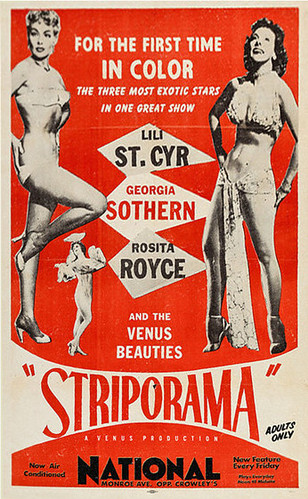
StriporamaStriporama, 1953, directed by Jerald Intrator (Something Weird Video release)

Unlike most burlesque movies of the time, Striporama tries to have a plot or at least a frame story. The New York Council of Culture is choosing the forms of entertainment to put into a time capsule and they are all agreed that burlesque has no place. Cut to two comics (Jack Diamond and Mandy Kay) bumbling around their apartment. The gags are pretty typical of burlesque comedy, only notable for one where a picture of their dream girl comes to life and… it’s Bettie Page! She dances in a tiny fringe bikini and notably speaks a few lines before vanishing leaving the comics to wake up in each other’s arms.

Cut back to the Council of Culture where the comics, led by Charles Harris (the straightman) burst in, dressed as gangsters and force the councilmen to watch a burlesque film. It went something like this: (this is long; for my summary go here.)

A parade of scantily-clad women, presumably The Venus Beauties, enter one by one and sit in a semi-circle. Each one is carrying a staff with a heart on top with one letter that, of course, spells out “BURLESQUE”. There’s an off-camera “tit singer” warbling about the Goddess of Love. The camera is particularly focused on the women’s legs.

Georgia Sothern, speaking in rhyme, introduces the four types of strippers (g-string quartet). She portrays them all: the baby-doll type: dressed in frills and ruffles;  the slow and easy type: slinking across the stage;  the wild and woolly type: Georgia’s typical fast and furious dance;  and the literary genius: a clear Gypsy Rose Lee impression (Gypsy and Georgia were best friends). In no case does she take off more than one garment. The clip felt like it was taken out of a larger context.

We see a woman undressing in silhouette in her window. At the end, she turns out the light, never having shown herself.

The comics do a sketch set in the jungle. I’ll be honest here — I don’t find a lot of classic burlesque comedy funny, so I skipped over this after getting the gist.

Marinette and Andre perform a Danse Apache on a Parisian street scene. This was pretty nifty. Not only is it a feat of athleticism and skill, I recently learned a lot about the history which I might share in a future post. These two were amongst the few credited performers that I could match with their acts.

Back to the comics, this time on a carnival set, where there are magic tricks involving eggs and hats.

Rosita Royce is the first of the star stripteases. One by one, her signature doves fly out and settle on her arms (protected with sequined sleeves) and headdress. Despite the stories that she had trained her doves to undress her, she takes off her own dress, no mean feat with multiple doves balanced on her arms. Her underlayer is relatively modest with a bra and full, rather drapey panties and even a large jewel covering her navel. However, while she had the dress on, I think she was wearing a g-string. I’m pretty sure I could see her bare bum through the sheer dress.

For more comedy we go to a harem where a pasha tells his assembled wives and daughters (presumably the Venus Beauties again) that he is going to honor a brave American sailor who saved his life during the war. The sailor can have his pick of four of the pasha’s daughters, but they will come before him one by one. If he rejects one, he can’t choose her later. Three of the daughters bellydance for him, but he turns them down. The pasha offers his most precious daughter. Cut to a bathing room.

As attendant prepare a (rather obviously empty) tub, Bettie Page prepares to bathe. I found her dipping her toe into the “water” to test the temperature funnier than the comedians. Next you see her in a tub full of soap bubbles, in which she joyfully plays.

Back in the harem, the last daughter dances for the sailor, and as the last one he must marry her and of course, when she removes her veil, it’s the other comic. *rim shot*

The comics return on the same carnival set as the magic trick sketch. Mr. America, a well-muscled man, performs feats of strength. He plays the trumpet while flexing his pecs, he performs a Cossack-style dance while playing the harmonica with a woman sitting on his shoulders, one of the comics puts on a harness and Mr. America picks him up using his teeth. For the finale, he effortfully lifts a 1000 pound barbell, which, of course, the comic easily picks up for the punchline. Although credited only as Mr. America, apparently it was fitness guru Jack LaLanne.

At last some more stripping. Georgia Sothern does a kind of a poor woman’s Lili St. Cyr on a set crowded with furniture. She’s reclining on a chaise in a robe reading a magazine when the phone rings. After the call, she slips behind a screen and joyfully removes the robe and puts on a gown. Then she adds a fur coat and a corsage. Another phone call, which ends poorly. Angrily she rips off the corsage, then the coat, then she goes back to the screen, returns to the robe. Finally she flops down onto the chaise and picks up her magazine again.

Cut back to the set, now cleared of almost all the furniture, and Georgia does her famous head-bobbing striptease. Like Rosita above, she only takes off one garment, a gown, and she’s basically full dressed underneath — panel skirt, drapey panties, bra, and navel jewel.

The movie ends here, but apparently there was a bit more where the Council agrees (of course) to add burlesque to the time capsule. It’s missing from the Something Weird print, which as far as I can tell, is the only one available.

But wait, you say, that poster advertises Lili St. Cyr. Where is she? Patience, my friends.

tl;dr.
Striporama is a bit higher-end than many other burlesque movies. Typically a burlesque movie was filmed in black and white and often with a fixed camera as though you were in the audience at a theatre, (aka as cheaply as possible), usually in an actual theatre.  This appears to be multi-camera, on a number of different sets, as well as in color.

For a movie promising a “striporama”, there’s very little actually stripping. Only Rosita Royce and Georgia Sothern (neither in the credits) perform anything close to a striptease and what they do perform is quite modest. They don’t go down to pasties and even cover their navels.

Since there’s no MC or title cards, like in other burlesque movies, I don’t know where the other performers in the credits appear, particularly Pat Lombard, Nola Lee, Betty Tunell, Doris Mackenzie, Anne Slayton.

According to some posters, Lili St. Cyr’s act “Cinderella’s Love Lesson”, was originally included, but I’ve seen it as a stand-alone film with credits from a different production company. Apparently it was pretty common for burlesque films to be cut up and repackaged. I’m wondering if the strip features were taken from elsewhere and inserted amongst the footage shot by Intrator and crew. It would explain why the stripteasers are credited on the posters, but not the film itself.

I’d be interested to see if any print other than the SWV version exists.

M2These writings and other creative projects are supported by my 20 Patrons. Thank you so much! To become a Patron, go to my Patreon page. Or you can just tip me if you liked this.

Published in: on 7 May 2024 at 3:03 pm  Leave a Comment  
Tags: ,

Review: Punk Rock Aerobics

Dear Constant Reader,

Your Faithful Correspondent is laid up in bed with some sort of bug (I’m doing better, just very tired) and since I can’t seem to bring myself to do any of the active things had planned for the day, how about a book review.

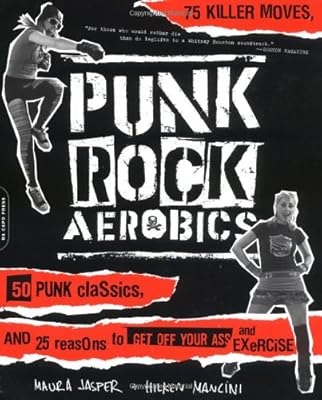
Punk Rock Aerobics by Maura Jasper and Hilken Mancini, 2004.

Wait, you say, is this our refined Miss Mina writing of punk rock? You many not believe this, but as a dainty young thing I could be found in the mosh pit at an all-ages hardcore club. I still retain a great deal of affection for the music. And you know how I love creative workouts.

I encountered Punk Rock Aerobics last fall whilst I was working on the Boston Public Library Passport Challenge (a missive for another day). The Parker Hill branch of the BPL was celebrating “Punk Rock Week” and I decided it give the it a whirl. I had a lot of sweaty fun and picked up the book.

The creators hated traditional fitness classes and gyms, but wanted to get in shape. After becoming certified aerobics instructors, like true punks, they tossed everything out and developed their own gritty workouts with moves like “skank” and “Iggy’s pop”. However, many of the exercises are ones you would recognize, just with punkier names, like the “unnatural axe” is a hamstring stretch.

The book takes you through the equipment needed, including good sneakers, a mat, water, weights (they use bricks) and then progresses through the vocabulary: stretches (both warm-up and cool-down), cardio, strength training (standing and on the floor). All of these are illustrated with black and white photos. The cardio moves are classified as hi-fi or lo-fi (high or low impact) or both. Difficulty is rated with skulls. “Hand-written” notes give helpful tips.

After an extensive tour of the moves, they show you how to create workouts. Pick three cardio moves (a mix of hi & lo-fi) and a song, which they call combo-hatching. You’ll be doing the three moves over and over to the song. Fortunately, punk songs are pretty short, so there will be a lot of variety in each cardio section. Then string your combos together into rock blocks. Choose your stretches and strength moves and put them all together into a workout of your desired length. Don’t panic, there are plenty of examples of combos and sample workouts.

The last chapter is tips on how to sustain your fitness practice. Throughout the book there are Q & A’s with musicians about their fitness routines and the authors recommend movies and albums for inspiration. The tone of the book overall is, as you might imagine, irreverent, but encouraging.

It’s hard to learn physical skills from a book, so I wouldn’t recommend this to a fitness novice. But if you’ve got some exercise experience, this is a fun way to shake things up.

A live PRA class ends with the instructors lobbing mini-candy bars at you, so give yourself a sweet treat when you’re done sweating.

M2These writings and other creative projects are supported by my 20 Patrons. Thank you so much! To become a Patron, go to my Patreon page. Or you can just tip me if you liked this.

Published in: on 29 April 2024 at 11:04 am  Leave a Comment  
Tags: , ,

Review: Carol Doda Topless at the Condor

Dear Constant Reader,

Carol Doda movie posterLast week I saw the documentary Carol Doda Topless at the Condor. By the way, what a pleasure it is to see a movie in a theatre! I found out the movie was playing near us at about the last minute and I’m glad the timing worked out so that we were able to see it. It’s not about burlesque per se, but the transitional period of adult entertainment between burlesque and the neo-burlesque revival.

Carol Doda was a cocktail waitress at the San Francisco night spot the Condor Club in North Beach in the early 1960s. Once the management saw how well the audience reacted to her dancing to the band, they had her dance on stage, or rather on the piano, since there wasn’t room on stage. One of the owners decided that the piano should descend from the ceiling with Carol on it and that became her signature.

On June 19, 1964 Carol Doda donned a monokini (topless swimsuit) and descended on the piano into history as the first topless dancer.  A topless craze followed which changed the trajectory of entertainment. San Francisco became a mecca for tourists and conventioneers and the Condor was the hottest night spot. Carol Doda was so synonymous with the Condor that a giant image of her adorned the exterior of the club (with flashing red lights for nipples) as well as her name, seemingly where ever there was a blank bit of wall.

The documentary consists of archival footage (of which there is an absolute wealth), present day interviews with people who knew Carol, and modern academics to put parts of the story into context. Although the main subject of the documentary is obviously Carol Doda and her role as the pioneering topless and then bottomless dancer, there are other topics to flesh out the story, such as Rudi Gernreich, the futurist fashion designer who created the monokini*, the origins of The Swim dance, nightlife in North Beach, local musicians, interracial relationships (with some very painful stories), the myth of bra burning, &c. It doesn’t always mesh with the main theme of the film, but it’s all interesting.

One of the most important subjects of the film was Carol Doda’s breasts. When she first became a sensation, she had modestly-sized breasts, but, knowing that as topless dancing became more common, she needed to set herself apart from all the others. Thus she opted** to enlarge her breasts. At the time that meant silicone injections. Be warned: there is some seriously disturbing contemporary footage of a woman undergoing the procedure and a horrific story from one of the interviewees. Carol endured 44 shots of silicone, until even her doctor was telling her to stop, bringing her bust to a 44DD.

Both she and the Condor were massive successes. They had a symbiotic relationship, which ended when Carol asked for more pay for her twelve shows a night. She also asked to buy into the club (which one of the owners laughingly dismissed, even today). She left, but the Condor continued to use her name and likeness and thrived. Eventually she returned, having never found the same success elsewhere.

In 1969 she went bottomless, again the first to do so. Her arrests for indecency had lead to a judicial verdict that topless dancing was legal, but bottomless dancing was eventually ruled illegal by the California Alcoholic Beverages Commission.

She worked as an adult entertainer until the mid-’80s, as North Beach became sleazier and the almost innocent fun of topless go-go dancing to a live band was replaced with full nude dancing to canned music, live sex shows, and porn movies. She continued performing, albeit with her clothes on, for most of the rest of her life, even as her health failed. As you’ve probably suspected, the health issues that caused her death in 2015 were related to those silicone shots decades before.

Although we see Carol, often in her own words, as an entertainer, an advocate for free expression, and a business woman, we never really get to know her. She’s funny and charismatic, but when the subject of her personal life comes up, she deflects or makes a joke. Any attempt to learn anything about her family or her past is quickly shut down. Even those who knew her personally didn’t really know much of Carol beyond the stage.

There’s a theme in the film that Carol helped create the zeitgeist of the 1960s, but perhaps she was more of a product of it. Did the court ruling that her topless dancing was self-expression and not indecency lead to the Summer of Love or was the verdict because San Francisco was already headed that way? Was she a product of the male gaze or did she subvert it for her own purposes? In any case, there is no doubt that she was a trailblazer in the world of adult entertainment and freedom of expression.

The documentary is a love letter to Carol Doda and the North Beach entertainment scene. We also learn about some of her contemporary dancers and friends. I was particularly intrigued by the stories from Judy Mamou, who as Tara, danced with a topless monkey! If the film comes to your area, do go see it.

*Ironically, he created the topless swimsuit because he felt a woman’s body should not be sexualized.
** With some pressure from the club’s publicist.

M2These writings and other creative projects are supported by my 19 Patrons. Thank you so much! To become a Patron, go to my Patreon page. Or you can just tip me if you liked this.

Published in: on 13 April 2024 at 6:27 pm  Leave a Comment  
Tags: ,

Book Review: Giblet and Belle

Dear Constant Reader,

After the previous rather mediocre review, I wanted to share some books I can actually endorse. They’re not about burlesque, but some of my other favorite things: mysteries and cats.

There are three books by Robert Lay, so far:
Giblet and Belle: The Case of the Missing Ring, 2021
Giblet and Belle: The Case of the One Still Too Many, 2022
Giblet and Belle: The Case of the Vendetta, 2023

In this world it’s the cats who are solving the mysteries. I know that sounds twee, but it’s not. The cats are the main characters, foiling criminals and gently (and not so gently) nudging humans in the right direction. Unbeknownst to People, for thousands of years there have been cats who are Protectors, looking out for humans and keeping order.

When our story first begins, tiny kitten Belle has only recently been adopted from a shelter by The People and is getting used to the new home in Torrington, Connecticut that she shares with dignified tabby Giblet (her best friend), old Joel Grey the Russian Blue, and the formidable Maine Coon Mittens. After a burglary, Belle learns that Mittens is a Protector, from a long line of heroic French cats. Mittens sees something promising in Belle and begins training her as a Protector.

In the second book, Belle is officially an apprentice Protector. The People and all their pets go to West Virginia for the summer so the Man-Person, a history professor, can do research for his book on moonshine production. Here we learn Joel Grey’s backstory and how he ended up with The People. The cats (along with canine and human allies) find themselves trying to bring a murderer to justice and save a family legacy. We also learn quite a bit about distilling whiskey, a major plot point. I do like novels with some educational content!

The third book, with Belle as a full-fledged Protector with her own protégé, delves deeper into the complexities and history of the cat world. We also meet several new cats: the kittens Holly Bear and Hamilton, and Holmes, a consulting cat detective, of course. The stakes are even higher in this story with a series of murders and a diabolical criminal mastermind bent on chaos and destruction.

The stories have excitement, peril, and even tragedy, but also sweetness and humor. I found them well-paced and hard to put down. The illustrations by Natalia Junqueira are charming.  If you like cozy mysteries, these books fit the bill. They’re an excellent read while traveling.

Like me, the author is big fan of Breaking Cat News and a frequent contributor to the comments section. There are a few in-jokes and Easter eggs in the books for those who are familiar with the comic strip. (And if you’re not familiar, do give it a read.)

I will admit that The Case of the Missing Ring made me cry several times. Bartholomew had only recently joined our household and it was a bit much reading about a huge wise cat teaching a young black cat how to protect the forever-family.

Chef HamiltonOne of the lovely bonuses in the latter two books are recipes from Hamilton A. Cat, a chef cat. I’ve tried them both and they are delicious. Full disclosure, I was one of the advisors on the second recipe.

You can buy the books at Amazon, B&N, &c. or directly from Giblet & Belle Press. If you visit Giblet & Belle, you can meet the real-life cats that inspired the characters and read half a dozen short “case files”.

I am eagerly awaiting the next book, which goes in a different direction and stars some of the characters introduced in The Case of the Vendetta.

M2These writings and other creative projects are supported by my 19 Patrons. Thank you so much! To become a Patron, go to my Patreon page. Or you can just tip me if you liked this.

Published in: on 14 December 2023 at 2:50 pm  Leave a Comment  
Tags: , ,