Review: Girl Show

Dear Constant Reader,

In May (on Toni Elling’s birthday, in fact) I took “The History of Cooch Tent Sideshows”, an on-line class from the Chocolate City Burlesque Academy, taught by founder (and dear friend) Bebe Bardeaux. The class was excellent, as were the others I took, and it reminded me that I never reviewed this book in my collection.

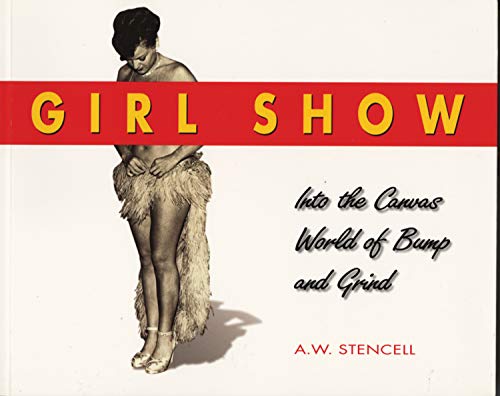
Girl Show: Into the Canvas World of Bump and Grind by A. W.  Stencell, 1999.

As long as there have been carnivals, there have been girl shows. This history covers the early days, starting with the 1893 Columbia Exposition through the decline in the 1980s. The many photographs illustrate all aspects of the carnival: girls in action and backstage, advertisements, posters, show fronts, and more. In the back there’s a glossary for some of the carney terms used throughout book, like single-O (a show with only one attraction), blow off (a final act for an additional fee), and bally (a free taste of the show inside).

Some of the biggest names in burlesque worked carnival girl shows: Gypsy Rose Lee, Sally Rand, and Lili St. Cyr, to name a few. Many of the shows were big production revues with relatively elaborate sets and lavish costumes. But there was a lot of grit behind the glitz. There were plenty of cooch shows where the girls worked nude and allowed the patrons to grope them… and more*. And this went on for 10, 12, 14 shows a day.

The book spotlights some of the great names in the carnival biz, some of whom are well known to burlesque fans and some who are more obscure. There’s a fabulous section all about Tirza the Wine Bath Girl and the evolution of her act, with photos. And there’s a mention of that girl who set her tits on fire. Sound like anyone you know?

Besides the girls, the book covers other people who worked these shows. There were talkers, who were not, as you might suppose, hosts or MCs. They stood out front with some of the girls from the show to entice the audience in. A good talker was an entertainer in his** own right as well as persuasive. The best needed only a few girls around him to advertise the show — his patter did most of the work. There’s a brief mention of Leon Claxton’s Harlem in Havana show in this chapter. You can learn more about it in Leslie Cunningham’s book, Brown Skin Showgirls. There were the candy butchers technically sold boxes of candy, but also worked a con to get people to buy by promising fabulous or risqué prizes. They were found in burlesque theatres as well and could have very entertaining pitches. There are also sections on producers, show families, and general carnival life.

It’s a good overview of the traveling show — a fine companion to Carnival Strippers and Brown Skin Showgirls.

*There are photos of this. Just a friendly warning.
**There were female talkers but they were in the minority

M2These writings and other creative projects are supported by my 18 Patrons. Thank you so much! To become a Patron, go to my Patreon page. Or you can just tip me if you liked this.

Published in: on 24 July 2025 at 4:46 pm  Leave a Comment  
Tags: , ,

Review: Tempest Storm

Dear Constant Reader,

I first saw this documentary in 2018 at a local theatre, but it took me this long to write up my thoughts. I know Tempest never would have seen this little blog, but I didn’t feel comfortable writing this while she was alive. The audience at the screening was sparse and I though that was sad. Harvey Robbins, Tempest’s manger, who I can’t stand (let’s just leave it at that) introduced the film and did a Q &A at the end, all of which I remember thinking we could have done without.

Tempest Storm movie poster

Tempest Storm directed by Nimisha Mukerji, 2016.

I won’t rehash Tempest’s amazing career here. Read The Lady is a Vamp if you want to know more. The film covers some of her glory days and some of her personal life, with interviews with Tempest, her family members, manager, and people in the neo-burlesque scene. There’s archival images and footage of Tempest, but also some artsy, mood-setting scenes, like actresses playing younger Tempest and little girl Tempest that I didn’t think was so necessary. 

Throughout Tempest is glamorous. They focus on a number of her triumphs: headlining at a burlesque festival, a photoshoot, signing her clothing line deal with Tatyana, greeting her adoring fans at conventions, performing at BHoF. 

The documentary follows Tempest as she attempts to reconnect with her family. She calls her daughter and leaves messages several times without response. Her father abandoned Tempest when she was a baby and she never knew him or why he left. After a genealogist traces him, Tempest goes back to Georgia to visit his grave. It feels a bit like a farewell tour as she sees her siblings and their families. She continues by going to Los Angeles to see her ex-husband Herb Jeffries (who died not long after their reunion). Marrying Herb, a Black singing cowboy, caused damage to her career and to her relationship with her family. Ultimately she chose her career over the marriage and their daughter. 

Then she flew to met with her estranged daughter. Who refused to see her. The film maker clearly had this plan for a redemption arc, with a mother-daughter reunion, which was foiled by people not acting like characters in a script.

She never seems to realize that she repeated history by leaving her daughter and husband, like her father abandoned her. When her daughter challenges Tempest over the phone for not being there for her and her granddaughter, Tempest tries to explain how busy she’s been with festivals and appearances, but never apologizes for her absence in their lives. It’s sad and I feel like her sorrow is exploited.

The film ends (not a spoiler) with footage of Tempest in a diaphanous white gown at dusk, dancing in a field of Georgia cotton, the kind she had to pick as a little girl. She worked so hard to get away and yet much of this film is about her return.

The documentary is a chance to hear her story from her and that is absolutely worth it. You can watch the entire film on YouTube.

M2These writings and other creative projects are supported by my 19 Patrons. Thank you so much! To become a Patron, go to my Patreon page. Or you can just tip me if you liked this.

Published in: on 26 June 2025 at 8:21 pm  Leave a Comment  
Tags: , ,

An Alternative to Amazon

Dear Constant Reader, 

Here at The Manor, we’re trying to live with less Amazon. I suspect some of you are as well. And thusly, I’ve been going through my book reviews and replacing links to Amazon with affiliate links to Bookshop.org. If you buy your books through those links, you’ll be supporting an independent bookstore and also this blog (as an affiliate I get a wee kickback).

You can tell which reviews have changed links by the ❤️ on the review page. I haven’t been able to replace all of them, since a number of the books are out of print.

I know it’s been a few months since my last book review. Any burlesque book in particular you’d like me to read and review?

M2These writings and other creative projects are supported by my 19 Patrons. Thank you so much! To become a Patron, go to my Patreon page. Or you can just tip me if you liked this.

Published in: on 13 March 2025 at 5:32 pm  Leave a Comment  
Tags: ,

Winter Reading Challenge

Dear Constant Reader,

The Winter Reading Challenge at the Boston Public Library is finishing up this week. For the past three years the challenge has been Read the World: six books from authors from six different regions of the world in two months. I love these challenges because I end up reading books that I otherwise might never have known about. My personal rule is no re-reads, although I’m fine with choosing an author I’ve read before.

This year’s picks were:
Africa: The Djinn Waits a Hundred Years, Shubnum Khan (South Africa)
A gothic tale of love and loss in a crumbling mansion inhabited by an eclectic group of Indian-South Africans.

The Americas: Silver Nitrate, Silvia Moreno-Garcia (Mexico)
Devastasia recommended this one and she wasn’t wrong. Horror and movies, what’s not to love?

Asia: The Order of the Pure Moon Reflected in Water, Zen Cho (Mayalsia)
Two years ago I read Black Water Sister; this is a very different kind of story — historic fantasy rather than horror.

Europe: The Midwich Cuckoos, John Wyndham (England)
This was the monthly selection for the Slightly Sinister Book Club, so I was double-dipping. Classic British science fiction/horror.

The Middle East: The Seven Necessary Sins for Woman and Girls, Mona Eltahawy (Egypt)
The only non-fiction book. Powerful stuff. This took me the longest to read because I had to take breaks between chapters.

Oceania: Return to Blood, Michael Bennett (Aotearoa/New Zealand)
I read the first Hana Westerman book, Better the Blood last year and could not wait to dive into the sequel.

Winter Reading 2025 pin

M2These writings and other creative projects are supported by my 19 Patrons. Thank you so much! To become a Patron, go to my Patreon page. Or you can just tip me if you liked this.

Published in: on 26 February 2025 at 4:08 pm  Leave a Comment  
Tags: ,

Review: Your Beauty Mark

Dear Constant Reader,

Here’s another book that’s been hanging around my shelves for far too long without a review.

Your Beauty Mark: The Ultimate Guide to Eccentric Glamour by Dita Von Tease with Rose Apodaca, 2015.

I’ll be perfectly honest; I did not have high hopes for this book. I thought Dita’s first book, Burlesque and the Art of the Teese/Fetish and the Art of the Teese, while very pretty, was a bit superficial and self-indulgant.

I was very pleasantly surprised that this book is packed with useful information. As to be expected, it’s full of glamourous pictures of Dita, but also some more practical demonstration ones. Besides just Dita, her co-author also offers beauty advice and there are sidebars from a number of other experts and eccentrics in the world of glamour.

There are a lot of topics in each section, but broken into bite-sized bits. As one would expect, the book covers makeup and hair styling, both of which are illustrated with photos of Dita demonstrating. I thought it very impressive that someone whose brand is based on artifice was willing to appear “undone”.

The first part is the most eclectic, covering skin care, fitness, nutrition, bathing, the bosom, hair removal, and perfume. Dita demonstrates her pilates-style workouts in photographs and shares her recipe for a green smoothie.

The second part is on cosmetics. She starts at the base with foundation and powder. The eye chapter has a lot about the cat eye, but also lashes, including false ones. Brows have their own chapter, as does blush, beauty marks (hers is a tattoo), lipstick, and manicures, including how to do Dita’s half-moon style, courtesy of “Mom Von Teese”. Throughout there are photos of Dita putting on her makeup. The last chapter of this section is a bit different, called “Striking Below the Waist”, it has very little to do with cosmetics. Instead, it discusses care for the waist, bum, legs and feet. There is the expected how-to for a pedicure, but also a discussion of stockings and a little about corsets. Lastly there are several pages on pubic hair and the styling thereof.

The third part is on hair. You’ll learn about cleaning and conditioning hair and hair tools and products. Of course there is a discussion of hair coloring; Dita is quite open that her blue-black locks come from a bottle. As with the makeup section, Dita demonstrates a number of her favored hairstyles, including her signature ‘do, in photographs

The fourth and last part is extreme forms of beauty — cosmetic surgery and stage makeup. Dita is quite honest about her breast augmentation. She is in favor of having work done, if it’s right for you and if you do a lot of research to find the doctor that’s right for you. And, she does point out that embracing your “flaws” make you unique. She outlines the lengths she goes to to create a flawless façade on stage, including covering herself neck to toe in body makeup that she blends herself. Having handled one of her costumes, I can confirm that the inside was daubed with pale foundation. She also gives tips for removing makeup, both the stray smudges and flecks that could mar your handiwork and how to get it all off afterwards.

As I said above, I was surprised and quite delighted about the amount of useful information in this rather weighty tome. Yes, Dita does take opportunities to shill her products, but one expects the reader to already be a Dita fan. Although she shows her signature styles and discusses her beauty regimines in detail, she does encourage the reader to find their own style of glamour — thus Your Beauty Mark.

M2These writings and other creative projects are supported by my 19 Patrons. Thank you so much! To become a Patron, go to my Patreon page. Or you can just tip me if you liked this.

Published in: on 11 December 2024 at 1:36 pm  Leave a Comment  
Tags: , , , ,

Review: The Family Vault

Dear Constant Reader,

It’s no secret that I love a good cozy mystery. And this is the perfect time of year for one. I want to thank the lovely Cat B. for recommending this charming one. What does this have to do with burlesque? Read on!

The Family Vault by Charlotte MacLeod, 1979

Sarah Kelling Kelling is a member of an old aristocratic Boston family,   married to her much older fifth cousin once removed, and desperately trying to keep up appearances in their Beacon Hill townhouse on a tiny budget.

When her great-uncle insisted that he be interred in the old family vault (instead of the newer family plot next to his wife), Sarah is present when the vault is opened prior to the funeral. Besides the expected ancient Kellings, they find the skeletal corpse of a woman still clad in a moldering corset and high heels, with chips of rubies embedded in her teeth.

She is quickly identified as Ruby Redd, an infamous burlesque dancer who performed at the notorious Old Howard in Scollay Square (pictured below). And she was murdered. Are there more skeletons (metaphorical and otherwise) in the Kelling family closet? What happened to the Kelling family fortune and jewels? And what about burlesque?

For the former questions, read the book. It’s fun, if a tad dated. As for the latter, there actually isn’t too much about burlesque. It’s not really a plot point, other than the profession of the murder victim and how she’s connected to the family, but there’s a little discussion throughout the story. 

I enjoyed it quite a bit, especially watching Sarah come into her own over the course of the story. And I’m looking forward to the rest of the books in the series, if I can find them.

Old Howard

M2These writings and other creative projects are supported by my 19 Patrons. Thank you so much! To become a Patron, go to my Patreon page. Or you can just tip me if you liked this.

Published in: on 4 December 2024 at 10:16 am  Leave a Comment  
Tags:

Review: Banned in Boston

Dear Constant Reader,

This is one of those books I was sure I reviewed ages ago, but didn’t…

Banned in Boston: The Watch and Ward Society’s Crusade against Books, Burlesque, and the Societal Evil by Neil Miller, 2010.

“Banned in Boston”. Anyone who is a fan of classic burlesque knows that phrase. But who did the banning? Professor Miller presents the history of the New England Watch and Ward Society, founded in 1878 as the New England Society for the Suppression of Vice, the first branch of Anthony Comstock’s New York organization. The Society was a volunteer organization dedicated to keeping Boston, the Athens of America, as well as the rest of New England, clean and moral. Essentially vigilantes, the Society used quasi-legal methods to expose and punish immoral crimes, such as gambling, drug use, and prostitution. Sometimes they worked with local police and sometimes they set up their own raids and stings. But ultimately the Society was about censorship.

Any book, play, or motion picture that did not meet with the Watch and Ward’s approval could be banned. At the height of the Society’s power, there was a gentleman’s agreement between them and the booksellers. Banned books would quietly be taken off the shelves and the bookstore owners would then not be prosecuted for selling obscene material. Eventually the “Banned in Boston” label was used as a selling point in the rest of the country.

There’s one chapter in the book on burlesque and the Watch and Ward. The Society objected to profanity and suggestive language, costumes that showed off the female figure, and risqué dance movements. By the 1930s, they were keeping tabs on burlesque shows in Boston, Worcester, Springfield, and Providence. In 1932 one investigator complained that Bubbles Keller had “pliable hips, oscillating buttocks, and breasts that seemed forever quivering.” Doth he protest too much?

According to Ann Corio, the box office at the Old Howard would warn the performers that a Watch and Ward member was in the house by hitting a button that would turn on a red light in the footlights. The performers would then go ahead with the “Boston version”, a cleaned up act. It’s unclear if this really happened, since the Old Howard was shut down a few times for violations before being closed for good in 1953 when Irma the Body was secretly filmed by vice cops.

It’s worth reading to understand the atmosphere in Boston during the Golden Age of burlesque, but despite the prominent photo of Sally Keith on the book cover, the burlesque specific chapter is relatively short. Much of the book is concerned with censorship of books and legitimate theatre. I found it interesting that when Eugene O’Neill’s play Strange Interlude was banned in Boston (to great outcry), it was produced with great success in liberal Quincy*.

Despite the book being published almost 15 years ago, it’s still a timely cautionary tale of what can happen when private citizens decide what is “decent” and “moral” for others and take enforcement into their own hands.

M2These writings and other creative projects are supported by my 19 Patrons. Thank you so much! To become a Patron, go to my Patreon page. Or you can just tip me if you liked this.

*For those unfamiliar with Boston politics, Quincy is pretty conservative these days and some years ago, blocked a certain burlesque troupe from opening a studio there.

Published in: on 14 November 2024 at 12:21 pm  Leave a Comment  
Tags: ,

Storytime: The Winding Sheet

Dear Constant Reader,

Happy Halloween!

To celebrate the holiday I want to share a reading from the story collection, Custom and Practice, by Rory O’Brien, author of Gallows Hill, The Afflicted Girl, and other books.

I have another story too, but it’s just for Patrons on Patreon… you know where to go if you want to hear it…

M2These writings and other creative projects are supported by my 19 Patrons. Thank you so much! To become a Patron, go to my Patreon page. Or you can just tip me if you liked this.

Published in: on 31 October 2024 at 2:51 pm  Leave a Comment  
Tags:

Summer Reading Challenge

Dear Constant Reader,

BPL bingo2024As summer is wrapping up, so did the Boston Public Library Summer Reading Challenge. It’s in the form of a bingo board, so you can aim to fill out lines or go for all the squares (guess which one I did…). You had between June 1st and August 31st to fill out and turn in your card. There wasn’t any kind of prize, just a sense of personal satisfaction.

On the standard card there are 25 squares: 12 for books, 6 for activities, and 6 for explorations (plus the center “free for all”). I am all about the books! (but I did the others too) Here are the book categories and what I read to fulfill them:

Indigenous Author: And Then She Fell by Alicia Elliot
Under 200 Pages: Let Me Tell You What I Mean by Joan Didion
Book with a Purple Cover: The Whispering Dark by Kelly Andrews
Author of Color: Misfortune Cookie by Vivian Chen
Banned or Challenged Book: Fun Home by Alison Bechdel
New England Author: Kitchen Yarns by Ann Hood
First in a Series: Arsenic and Adobo by Mia P. Manasala
Main Character Over 60: Killers of a Certain Age by Deanna Raybourn
LGBTQ+ Author: Into the Drowning Deep by Mira Grant
Award Winner: Savor by Fatima Ali
Children’s Chapter Book: The House that Whispers by Lin Thompson
Disabled or Neurodivergent Author: Floppy by Alyssa Graybeal

A bunch of these books filled multiple categories (e.g. Fun Home is also an LGBTQ+ Author and Award Winner) so there was a bit of a game to decide what went where.

This year there was also the “Read More” bingo card, which was all books, for those who didn’t want to “Experience a piece of art” or “Read outside your home” or other experiential challenges. Of course, I wanted to try this one too. The first twelve categories overlapped with the standard card.

Indigenous Author: New Native Kitchen by Chef Freddie Bitsoie & James O. Fraioli
Under 200 Pages: The Labyrinth’s Archivist by Day Al-Mohamed
Book with a Purple Cover: The Honor of Your Presence by Dave Eggers
Author of Color: Parable of the Sower by Octavis Butler
Banned or Challenged Book: The Complete Persepolis by Marjane Satrapi
New England Author: The Cabin at the End of the World by Paul Tremblay
First in a Series: A Spindle Splintered by Alix E. Harrow
Main Character Over 60: The Dinner Lady Detectives by Hannah Hendy
LGBTQ+ Author: Jonny Appleseed by Joshua Whitehead
Award Winner: Binti by Nnedi Okorafor
Children’s Chapter Book: The Storyteller by Brandon Hobson
Disabled or Neurodivergent Author: Please Do Not Touch This Exhibit by Jen Campbell

These categories were unique to the Read More challenge:

Book Published in the 1920s: Passing by Nella Larsen
Book with a One-Word Title: Shutter by Ramona Emerson
Debut Author: The September House by Carissa Orlando
Book About Social Justice: The Age of Grievance by Frank Bruni
Book in Translation: The Village of Eight Graves by Seishi Yokomizo
Young Adult Book: Reader, I Murdered Him by Betsy Cornwell
Poetry Collection: i shimmer sometimes too by Porsha Olayiwola
Genre You Don’t Often Read: Daring Greatly by Brené Brown
Memoir: Dust Tracks on a Road by Zora Neale Hurston
Classic Book: Heart of Darkness by Joseph Conrad
Unreliable Narrator: We Have Always Lived in the Castle by Shirley Jackson
Book About a Road Trip: Trip of the Tongue by Elizabeth Little

It was only when I went to the wrap-up party at the Central Branch, that I learned I could have used some of the books I read for the first card for the second. You couldn’t use the same book more than once per card, not once only. Oh well…

I’m pretty impressed with myself — 36 books in 92 days. There were plenty of recommendations from the BPL for the 12 categories of the first card, which I used, but for the additional ones on the Read More card, I got recs from friends or just stumbled into stuff. Like, I was reading We Have Always Lived in the Castle for Under 200 Pages, when I suddenly realized the narrator was unreliable. Genre You Don’t Often Read was a challenge, as I’m pretty genre agnostic.  Book About a Road Trip also surprisingly hard for me to find, until I walked into one of the library branches and saw a display on just that subject.

My personal rule with these challenges is no re-reads*. I end up reading a lot of books I never would have otherwise picked up and some which I always meant to read. You can tell from my choices that I’m quite fond of mysteries, horror, and food writing and that I tend toward books written by women.

Someone asked me what my favorite book was and I just can’t winnow it down because I enjoyed many of them for different reasons. The best I can do is a Top 10:

The Age of Grievance
The Cabin at the End of the World
The Complete Persepolis
Daring Greatly
Dust Tracks on a Road
Fun Home
Killers of a Certain Age
Parable of the Sower
The September House
We Have Always Lived in the Castle

Did you read anything good over the summer? What books would you recommend for some of these categories?

M2
*Technically Heart of Darkness should have been a reread as it was assigned in my AP English class. I never even opened the book. Don’t tell my mom… I mean, I guess it’s okay since I scored high enough on the AP test to get out of some college requirements and also won the high school English prize. But I’ve always felt a little guilty.

These writings and other creative projects are supported by my 19 Patrons. Thank you so much! To become a Patron, go to my Patreon page. Or you can just tip me if you liked this.

Published in: on 17 September 2024 at 12:59 pm  Leave a Comment  
Tags: ,

Review: Striporama

Dear Constant Reader,

Whilst I was swooning on my invalid’s couch I might as well watch a movie and write a review. I should have picked a different movie because I had so many questions from this one
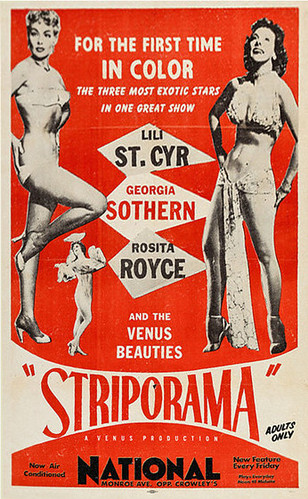
StriporamaStriporama, 1953, directed by Jerald Intrator (Something Weird Video release)

Unlike most burlesque movies of the time, Striporama tries to have a plot or at least a frame story. The New York Council of Culture is choosing the forms of entertainment to put into a time capsule and they are all agreed that burlesque has no place. Cut to two comics (Jack Diamond and Mandy Kay) bumbling around their apartment. The gags are pretty typical of burlesque comedy, only notable for one where a picture of their dream girl comes to life and… it’s Bettie Page! She dances in a tiny fringe bikini and notably speaks a few lines before vanishing leaving the comics to wake up in each other’s arms.

Cut back to the Council of Culture where the comics, led by Charles Harris (the straightman) burst in, dressed as gangsters and force the councilmen to watch a burlesque film. It went something like this: (this is long; for my summary go here.)

A parade of scantily-clad women, presumably The Venus Beauties, enter one by one and sit in a semi-circle. Each one is carrying a staff with a heart on top with one letter that, of course, spells out “BURLESQUE”. There’s an off-camera “tit singer” warbling about the Goddess of Love. The camera is particularly focused on the women’s legs.

Georgia Sothern, speaking in rhyme, introduces the four types of strippers (g-string quartet). She portrays them all: the baby-doll type: dressed in frills and ruffles;  the slow and easy type: slinking across the stage;  the wild and woolly type: Georgia’s typical fast and furious dance;  and the literary genius: a clear Gypsy Rose Lee impression (Gypsy and Georgia were best friends). In no case does she take off more than one garment. The clip felt like it was taken out of a larger context.

We see a woman undressing in silhouette in her window. At the end, she turns out the light, never having shown herself.

The comics do a sketch set in the jungle. I’ll be honest here — I don’t find a lot of classic burlesque comedy funny, so I skipped over this after getting the gist.

Marinette and Andre perform a Danse Apache on a Parisian street scene. This was pretty nifty. Not only is it a feat of athleticism and skill, I recently learned a lot about the history which I might share in a future post. These two were amongst the few credited performers that I could match with their acts.

Back to the comics, this time on a carnival set, where there are magic tricks involving eggs and hats.

Rosita Royce is the first of the star stripteases. One by one, her signature doves fly out and settle on her arms (protected with sequined sleeves) and headdress. Despite the stories that she had trained her doves to undress her, she takes off her own dress, no mean feat with multiple doves balanced on her arms. Her underlayer is relatively modest with a bra and full, rather drapey panties and even a large jewel covering her navel. However, while she had the dress on, I think she was wearing a g-string. I’m pretty sure I could see her bare bum through the sheer dress.

For more comedy we go to a harem where a pasha tells his assembled wives and daughters (presumably the Venus Beauties again) that he is going to honor a brave American sailor who saved his life during the war. The sailor can have his pick of four of the pasha’s daughters, but they will come before him one by one. If he rejects one, he can’t choose her later. Three of the daughters bellydance for him, but he turns them down. The pasha offers his most precious daughter. Cut to a bathing room.

As attendant prepare a (rather obviously empty) tub, Bettie Page prepares to bathe. I found her dipping her toe into the “water” to test the temperature funnier than the comedians. Next you see her in a tub full of soap bubbles, in which she joyfully plays.

Back in the harem, the last daughter dances for the sailor, and as the last one he must marry her and of course, when she removes her veil, it’s the other comic. *rim shot*

The comics return on the same carnival set as the magic trick sketch. Mr. America, a well-muscled man, performs feats of strength. He plays the trumpet while flexing his pecs, he performs a Cossack-style dance while playing the harmonica with a woman sitting on his shoulders, one of the comics puts on a harness and Mr. America picks him up using his teeth. For the finale, he effortfully lifts a 1000 pound barbell, which, of course, the comic easily picks up for the punchline. Although credited only as Mr. America, apparently it was fitness guru Jack LaLanne.

At last some more stripping. Georgia Sothern does a kind of a poor woman’s Lili St. Cyr on a set crowded with furniture. She’s reclining on a chaise in a robe reading a magazine when the phone rings. After the call, she slips behind a screen and joyfully removes the robe and puts on a gown. Then she adds a fur coat and a corsage. Another phone call, which ends poorly. Angrily she rips off the corsage, then the coat, then she goes back to the screen, returns to the robe. Finally she flops down onto the chaise and picks up her magazine again.

Cut back to the set, now cleared of almost all the furniture, and Georgia does her famous head-bobbing striptease. Like Rosita above, she only takes off one garment, a gown, and she’s basically full dressed underneath — panel skirt, drapey panties, bra, and navel jewel.

The movie ends here, but apparently there was a bit more where the Council agrees (of course) to add burlesque to the time capsule. It’s missing from the Something Weird print, which as far as I can tell, is the only one available.

But wait, you say, that poster advertises Lili St. Cyr. Where is she? Patience, my friends.

tl;dr.
Striporama is a bit higher-end than many other burlesque movies. Typically a burlesque movie was filmed in black and white and often with a fixed camera as though you were in the audience at a theatre, (aka as cheaply as possible), usually in an actual theatre.  This appears to be multi-camera, on a number of different sets, as well as in color.

For a movie promising a “striporama”, there’s very little actually stripping. Only Rosita Royce and Georgia Sothern (neither in the credits) perform anything close to a striptease and what they do perform is quite modest. They don’t go down to pasties and even cover their navels.

Since there’s no MC or title cards, like in other burlesque movies, I don’t know where the other performers in the credits appear, particularly Pat Lombard, Nola Lee, Betty Tunell, Doris Mackenzie, Anne Slayton.

According to some posters, Lili St. Cyr’s act “Cinderella’s Love Lesson”, was originally included, but I’ve seen it as a stand-alone film with credits from a different production company. Apparently it was pretty common for burlesque films to be cut up and repackaged. I’m wondering if the strip features were taken from elsewhere and inserted amongst the footage shot by Intrator and crew. It would explain why the stripteasers are credited on the posters, but not the film itself.

I’d be interested to see if any print other than the SWV version exists.

M2These writings and other creative projects are supported by my 20 Patrons. Thank you so much! To become a Patron, go to my Patreon page. Or you can just tip me if you liked this.
Published in: on 7 May 2024 at 3:03 pm  Leave a Comment  
Tags: ,