Dear Constant Reader,
I recently made dinner based on a menu in a little cookbook from 1950, Meals for Two Cookbook. True confession, I just used the menu as a guideline and made similar dishes from other vintage cookbooks in my collection.
The entree (Lamb en Brochette) was from an undated “postwar” butcher’s pamphlet, the vegetable (Épinard à l’italienne) was from a 1947 cookbook, and the bread (Sweet Potato Biscuits) came from a 1935 baking powder pamphlet. Dessert, however, did come from the original cookbook and that’s what I want to share with you.
Dessert was Peach Mousse and I was intrigued. Usually when I make mousse, it involves whipping heavy cream or egg whites (or both) and maybe a little gelatin to stabilize. This used evaporated milk, a substance I’d never had in my kitchen before, and it was a frozen dessert.

The ingredients are simple: peaches, sugar, evaporated milk, lemon juice, and a dash of salt (the salt box is hiding behind the other ingredients — I forgot to move it into the shot).
Peel the peaches and mash them to make 3/4 cup of puree. That was about a peach and a half in my case. Add some sugar and stir until it dissolves.
The recipe says to whisk the chilled milk until stiff. This is terribly amusing. I was using my trusty hand mixer and while the milk thickened, it was nowhere near stiff. After a little research I discovered that whipping evaporated milk needs a little special prep. Put the milk, bowl, and beaters into the freezer for half an hour. Then beat for only a few minutes. I did get soft peaks, but I’d never call it stiff. I couldn’t imagine this working with a whisk at all.
Fold in the peach puree, lemon juice, and salt and stick in the freezer. I put it in smaller, lidded container to freeze. That night it was in the freezer for maybe 5 hours and it was still soft at dessert time. A couple days later, it was very hard and probably wanted to spend a little time at room temperature before scooping.
I served it with fresh blueberries thus:

It’s more like ice cream than mousse, but so deliciously peachy that who cares. It’s easy to make, as long as you properly chill the milk. The actual preparation is pretty fast, although you’ve got to wait hours for it to harden up enough to serve.
Here’s the recipe:
Peach Mousse
2 large peaches
1/4 cup sugar
3/4 cup evaporated milk
1 Tablespoon lemon juice
Dash salt
Pour evaporated milk into a bowl (preferably metal) and put it and the mixer’s beaters in the freezer for 30 minutes.
Peel and stone the peaches and mash to get 3/4 cup puree. Add the sugar and stir until sugar is dissolved.
Whip the milk for just about three minutes, until it resembles whipped cream. Fold in the peach mixture, lemon juice, and salt.
Cover and freeze for several hours, until firm.
Makes about 3 cups.
There’s a variation that uses bananas instead of peaches. I loathe bananas, but maybe I can find some brave taste-testers.


 Since the recipe called for canned asparagus and I was using fresh, I had to do a little prep work before I could get started. I snapped the tough ends of the asparagus (it’s fun!) and blanched them. Some people advocate blanching the asparagus standing up, but I think that takes way too much time and water. I like to throw them in a little boiling water in a big skillet, presumably the same one they’re going to get cooked in later, to save on dish washing. After a few minutes the asparagus turns bright green and is tender. Don’t let it overcook. Drain the asparagus and run some cold water over it to stop the cooking process.
 Then mix up the oil, broth, some water, sherry, soy sauce, and cornstarch in the pan and bring to a boil. When it’s bubbling away, toss in the asparagus and cook until it’s hot. The sauce will be really thick, bordering on gloppy. Serve.
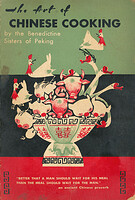 The Art of Chinese Cooking, The Benedictine Sisters of Peking (1956)
 Combine soy sauce, salt, sugar, cornstarch, and vinegar* in a bowl. Chop the chicken into small cubes and add to the bowl. Set aside. Not the most attractive photo, but raw chicken isn’t exactly glamorous.
 Chop up bamboo shoots, water chestnuts, celery, and onion. The most important thing when making Chinese food is to cut up everything first, because you won’t have time once you start cooking. Also, everything should be about the same size so it all cooks evenly.
 Heat up some oil** and add the veggies. Stirfry them until they’re softened (not mushy — you’ll be cooking them more later) and the onion is just little bit brown. You want to use a big pan and high heat. Scoop the cooked veggies out of the pan.
 In the oil remaining in the pan (add some if necessary), brown the cashews. This is why I specified raw ones. Keep an eye on them, so they don’t burn. Once they’re toasty, remove them from the pan. The original recipe is for walnut chicken (with a substitution of blanched almonds), but walnuts are my least favorite nut. The original also calls for deep frying the nuts. I though that was excessive. But feel free to make it that way if you like.
 Add more oil to the pan and add the chicken. Be careful; it will spit! Cook the chicken until it’s browned. Then add some chicken broth or stock. When that heats up, add the vegetables and nuts and cook it all until it’s hot.



 Oh, The Glamourous Life!