From ABC to BHoF: Honoring Kitten Natividad

Dear Constant Reader,

In April the American Burlesque Collection was contacted by the Burlesque Hall of Fame about a loan for their new exhibit Let’s Get Loud! The Heritage of Latin Burlesque. They needed something to represent Kitten Natividad and ABC has one of her costumes, among other items which were featured in the 2021 exhibit, ¡Viva Estriptís!. The costume was made by Sue Nice for Kitten’s Australian tour. Kitten sold the costume to Lili VonSchtupp, who wore it for her Jack of Hearts photo in The Burlesque Deck. From Lili, it came to ABC.

We were happy to honor Kitten in this way. The catch was that the exhibit was opening within days of the request. They would need the costume right away.

Now, if you or I want to lend something we own to someone we know, it’s easy. We just do it. Maybe there’s a little conversation about who’s going to pick it up or when the thing needs to be returned, but there aren’t a lot of details and the ones that do pop up can usually be settled with a quick text. Things are very different when the loan is from one museum to another.

Every museum has their own version of a “standard” agreement. And, as you can guess, none of them are the same! The loan agreements cover every detail: insurance, shipping, mounting and display, security, how the loaning institution is to be acknowledged…down to minutiae like the lighting and humidity. It took a long time of back and forth until there was an agreement both museums found acceptable. It took weeks and weeks before it was settled and in the meantime the exhibit had opened to the public.

After the agreement was signed, Scratch prepared a Condition Report, which recorded the condition of each item at the time it left A.B.C.’s custody. The condition report includes photos and notes on any pre-existing damage like missing rhinestones, loose threads, or stains.

Muslin envelopesThen we had to get it there in the same shape it left our care. We knew we wanted to individually package each of the six elements of the costume before putting them all in the shipping box. I created some envelopes out of unbleached muslin. It’s lightweight, breathable, and doesn’t have any dyes or chemical treatment which might affect the costume. Some of the costume pieces could be folded mostly flat without risk of damage, but if you know Kitten, you can figure out which items had to be shipped with padding inside them to keep them from being crushed. Then each element was wrapped in acid-free tissue and slipped into its own custom envelope.

Scratch packed it all in a box, and then packed that box securely in another box before shipping the costume off. We breathed a little easier when word came that it had been received safe and sound. Many museums send their artifacts by courier, but we’re a touch small for that.

The costume was mounted in time for The Burlesque Hall of Fame Weekender in early June.

and here it is!
View from entrance
Left side of exhibit
Right Side of Exhibit
Close up
(All exhibit photos by Scratch)

Because they had limited exhibit space, BHoF decided only to display the robe and Scratch hand-carried the other pieces back with him.

Let’s Get Loud! The Heritage of Latin Burlesque runs until October. If you get the chance to see it, I want to hear all about it!

M2


(with input from Scratch)


These writings and other creative projects are supported by my 20 Patrons. Thank you so much! To become a Patron, go to my Patreon page. Or you can just tip me if you liked this.

Published in: on 19 August 2024 at 11:30 am  Leave a Comment  
Tags: , , ,

Friday Tip

Dear Constant Reader,

It’s Friday! It’s also the Burlesque Hall of Fame Weekend. 

And in that spirit, here is your tip:

Know the history of our art. You can only truly move forward if you know who came before you.

M2These writings and other creative projects are supported by my 20 Patrons. Thank you so much! To become a Patron, go to my Patreon page. Or you can just tip me if you liked this.

Published in: on 7 June 2024 at 4:39 pm  Leave a Comment  
Tags: ,

In Memoriam: Toni Elling

Dear Constant Reader,

I hate writing these. This one more than most. And it’s taken me so long to figure out what to say.

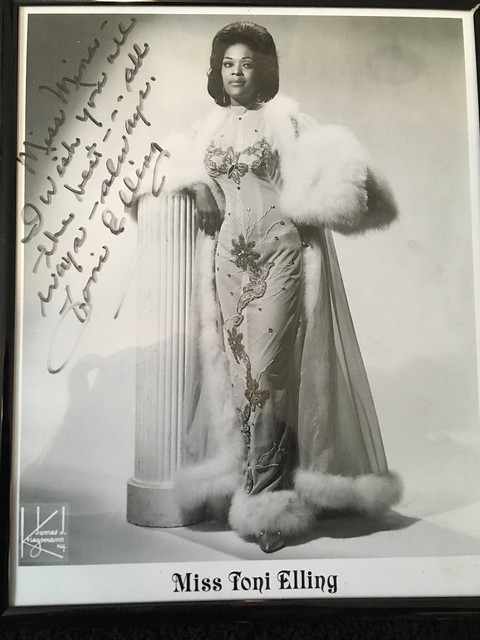
Toni Elling PhotoToni Elling was the first Legend I met. It was at Miss Exotic World 2006, the first time the event was held in Las Vegas (and the only time I’ve been.) I was sitting by the registration desk, chatting, and this graceful woman came over and said “You look like what we would call an ‘exotic’.” then complimented my outfit and apologized for interrupting. I believe I was speechless beyond “thank you”.

To paraphrase Scratch, when she walked into a room, you looked; when she spoke, you listened (if you were smart). I learned many nuggets of wisdom from her that I still use and gift to my students. At The Expo I was escorting her back to her room after her class on panels. I was planning to head to Willy Barrett’s Delsarte class — I never miss one if I can help it — after I dropped her off. But she she invited me in and started talking. I stayed, of course, delighted for the honor of a private conversation.

Me and Toni EllingI had the fortune and pleasure to see her several times and each time, no matter the circumstances, she always remembered where we had last seen each other and had something kind to say. The last time we spoke, a big group Zoom call for her 92nd birthday, I was sure she wouldn’t remember who I was, but she thanked me for my latest letter, apologized for not writing back, and said she hoped to come to Boston again. Later, it was so painful to learn that her sharp mind was failing her.

She was gracious and graceful and the epitome of class. Recently Scratch shared this story with me. I think it demonstrates well those virtues of hers. When she was the Guest of Honor at The Expo, on Sunday morning, Scratch took her out for a quiet breakfast at a diner not far from our house. Albert had been in our life for just about a year and I think this was the longest we’d been away from him. Scratch was talking about him and Miss Toni must have picked up on the love and worry because she said “I think I’d like to meet this cat of yours.” Scratch brought her to The Manor where I’m sure she and Albert charmed one another.

My heart goes out to all those who are mourning their Mama Toni, especially GiGi Holiday and Lottie Ellington who took such good care of her.

There’s a lovely article about Miss Toni and her legacy in the Detroit Metro Times.

Curtain callFarewell, Satin Doll.

M2

Published in: on 1 June 2023 at 2:57 pm  Leave a Comment  
Tags: , ,

In Memoriam: Kitten Natividad

Dear Constant Reader,

I hate writing these missives. The death of every Legend is a tragedy. We lose so much of our history with them. But this one cuts very deep.

Photo by John Bilotti at The Great Burlesque Expo.

I saw her for the first time at Miss Exotic World in Las Vegas in 2006. In a voice I never heard before from him, tinged with awe and delight, Scratch said, almost reverently, “That’s Kitten Natividad!” I replied “Who?”

I learned who she was — Russ Meyer’s muse, burlesque Legend, Miss Nude Universe, porn star. And eventually our friend.

I’m usually more than a little intimidated by Legends, but she was so open and friendly that all my apprehensions just melted away. We got along very well, which surprised me sometimes. She was so exuberant and unapologetic, where I am reserved and demure. One year for my birthday she gave me fishnet bodystockings, saying how good I’d look. It took me a little while to get used to the idea, but she was right.
_DSC5198 fishnetPhoto by Altar Boy Photography

Whenever Scratch and I went to Los Angeles we would visit her and take her out (and she would take my leftovers home). The last trip was the best. She insisted we stay in her guest suite and Scratch made her breakfast every morning. We would sit in her courtyard and watch her crazy kittens race around. The night we left, we took her to dinner at Musso & Frank, our favorite L.A. restaurant and hers too. I think this is the only picture I have of us together.
IMG_8648Photo by a waiter at Musso and Frank

Then the pandemic came. We would call her from time to time and check in. We always talked about visiting as soon as we could. She would say “And you’ll stay with meeee!” We would assure her we would and Scratch would cook for her. And then we would tell her we loved her. That’s not something I say casually.

She told such wonderful stories about her time in burlesque, in porn, with Russ, but she was just as interested and enthusiastic about we were doing. When Scratch opened the American Burlesque Collection, she was so supportive. One of the exhibits was dedicated to Latina burlesque performers and a big part was devoted to her. I know Scratch did a little video tour for her, but I wish she could have seen it in person.

The last time we were in touch, she told us the cancer had come back. I said I would drop everything and come see her. She said “I’m not going anywhere” so we talked about going out for Scratch’s birthday in November or mine in February.

I wish I had known how sick she really was. Even if she couldn’t have had visitors, I wish we’d called her one more time.

I’m devastated. I can’t believe I’ll never see her again, never hear her wonderful laugh or feel her infectious delight for everything. I hope she knew how much I love her.

She touched and inspired so many of us. Lili VonSchtupp wrote a lovely tribute on her Patreon. Last year Angie Pontani interviewed Kitten for her podcast, The Bump ‘n Grind.

The thing I loved most about Kitten was the unbridled joy she took in life. She regretted nothing that she had done. I cannot think of a better tribute to her than to live life on those terms.

M2

Published in: on 24 October 2022 at 6:19 pm  Leave a Comment  
Tags: , ,

In Memoriam: Tempest Storm

Dear Constant Reader,

Last night I got the sad news that Tempest Storm had died at 93*. In some way I thought she’d outlive us all.

She was probably the most famous of our Living Legends and I don’t need to rehash her life and career here (you can read her memoir or see Teaserama or the 2016 documentary Tempest Storm).

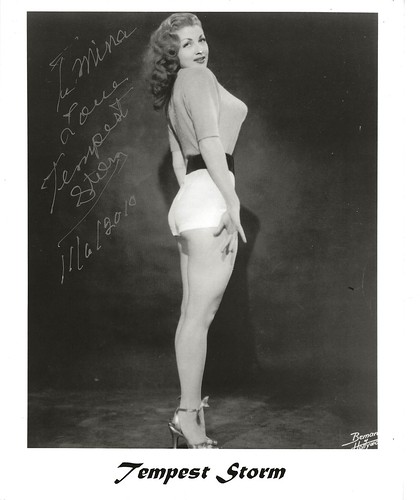
I first saw Tempest at Miss Exotic World in 2006. She strutted on stage in a purple evening gown and boa to the beat of an actual drummer. She was every inch a queen and owned that room. She had the audience in the palm of her hand her entire act (I think it was about 3 songs; definitely more time than anyone else got). This was a true connection between or past and our present, right there on stage in front of me. Even in her late 70s, she was gorgeous and graceful.

A couple of years later I was overwhelmed to learn we** would be performing in Tempest Storm’s Las Vegas Burlesque Revue for its New England dates. Tempest wasn’t performing, since she had recently broken her hip, but she introduced the show with her charming accent and gave the audience a good look at her famous figure and trademark flaming hair. She was so kind and gracious, posing for pictures and signing autographs afterwards. After the show at the Merrill Auditorium in Portland, Maine (easily the biggest venue I’ve ever played), the cast went out for a late-night seafood feast. At a long table packed with performers, there were oysters and wine and lots of loud conversation and laughter. I think we were celebrating Angie Pontani’s birthday. Tempest sat quietly at the end of the table, with a soft smile. I wish I had known what to say to draw her out, convince her to tell some stories of her amazing life, but I was too awestruck.

I’m grateful for those small brushes with greatness. Tempest was not just a Legend; she was Legendary. Her death is the end of an era. Our world is a little duller without her sparkle.

Tempest photo

M2These writings and other creative projects are supported by my 14 Patrons. Thank you so much! To become a Patron, go to my Patreon page. Or you can just tip me if you liked this.

*or 23 — she was born on February 29.
**Betty and I were performing; Scratch ended up, as usual, supplying vital tech expertise and backstage support, including providing a chaise for Kitten DeVille to hump.

Published in: on 21 April 2021 at 3:46 pm  Leave a Comment  
Tags: , ,

Review: Brown Skin Showgirls

Dear Constant Reader,

Although I still have a huge pile of books to review, today I’m grabbing the newest addition to my library from the top of the pile.

Brown Skin Showgirls by Leslie Cunningham, 2017.

This slim paperback showcases photographs from Leon Claxton’s Harlem in Havana, a revue with Black and Cuban entertainers that toured with Royal American Shows from 1936 to 1967. Royal American was the carnival with which both Sally Rand and Gypsy Rose Lee toured, and just a few tents away Harlem in Havana also presented striptease as well as Latin and Caribbean dances.

The book is almost entirely photographs with captions, but very little other text other than a short introduction to the history of the show. Some of the stars of the show are highlighted, like The Bates Sisters (including the author’s grandmother), The Cuban Dancing Dolls, and female impersonator Greta “Garbage” Garland. It certainly left me wanting more!

Don’t get me wrong — The photos are absolutely worth the price of admission. Pages and pages of performers on stage (and occasionally off). Performance photos are so much rarer than publicity photos and photos of Black burlesque performers are very scarce. This book is a treasure trove! And you can get a good look at the costumes too.

I was happy to hear that Cunningham is going to expand on the story of Harlem in Havana with the documentary film, Jig Show: Leon Claxton’s Harlem in Havana. It should be out soon (all things depending on the pandemic, of course). I want to learn more about the performers in these tantalizing photographs.

Order your book direct from the author and she’ll sign it for you!

I want to thank Jo Weldon’s NYSB Book Club for arranging for Bebe Bardeaux‘s great interview of Leslie Cunningham about Brown Skin Showgirls, Harlem in Havana, and Jig Show.

M2These writings and other creative projects are supported by my Patrons. Thank you so much! To become a Patron, go to my Patreon page. Or you can just tip me if you liked this.

Published in: on 12 August 2020 at 3:10 pm  Leave a Comment  
Tags: , , ,

The Story of Buddy Wade

Dear Constant Reader,

As I was writing my Friday Tip about research, I was going to include an example of an uncorroborated statement and fell down one of those rabbit holes I mentioned.

On page 240 of Striptease: The Untold History of the Girlie Show, Rachel Shteir writes of strippers with tragic ends. “Buddy Wade’s tap shoes caught fire, the sparks ignited her costume, and she burned to death one night at the Old Howard in Boston. Walter Winchell wrote a column about her commemorating her courage for not getting near the other performers.”

That’s it. No footnotes. Not even the date when this event occurred. I always thought it was a little weird — her tap shoes caught fire? Boston historian David Kruh was also puzzled and contacted Ms. Shteir to ask for her sources, but she was unable to provide any.

For years, that’s where it stood. While writing the Tip, I thought I should see if I could find any confirmation before I dubbed the story fiction. I had my doubts about finding any evidence. Like everyone else, I’m stuck at home and can’t go to the library, so I had to try my luck with the Internet.

After striking out a lot, I hit on the key search word — “chorine”. From there I found an issue of The Billboard from December 26, 1936. In “Events of the Year” under the “Burlesque” section, dated January, it says “Buddy Wade, chorine, died from burns received on the stage of the Howard, Boston, a heroine in preventing spread of blaze.” Now I had confirmation of the kernel of the story, if not all the details, and better yet, a year!

Now I was able to find the Winchell column. Walter Winchell didn’t actually write about her. He published a letter from a Boston Post reporter who couldn’t get the story in his own paper. I found more information; Scratch found some too. I’m still hunting.

Here’s the story of Buddy Wade as I have pieced it together…

Mary Wandzilak was 23, a miner’s daughter from Shenandoah, Pennsylvania who started in burlesque in Philadelphia. Under the name Buddy (or Buddie) Wade, she was performing in the chorus of the Merry Maidens burlesque revue when it was booked at the Old Howard for a week. Also on the bill for that show was Countess Vanya with her “Dance of the Bats”, Chang Lee in “Dance of the Chinese Lamps” and comics Harry “Hello Jake” Fields and Hap Hyatt.

On Friday afternoon January 10, 1936, the chorus was about to go on for a ballet number, after stripper Margot Lopez. A spark fell from an arc light onto Buddy’s tulle skirt and began to burn. Rather than panic and run past her fellow dancers in their tulle skirts, she pressed against the brick wall of the proscenium and headed backstage to a place without anything flammable. With burns over most of her body, she was taken to Haymarket Relief, an outpost of Boston City Hospital. Unfortunately, she succumbed to her injuries. Before she died on January 12, she spoke to Boston Post reporter Allen Lester and supposedly asked if she had spoiled the show.

The drawing is a self-portrait, published along with her story in the Detroit Free Press.

Lester sent her story to Winchell to make sure people knew of her courage. Presumably the management of the Old Howard had no interest in having their audience know how close they came to a theatre fire and perhaps kept the story from running in the local papers. Lester mentions the “Iroquois theatre catastrophe” of 1903, which in 600 people were killed in a Chicago theatre when an arc light sparked, igniting a muslin curtain. Buddy Wade’s sacrifice may have prevented just such a tragedy in Boston.

I’m still looking for more information, like confirmation of her birth name and the date she died [EDIT 10/17/20: birth name and death date found and missive updated]. I’d also love to find a program from the Old Howard for that week. I’ll update you if I find anything new!

[UPDATE: 4/28/25: I think I found Shteir’s source: The American Burlesque Show by Irving Zeidman, page 213-14. “In 1936 Buddy Wade, a chorine at the Boston Howard, burned to death backstage when her costume caught fire. Yet, at the cost of her own life, she kept away from the rest of the cast lest their inflammable costumes also catch fire.” Note, no mention of tap shoes.]

Sources
“Countess Vanya Featured in Old Howard Burlesque.” Boston Globe, January 7, 1936, page 14.
“Girl Fatally Burned in Theatre Accident.” The Gazette and Daily (York, PA), January 13, 1936, page 1. [added 10/17/20]
Massachusetts Death Index, Volume 6, Page 414.
“The Newest Burlesque Girl Gave Her Life for the Theatre’s Oldest Tradition.” Detroit Free Press, March 8, 1936, page 106.
“Shenandoah Girl Fatally Burned.” Shamokin (PA) News-Dispatch, January 13, 1936, page 7. [added 10/17/20]
Shteir, Rachel. Striptease: The Untold History of the Girlie Show. Oxford University Press, 2004.
Winchell, Walter, “On Broadway.” Reading (PA) Times, January 15, 1936, page 8.
Zeidman, Irviing. The American Burlesque Show. Hawthorn Books, Inc., 1967. [added 4/28/25]

M2These writings and other creative projects are supported by my Patrons. Thank you so much! To become a Patron, go to my Patreon page. Or you can just tip me if you liked this.

Published in: on 8 July 2020 at 3:01 pm  Comments (3)  
Tags: ,

Review: Inside The Combat Zone

Dear Constant Reader,

I love burlesque history — all the glitz and glamour of days gone by. But I also think it’s important to know about the less savory portions of our art, like carnivals. I’m particularly interested in Boston’s Combat Zone, where burlesque went after Scollay Square was demolished. I was very excited to learn about this new book and even more so when Scratch invited the author to speak at The Expo.

Schorow, Stephanie. Inside The Combat Zone: The Stripped Down Story of Boston’s Most Notorious Neighborhood, 2017.

The Combat Zone, officially designated the “Adult Entertainment District” (AED), was the area around lower Washington Street, bordering Chinatown. It was the city’s attempt to contain the adult businesses that had already moved into the area. City officials hoped for an exciting and naughty destination, with porno theatres, dirty book shops, and burlesque houses, carefully controlled. What they ended up with was a sleazy area of XXX shows, strip clubs, prostitution, pickpockets, and drugs.

After the destruction of Scollay Square (and the burlesque theaters for which it had been famed) so the new Government Center could be built on the rubble, the seamier entertainments began congregating around Washington Street. Knowing that an outright ban would just cause the businesses to move elsewhere (and that might be someplace with higher property values…), the straight-laced and puritanical Boston decided to make one legally-zoned area for adult businesses.

Schorow’s book deals a lot with the political, social, and zoning issues of The Combat Zone, but of course, she also writes about burlesque. None of the theaters originally in Scolllay Square, like the Old Howard or The Casino, moved to Washington Street, but there were plenty of new locations to see striptease. The infamous Pilgrim Theatre wanted to bring back classic burlesque and booked such well-known practitioners as Tempest Storm and Blaze Starr, but it was Fanne Foxe that made history there, with her relationship with Congressman Wilbur Mills and his unexpected appearance on stage with her.

I was delighted to learn the story of Miss Bicentennial and even more so to meet her at a book event. Julie Jordan made the Boston Herald when she stripped at City Hall Plaza in 1976. “Right on the grave of old Scollay Square”, she peeled off her star-spangled Hedy Jo Star costume.

Schorow’s book takes you through the history of the Combat Zone, from its well-intentioned beginnings through the quick slide to a dangerous area of mobsters and murder to its dwindling when adult businesses were shut down in favor of restaurants, condos, and other more “reputable” businesses. The last remnants of the Combat Zone are two strip clubs on LaGrange St. Most Bostonians don’t miss the chaos and the crime, but it was part of our past and all burlesque performers in the area should know of it.

Special bonus: the cover art is based on a photo of Satan’s Angel who was interviewed for the book, along with a few other women who worked in the clubs of the Zone.

M2These writings and other creative projects are supported by my Patrons. Thank you so much! To become a Patron, go to my Patreon page. Or you can just tip me if you liked this.

Published in: on 10 June 2019 at 2:42 pm  Leave a Comment  
Tags: , ,

Sally Keith, Queen of the Tassels

Dear Constant Reader,

As part of the mentorship program with The House of Knyle, we each had to write an essay on a Legend. I think most of the other women chose living Legends — I know some of the subjects were Shawna The Black Venus, Miss Topsy, and Kitten DeVille. Because I like a good challenge, I chose Sally Keith, a performer strongly associated with Boston and Scollay Square. She was very well-known, but as it turns out, not known well. I had to do a lot of digging to get beyond a couple of superficial stories and along the way I found a lot of contradictions. Perhaps in my spare time (“spare time”, I’m so funny!), I’ll continue my research.

[Note: I made a couple of corrections for grammar and spelling that I missed when I originally submitted this and added one tidbit that surfaced after the due date.]
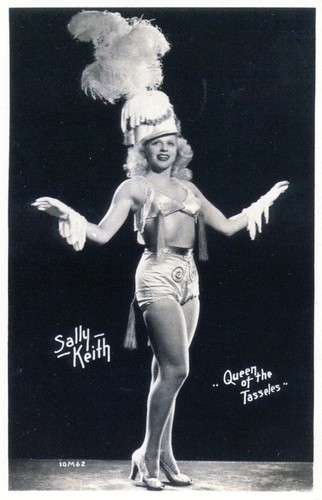
Sally Keith
Queen of the Tassels

Sally Keith is one of the burlesque performers tied strongly to Boston during the Golden Age of burlesque in Scollay Square. For someone so famous, there is very little information on her personal life, especially before and after she performed in Boston. I’ve gleaned as much as I could about her life and career from newspaper articles, books, and some from people who knew her. The two main sources were her niece, Susan Weiss, and her protégé, Lilian Kiernan Brown (Lily Ann Rose), who wrote a memoir of her own time in burlesque. Memory is, of course, inherently unreliable, especially after decades, and research is made even harder by the fact that Sally seems to have fabricated some of her public story, especially her age. This is her story, as best as I have pieced together.

Known as “Queen of the Tassels”, Sally Keith performed at The Crawford House’s Theatrical Bar in Boston’s Scollay Square for almost 20 years. Her specialty was to twirl tassels on her breasts and buttocks. She was famed for being able to twirl in every direction, especially opposite. Her tassels were very long, I’d guess about 8 inches, and all the photos show them sewn to her costumes. I wish we could see her act, but it doesn’t seem to have been filmed. It was clearly memorable, since many people in Boston talked about seeing her, even decades later.

Stella Katz was born in 1913, in Cicero, Illinois, near Chicago. She came from a large Jewish family with eight brothers. Her father was frequently reported to be a Chicago policeman, perhaps because it made for better publicity. In reality he was a house painter, although Sally also said he owned a bakery. A beautiful blonde with lovely blue eyes, she changed her name to the less Jewish-sounding “Sally Keith” when she began performing in Chicago. “Keith” may have been an aspirational name, from the very prestigious B.F. Keith vaudeville circuit, onto which many performers dreamed of being booked. Unfortunately I haven’t found any information about where she performed in Chicago and if she was doing tassel twirling then.

She told Lilian Brown that she won a beauty contest at the 1933 World’s Fair (where Sally Rand got her start) at age 15. You may have noticed that the math doesn’t work — she seemed to be in the habit of shaving a few years off her age all her life. She was then discovered by a Jack Parr, who became her agent and taught her the tassel dance. He got her started in Atlantic City and then brought her to the Crawford House in Boston. Another source said it was Harry Richman, a popular entertainer of the time, who spotted her at a beauty contest in a Chicago suburb and he got her started on Broadway. I’m not sure how much, if any, of these stories are true. Her obituary in the Boston Globe states she was discovered at Leon & Eddie’s, a popular burlesque venue in New York, by Boston theatrical agent Ben Ford in 1937.

Ann Corio said “Sally Keith, next to Carrie Finnell, was the best tassel-twirler I ever saw. She didn’t have Carrie’s huge bosoms and fantastic muscular control, but she could make those tassels spin with a fury.” Carrie Finnell twirled her tassels using her pectoral muscles, which indicates that Sally didn’t. Sally’s secret to her amazing twirling, it’s said, was to weight her tassels with buckshot. In an interview she mentions painting her tassels with radium, so she must have done a twirling act that glowed in the dark. I’ve seen advertisements for her “electrified tassel dance”, which was probably the one.

Scollay Square, a restaurant in Boston, claims to have a pair of her tassels, but I don’t think they’re authentic because they are attached to pasties. According to reports and photographs she wore the tassels attached to her costume, rather than to her body. Her twirling costumes are fairly modest, at least by modern standards. I don’t think she stripped during the tassel dance, but she did in other parts of her act. An MIT student remembers going to her dressing room to ask for a g-string as part of his fraternity initiation. She invited him and his brothers to see the show, saying she was tired of Harvard men.

Besides twirling her tassels and dancing, Sally also sang. Some of her singing captured on 78 records in the 1940s, which I think were live recordings of her shows. She also composed at least one song, “Belittling Me”, which was published as sheet music. Her photo, in her tassel outfit, graces the cover.

Her home base, the Crawford House, was a hotel and restaurant which opened in 1867 and lasted until it was demolished in 1962, like the rest of Scollay Square, to make way for the new City Hall and Government Center. A few sources say Sally eventually owned the Crawford House, but I haven’t found any evidence of that. She was so strongly associated with it and may have had some creative control over the shows that people may have just believed she was the owner as well.

At the Crawford House, Sally reigned at the Theatrical Bar. It began as The Strand Theatre, a 24-hour movie theatre under the Crawford House, but been transformed by the early 1930s. Patrons could see “3 Sparkling Floor Shows Nightly”, featuring comedians, dancers, and of course Sally Keith. Her photograph was even on the cover of the restaurant menu.

During the War, Sally did her part for the troops, touring with the USO and visiting military bases. She was even named “Sweetheart of Camp Edwards”. Some of her support for the troops may have been because most of her brothers were serving. She liked to live large, with furs, jewels, and elaborate clothes, but she was also generous with her money. She put aside part of her earnings for war bonds. A newspaper article praised her incredible generosity and listed some of her good deeds, like paying for medical treatments and tuition for the less fortunate. According to the article, one of the beneficiaries of her largess had willed her his life savings of $18,000. This may have just been a publicity stunt, but she did perform in benefits to help others. She was certainly very generous with her family, sending money home to support them. Her niece recalls that when her parents went to Boston for their honeymoon, Sally picked up the tab.

She owned a gold Cadillac convertible with leopard-covered seats and monogrammed doors. The color went beautifully with her platinum hair, but she was a terrible driver. She knew it and would have other people drive her around, like her 14-year-old protégé, Lily Ann Rose (Lilian Keirnan Brown). Sally didn’t seem to care that Lily Ann didn’t have a driver’s license – she was much better behind the wheel than Sally.

Another of Lily Ann’s jobs was getting Sally in and out of bed when she’d had too much to drink, apparently a fairly frequent occurrence. Although the Crawford House served a cocktail in her honor, The Tassel Tosser (brandy, anisette, and Triple Sec — for just $1), Sally preferred stingers, a mix of brandy and crème de menthe. Her drinking problem seems to have continued her entire life.

1948 was a big year for Sally, making headlines in the local papers. On January 5th, Sally had finished her last performance of the evening and had gone up to her suite in the Crawford House hotel. She answered a knock at her door, thinking it was the bellboy, bringing her a sandwich. Two men burst in and knocked her down. She struggled and one of them tore off her clothing while the other grabbed her $4000 mink coat and $600 worth of costume jewelry, leaving about $35,000 of real jewels behind. The coat was later recovered in the hotel. Sally made the front page of a Boston paper with a photograph showing the bruises she had sustained in the attack. She moved out of the Crawford House shortly thereafter.

Sally’s niece, Susan Weiss, claims the whole thing was a publicity stunt and the bruises were just makeup. Lily Ann Rose says the robbery actually happened and Sally kept her jewelry in a bank after that, except for two diamond necklaces that Sally and Lily Ann wore all the time for safe keeping.

In March of the same year there was a fire at the Crawford House. Sally had moved out by then, but her wardrobe was still kept in her suite. She burst into the building demanding to go to her rooms where she had $100,000 worth of furs, jewelry, and costumes. The Boston Herald reported “Sally Keith Grinds Her Way into Blaze, Bumps Fireman”. The fire destroyed two stories of the hotel, but not Sally’s rooms on the second floor.

Like many of her contemporaries, Sally modeled for girlie magazines and ended up on a couple of covers. I haven’t found any evidence that any of her performances were filmed. It’s too bad that her act wasn’t preserved because her tassel dance sounds like nothing anyone else was doing. Sally was noted for not taking herself too seriously as a performer, but her career lasted for decades. She was clearly a decent businesswoman as, unlike other burlesque performers of the era, she seems to have managed her finances well.

I found mention of her performing in Boston as late as 1960. Although she is strongly associated with Boston and The Crawford House, she performed in other venues and cities, like New York and Miami. She also performed internationally, with tours of Europe and South America. In the late 1940s The Sally Keith Revue, created by and starring Sally Keith, of course, opened in Boston for three months, then went on to New York City for several months. For the summer the show moved to Lake Geneva in upstate New York.

There’s very little about Sally’s personal life. We know she married twice. Her first husband was her agent, Jack Parr, who she divorced when she was 22 because he was too controlling. If she had any romantic relationships while she was in Boston, they were kept very quiet. She married her second husband, Arthur Brandt, after she had retired from performing and was living in Hollywood, Florida. She had no children.

She died on January 14, 1967 in New York of cirrhosis of the liver or perhaps a cerebral hemorrhage – sources differ. Besides her obituary in the Boston Globe, I found a tiny squib in a newspaper in Lowell, Massachusetts mentioning her upcoming funeral. Both that notice and a reminiscence by a Globe reporter listed her age as 51. Keeping with her lifelong practice of taking a few years off, she was actually a few years older. Ed McMahon, who performed at the Crawford House, mourned her on The Tonight Show with Johnny Carson.

Sally Keith may have been indelibly linked to Boston, but she deserves to be known more widely. Her tassel dance sounds like something unlike any other tassel twirling act, past or present. She should be included in any list of tassel-twirling legends, alongside Carrie Finnell, Satan’s Angel, and Tura Satana. I hope more present-day burlesque performers take inspiration from her.

Bibliography

Brown, Lillian Kiernan. Banned in Boston: Memoirs of a Stripper. 1st Books, 2003.

Corio, Ann., with Joseph DiMona This Was Burlesque. Madison Square Press, 1968.

Kruh, David. Scollay Square. Arcadia Publishing, 2004.

Kruh, David. Always Something Doing: Boston’s Infamous Scollay Square. Northeastern University Press, 1999.

Kruh, David. “Sally Keith, Queen of the Tassels.” Welcome to Scollay Square.

Zemeckis, Leslie. Behind the Burly Q: The Story of Burlesque in America. Skyhorse Publishing, 2013.

Scollay Square and Tales from The Crawford House.” New England Historical Society.

“Sally Keith Beaten, Robbed.” Boston American, 6 Jan. 1948.

“Sally Keith Grinds Her Way into Blaze, Bumps Fireman.” Boston Herald, 24 March 1948

“Sally Keith’s Unknown Friend.” The American Weekly, n.d. 1948.

“Sally Keith Dies in New York, Long a Hub Entertainer.” Boston Globe, 15 Jan. 1967.

“Sally Keith Rites Wednesday.” Lowell Sun, 16 Jan. 1967.
M2These writings and other creative projects are supported by my Patrons. Thank you so much! To become a Patron, go to my Patreon page. Or you can just tip me if you liked this.

Published in: on 4 February 2019 at 3:07 pm  Comments (3)  
Tags: , ,

Review: Feuding Fan Dancers

Dear Constant Reader,

I know it’s been a long time (a year!) since I gave you a new book review. Here’s one for a brand-new, hot-off-the-presses book.

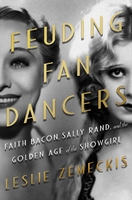
Feuding Fan Dancers: Faith Bacon, Sally Rand, and the Golden Age of the Showgirl by Leslie Zemeckis (2018).

I’ve enjoyed Leslie’s previous books (Behind the Burly-Q and Goddess of Love Incarnate) and this one is just as good. Her writing is very accessible and she brings these long departed people to life. The history of burlesque, at best a niche art, could be so easily lost and I’m glad these engaging books are capturing precious bits of information and bringing them to a wider audience.

We all know Sally Rand as the most famous fan dancer of all time. But was she the first? Faith Bacon, a beautiful, but fragile showgirl, seems to have originated the feathered tease. Zemeckis follows the lives and careers of both women through triumph and catastrophe. In a simple summation one could say that Faith had a tragic life, overshadowed by the successful Sally, but there is more to the story.

Faith Bacon was considered one of the most beautiful women of her time and her daring suggestion that she use fans to cover her nude body should have cemented her place as a star on stage. Sadly, drug addiction, poor choices, and plain bad luck dragged her into obscurity and a short life. Sally Rand, less attractive but more vivacious, by determination and ambition, made the fan dance synonymous with her name.

You can see to the right a souvenir lamp from the 1933 Chicago World’s Fair from our collection. It’s just labeled “The Fan Dancer”, but is always identified as Sally Rand, despite the fact that both women performed at that event. One could say Sally had the success story, as she had a long life, performed for most of it, and is remembered today, but she had her share of hardships. She was constantly performing because she was chronically running out of money.
Although the fan dance has become a staple on the burlesque stage, neither woman would have considered herself a burlesque performer. They didn’t strip, but used the fans to conceal and tease. Faith was a showgirl, performing for Ziegfeld and Carroll, while Sally, after struggling in Hollywood, found her place performing at World Fairs and Expositions.

Telling two stories in alternating chapters is a challenge for a writer and sometimes feels forced (I’m looking at you, Thunderstruck) but these two women did have lives that ran in parallel, met, intertwined, and ultimately diverged. Since more than century has passed since the birth of the feuding fan dancers there were fewer eyewitness accounts that in the author’s other two books, but she fleshed out the stories with many other sources. If you love the fan dance or burlesque history in general, this is a must read.

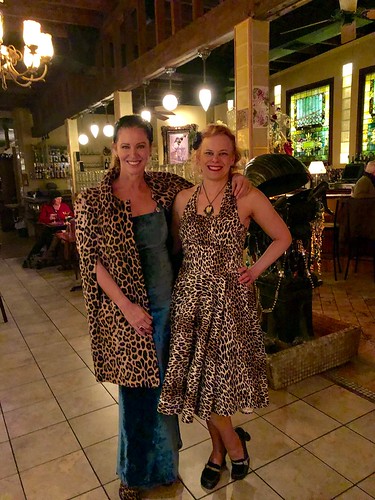
Just for fun, here I am with the author at her book event in Cambridge.

Leopard-print forever!

M2These writings and other creative projects are supported by my Patrons. Thank you so much! To become a Patron, go to my Patreon page.

Published in: on 5 December 2018 at 3:33 pm  Comments (1)  
Tags: ,