Review: Tempest Storm

Dear Constant Reader,

I first saw this documentary in 2018 at a local theatre, but it took me this long to write up my thoughts. I know Tempest never would have seen this little blog, but I didn’t feel comfortable writing this while she was alive. The audience at the screening was sparse and I though that was sad. Harvey Robbins, Tempest’s manger, who I can’t stand (let’s just leave it at that) introduced the film and did a Q &A at the end, all of which I remember thinking we could have done without.

Tempest Storm movie poster

Tempest Storm directed by Nimisha Mukerji, 2016.

I won’t rehash Tempest’s amazing career here. Read The Lady is a Vamp if you want to know more. The film covers some of her glory days and some of her personal life, with interviews with Tempest, her family members, manager, and people in the neo-burlesque scene. There’s archival images and footage of Tempest, but also some artsy, mood-setting scenes, like actresses playing younger Tempest and little girl Tempest that I didn’t think was so necessary. 

Throughout Tempest is glamorous. They focus on a number of her triumphs: headlining at a burlesque festival, a photoshoot, signing her clothing line deal with Tatyana, greeting her adoring fans at conventions, performing at BHoF. 

The documentary follows Tempest as she attempts to reconnect with her family. She calls her daughter and leaves messages several times without response. Her father abandoned Tempest when she was a baby and she never knew him or why he left. After a genealogist traces him, Tempest goes back to Georgia to visit his grave. It feels a bit like a farewell tour as she sees her siblings and their families. She continues by going to Los Angeles to see her ex-husband Herb Jeffries (who died not long after their reunion). Marrying Herb, a Black singing cowboy, caused damage to her career and to her relationship with her family. Ultimately she chose her career over the marriage and their daughter. 

Then she flew to met with her estranged daughter. Who refused to see her. The film maker clearly had this plan for a redemption arc, with a mother-daughter reunion, which was foiled by people not acting like characters in a script.

She never seems to realize that she repeated history by leaving her daughter and husband, like her father abandoned her. When her daughter challenges Tempest over the phone for not being there for her and her granddaughter, Tempest tries to explain how busy she’s been with festivals and appearances, but never apologizes for her absence in their lives. It’s sad and I feel like her sorrow is exploited.

The film ends (not a spoiler) with footage of Tempest in a diaphanous white gown at dusk, dancing in a field of Georgia cotton, the kind she had to pick as a little girl. She worked so hard to get away and yet much of this film is about her return.

The documentary is a chance to hear her story from her and that is absolutely worth it. You can watch the entire film on YouTube.

M2These writings and other creative projects are supported by my 19 Patrons. Thank you so much! To become a Patron, go to my Patreon page. Or you can just tip me if you liked this.

Published in: on 26 June 2025 at 8:21 pm  Leave a Comment  
Tags: , ,

Review: Carol Doda Topless at the Condor

Dear Constant Reader,

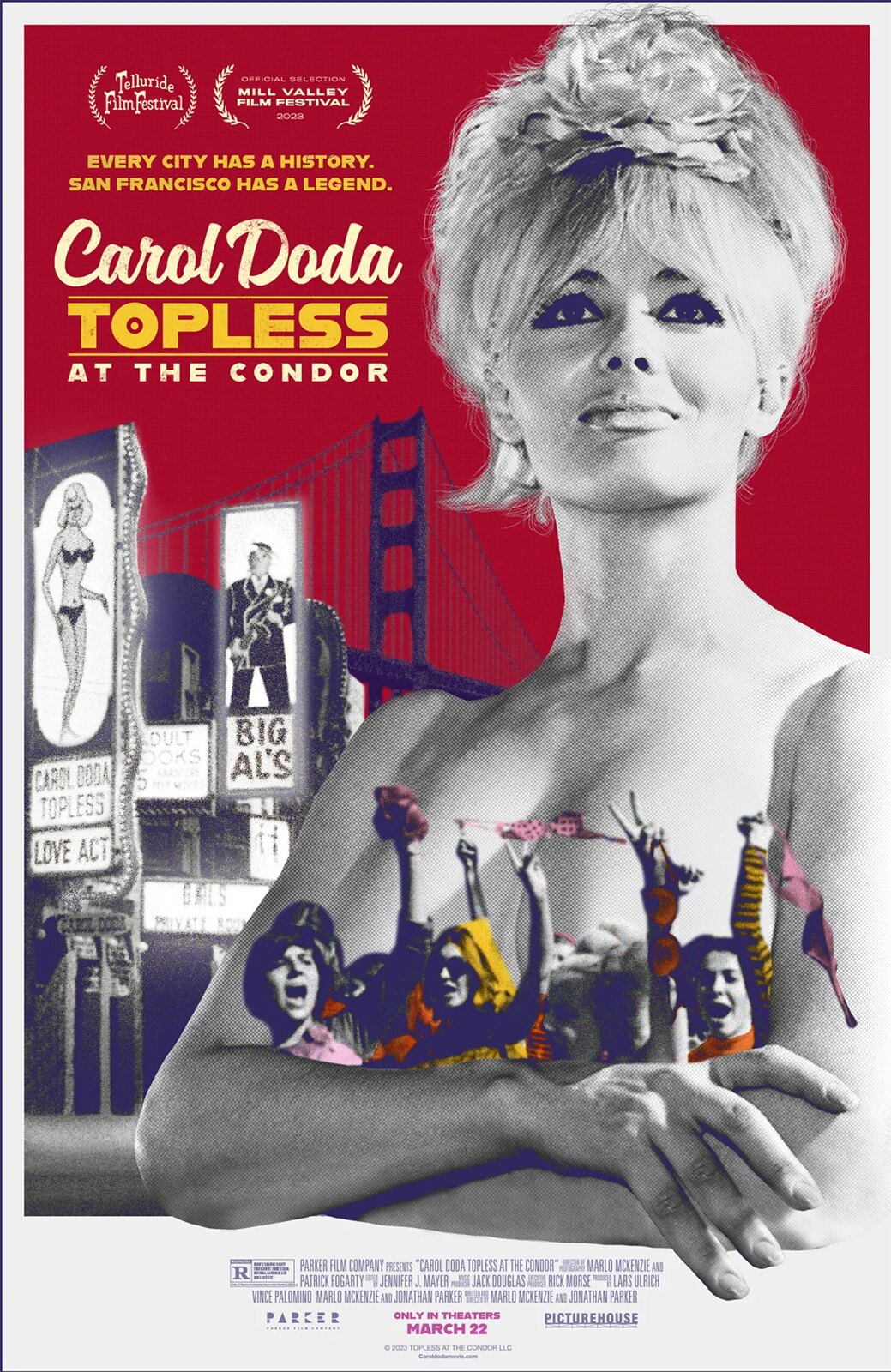
Carol Doda movie posterLast week I saw the documentary Carol Doda Topless at the Condor. By the way, what a pleasure it is to see a movie in a theatre! I found out the movie was playing near us at about the last minute and I’m glad the timing worked out so that we were able to see it. It’s not about burlesque per se, but the transitional period of adult entertainment between burlesque and the neo-burlesque revival.

Carol Doda was a cocktail waitress at the San Francisco night spot the Condor Club in North Beach in the early 1960s. Once the management saw how well the audience reacted to her dancing to the band, they had her dance on stage, or rather on the piano, since there wasn’t room on stage. One of the owners decided that the piano should descend from the ceiling with Carol on it and that became her signature.

On June 19, 1964 Carol Doda donned a monokini (topless swimsuit) and descended on the piano into history as the first topless dancer.  A topless craze followed which changed the trajectory of entertainment. San Francisco became a mecca for tourists and conventioneers and the Condor was the hottest night spot. Carol Doda was so synonymous with the Condor that a giant image of her adorned the exterior of the club (with flashing red lights for nipples) as well as her name, seemingly where ever there was a blank bit of wall.

The documentary consists of archival footage (of which there is an absolute wealth), present day interviews with people who knew Carol, and modern academics to put parts of the story into context. Although the main subject of the documentary is obviously Carol Doda and her role as the pioneering topless and then bottomless dancer, there are other topics to flesh out the story, such as Rudi Gernreich, the futurist fashion designer who created the monokini*, the origins of The Swim dance, nightlife in North Beach, local musicians, interracial relationships (with some very painful stories), the myth of bra burning, &c. It doesn’t always mesh with the main theme of the film, but it’s all interesting.

One of the most important subjects of the film was Carol Doda’s breasts. When she first became a sensation, she had modestly-sized breasts, but, knowing that as topless dancing became more common, she needed to set herself apart from all the others. Thus she opted** to enlarge her breasts. At the time that meant silicone injections. Be warned: there is some seriously disturbing contemporary footage of a woman undergoing the procedure and a horrific story from one of the interviewees. Carol endured 44 shots of silicone, until even her doctor was telling her to stop, bringing her bust to a 44DD.

Both she and the Condor were massive successes. They had a symbiotic relationship, which ended when Carol asked for more pay for her twelve shows a night. She also asked to buy into the club (which one of the owners laughingly dismissed, even today). She left, but the Condor continued to use her name and likeness and thrived. Eventually she returned, having never found the same success elsewhere.

In 1969 she went bottomless, again the first to do so. Her arrests for indecency had lead to a judicial verdict that topless dancing was legal, but bottomless dancing was eventually ruled illegal by the California Alcoholic Beverages Commission.

She worked as an adult entertainer until the mid-’80s, as North Beach became sleazier and the almost innocent fun of topless go-go dancing to a live band was replaced with full nude dancing to canned music, live sex shows, and porn movies. She continued performing, albeit with her clothes on, for most of the rest of her life, even as her health failed. As you’ve probably suspected, the health issues that caused her death in 2015 were related to those silicone shots decades before.

Although we see Carol, often in her own words, as an entertainer, an advocate for free expression, and a business woman, we never really get to know her. She’s funny and charismatic, but when the subject of her personal life comes up, she deflects or makes a joke. Any attempt to learn anything about her family or her past is quickly shut down. Even those who knew her personally didn’t really know much of Carol beyond the stage.

There’s a theme in the film that Carol helped create the zeitgeist of the 1960s, but perhaps she was more of a product of it. Did the court ruling that her topless dancing was self-expression and not indecency lead to the Summer of Love or was the verdict because San Francisco was already headed that way? Was she a product of the male gaze or did she subvert it for her own purposes? In any case, there is no doubt that she was a trailblazer in the world of adult entertainment and freedom of expression.

The documentary is a love letter to Carol Doda and the North Beach entertainment scene. We also learn about some of her contemporary dancers and friends. I was particularly intrigued by the stories from Judy Mamou, who as Tara, danced with a topless monkey! If the film comes to your area, do go see it.

*Ironically, he created the topless swimsuit because he felt a woman’s body should not be sexualized.
** With some pressure from the club’s publicist.

M2These writings and other creative projects are supported by my 19 Patrons. Thank you so much! To become a Patron, go to my Patreon page. Or you can just tip me if you liked this.
Published in: on 13 April 2024 at 6:27 pm  Leave a Comment  
Tags: ,

Film Review: The Night They Raided Minsky’s

Dear Constant Reader,

The other day one of my students asked for recommendations for movies about burlesque and I remembered this one…

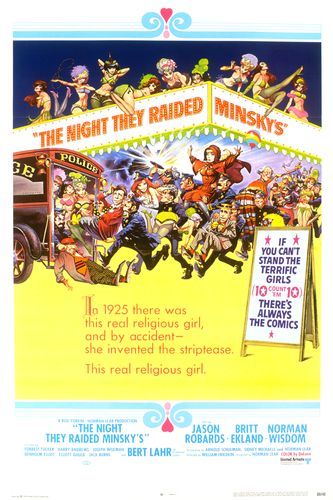
The Night They Raided Minsky’s, directed by William Friedkin, MGM, 1968.

Based on the book of the same name, this movie, set in 1925, tells the tale of Rachel Schpitendavel (Britt Ekland), an Amish girl who dreams of dancing on stage in New York. She arrives at the National Winter Garden, a burlesque house, run by Billy Minsky (Elliot Gould).

Minsky is beleaguered by Vance Fowler (Denholm Elliott) a zealous anti-vice crusader who wants to raid the theater. Straightman Raymond Paine (Jason Robards) and top Banana Chick Williams (Norman Wisdom) realize they can solve this problem by informing Fowler that Mademoiselle Fifi will be performing her dance that drove a million Frenchmen wild at the midnight show. Of course, the performer will actually be modest Rachel, doing her Biblical interpretive dance. The raid will be a bust and Fowler humiliated.

Meanwhile Minsky is courting gangster Trim Houlihan (Forrest Tucker) in hopes that he’ll invest in the theatre, but Houlihan thinks that investment gives him exclusive rights to Mlle. Fifi… But not if Raymond Paine seduces her first… And Rachel’s father is storming into the city from Pennsylvania. His daughter had better on the last train home or he will disown her.

Suffice it to say, almost every man in this movie wants Rachel for something.

It’s not spoiling anything (since they announce it at the start of the movie) to say that Rachel gets on stage, discovers the power she has over an audience, and invents the striptease.

The movie betrays its 1960s creation with the saturation of the colors and Britt Ekland’s bouffant hair. However, it does slip in some actual footage from the 20s, and the Lower East Side is dressed up pretty accurately. There’s a nice bit where they transition from the vintage footage to black and white film of a street scene and then take it to color.

The best reason to watch this movie is the burlesque show. Throughout the movie you see the show in progress. A chorus line of 10 terrific girls (but only 9 costumes) prance and shimmy on the stage in skimpy costumes. One of them looks like she’d rather be anywhere else and another just can’t dance. There are classic comedy sketches like “Meet me Round the Corner” and “Crazy House”, some of them including talking women. The candy butcher does his spiel, pitching bonbons along with the promises of gold watches and racy pictures of Mlle. Fifi.

In 1968 there were plenty of people who still remembered burlesque and some of those people were in the movie. The Master of Ceremonies is played by burlesque tit singer Dexter Maitland. Bert Lahr, playing a retired straightman, got his start as a burlesque comic, before his fame as The Cowardly Lion. When he died before filming was complete, burlesque comic Joey Faye stood in for him. Morton Minsky, the youngest Minsky brother, was the technical advisor.

It’s a fun film with a great cast, but the highlights are the scenes onstage and backstage.

M2These writings and other creative projects are supported by my Patrons. Thank you so much! To become a Patron, go to my Patreon page. Or you can just tip me if you liked this.

Published in: on 14 April 2020 at 2:44 pm  Leave a Comment  
Tags: , ,

Alleluia

Dear Constant Reader,

A couple of years ago we were asked to open for The Devil’s Carnival movie. You can read all about it here. At that time we knew next to nothing about the movie, but tried to pick an act with the right feel. After a few minutes into the movie, I said to Scratch “‘Creepy Doll’ would have been perfect.” So, I was delighted when we learned the second movie, Alleluia! The Devil’s Carnival, was coming to The Coolidge Corner Theatre and their tour manager contacted us to open again and specifically requested “Creepy Doll”.

Last night, Scratch & Devora packed up the creepy dollhouse and headed over to The Coolidge. I was tagging along as stage kitten/Wrathskeller promoter/person who really wanted to see the movie.

We thought we were in Theatre 2 upstairs, where there are wings, which were kind of necessary for the act. Turns out the movie was massively oversold and they moved it into the much larger Theatre 1 downstairs. The staff were fabulous and found us a three-panel screen to make a temporary wing, as well as helping to heft the dollhouse up onto stage (there’s a ramp to the stage in the Theatre 2…).

The performance was a little rocky on the tech side. We had to make some last minute adjustments with the dollhouse and the wrong song briefly got played at the wrong time, but Scratch & D.D. took it in stride. I thought they did a great job and so did the audience, judging from the number of compliments in person and on-line.

Here’s the first picture I found of Herr Bücher and The Lost Girl, snagged from Broke Horror Fan

The movie itself was quite good, even better than the first one. I’d recommend seeing it, especially if you’re a fan of disturbing musicals. This episode, as you might expect from the title, mostly takes place in Heaven. I just loved the look of it. It had a very 1940’s Hollywood feel, but there were these unsettling, but terrifically designed, totalitarian posters all over. I felt like the slinky black dress I was wearing for the evening, while not so Carnivalesque, fit in pretty well with Heaven’s nightclub. I think my favorite song was “Hoof and Lap” (I’m a sucker for German cabaret), but there several very good ones. After the movie, there was a brief Q&A with the creators and it was disconcerting to hear Lucifer’s voice come from Terrance Zdunich’s completely human face.

Totally worth not getting to bed until 2AM. Even if it does mean a less than coherent missive today.

M2

Published in: on 10 September 2015 at 12:16 pm  Leave a Comment  
Tags: ,

Late Night Fun

Dear Constant Reader,

Yesterday was gorgeous here in Boston, sunny, clear, and just warm enough. Scratch decided it was just the right day to put in an arbor to support the grapevines that are taking over the back fence at Stately Babydoll Manor and escaping. Somehow this planning involved lunch at a little deli with enormous sandwiches. As we were enjoying them on the patio, Scratch got a call.

Short version — The Devil’s Carnival was playing at The Coolidge Corner Theatre and they wanted an burlesque act to open things up. Yes, I would. How about a fan dance? Back to Stately Babydoll Manor to prepare (with a pause for the installation of the grape arbor).

I thought the best fit for the creepy carnival theme from my fan dance repertoire would be “Toccata und Fuge in D Minor”. You know it: it’s the Phantom of the Opera organ music. I spent the afternoon rehearsing it.

As the show was at midnight, and I’m not much of a night owl, I took a nap. Upon rising and starting to get ready for the show, Scratch had decided, having seen clips of the film, that the fan dance was not the best fit and I should do “Macker Messer”. (It was my opening act for The Wrathskellar last year). Well, never let it be said that I’m not flexible. I put away my fans and packed up my “Mackie” costume (top hat, tail coat, switchblade, &c.)

I must say the screening was an impressive event. Many people there had seen the film before (and were singing while they waited) or were fans of Repo! The Genetic Opera (from the same creative team) and there were lots of costumes. Once the regular ticket holders were let in (there was a private Q & A for some VIPs first), the theatre filled up fast and things got started.

Their adorable MC introduced Scratch who introduced me. I’m always a little worried about “Mackie” out of context. It’s so deadpan and pretentious, and the song is in German. Scratch gave it the proper warm up: “Are you ready to be ignored by a beautiful woman?” And away we went. The crowd loved it.

Now we could relax and enjoy the festivities, like a short film about the making of Repo!, a costume contest with some pretty elaborate entries, and a Q & A with the creators.

The movie itself is quite good and so are the songs. It would definitely appeal to fans of The Wrathskellar. Although it is obviously a carnival while we are a cabaret, there’s a kinship in the aesthetic. In fact, when handing out leaflets afterward I told people just that: “It has a similar feel, only more boobs.”

Published in: on 22 July 2012 at 11:30 am  Leave a Comment  
Tags: ,