In the Kitchen: Murphy’s Herbed Cream Cheese Dip (1971)

Dear Constant Reader,

My mother recently sent me some of the family cookbooks. I’ve really enjoyed flipping through them, seeing the stained pages of frequently-used recipes and my mom’s notes. One of them was Playhouse Cookery, a community cookbook from the nursery school my sister and I went to. I have a fondness for community cookbooks and cuisine from the 1970s, that, plus the personal connection (not to mention my surprise that it still existed), delighted me immensely.

Last weekend, Ava had a barbecue and I wanted to bring this dip, which my mother used to make for parties. It was contributed by my sister’s teacher (personal connection again) and uses herbs that I have in abundance in my garden. 

To make Murphy’s Herbed Cream Cheese Dip, you will need

Untitled

garlic, onion, salt, dry mustard, cream cheese, mayonnaise, lemon juice, olives, thyme, Tabasco, parsley, chives
You may notice that there are no olives in the picture. My mom never used them and I don’t either. If you want to use olives, I suggest the classic pimento-stuffed green. (Also, that’s not Tabasco — I have no idea where our bottle went — so I subbed a similar hot sauce, label turned away in shame)

Mince the onion and garlic, chop the olives, and mix everything together. That’s it! It’s a bit easier to mix if you let the cheese cheese come up to room temperature.

I recommend making the dip in advance. A night in the fridge improves the flavor, but it’s also the sort of thing you could throw together pretty quickly.

I like to serve it with crudités, but it’s also thick enough to use as a spread on crackers.

The book Fashionable Food: Seven Decades of Food Fads by Silvia Lovegren sums up cuisine in the 1970s as “gooshy” — soft, creamy, rich, and goopy. While I disagree with some of her snarky takes, this dip does kind of fall into that category.

Here’s the original recipe. I always double the amounts.  

Untitled

Murphy’s Herbed Cream Cheese Dip
2 clove garlic, minced
1-2 tsp minced onion
1/4 tsp salt
pinch dry mustard
1 (3 oz)cream cheese
1/4 c mayonnaise
1 T lemon juice
2 T chopped olives
1/4 tsp thyme
dash tabasco
parsley
chives

Mix ingredients together. Good with cold vegetables.
–Ronnie Stern

The tiny amount of thyme suggests that it’s supposed to be dried. I like to use fresh because I have a very thriving thyme plant. If you also use fresh thyme, add three times as much and give the leaves a little chop after you pull them off the a stem. The parsley and chives are up to your whim. I never measure and just sorta add enough.

So, who was Murphy? No idea, but I’m happy his? her? recipe lives on.

Enjoy!

M2These writings and other creative projects are supported by my 18 Patrons. Thank you so much! To become a Patron, go to my Patreon page. Or you can just tip me if you liked this.

Published in: on 9 July 2025 at 4:26 pm  Leave a Comment  
Tags: , , ,

Kitchen Magic: Angel Pudding (1924)

Dear Constant Reader,

You all know of my devotion to Fannie Farmer’s Kitchen Cabinet, but occasionally I branch out. Scratch got me a set of recipe cards titled “Seven ways to hold a Husband”, published in 1924 by Mabel Claire (Mrs. Jack Bechdolt) who also wrote The Busy Woman’s CookbookSeven Ways

Who knew that meme went back so far…distractedboyfriend

Anyway… The seven ways are desserts. There’s a cake and a pie and cookies and a pudding and a frozen dessert and a meringue and a fruit dish. The best part is the names! I was considering trying Gloom Chaser or Fluffy Ruffles first, but I had some egg whites leftover from making creme anglaise, so Angel Pudding it was.

You’ll need:

Angel Pudding ingredients

egg whites, cream of tartar, sugar, flour. 

UntitledStart by whipping the egg whites and then add the cream of tartar. Acidity helps stabilize the the egg whites, so if you don’t have cream of tartar, you can use lemon juice or vinegar. The Victorians used copper bowls for the same reason.

Then beat the whites until they form stiff peaks, gradually adding the sugar. Finally, gently fold in flour.

The mixture bakes in “an ungreased tin in a moderate oven”. A moderate oven is about 350F; however, there’s no indication how big a tin. I ended up using a 5x 9″ loaf pan and the mixture filled it about half-way. I baked it for the recommended half hour.

I should mention that I was making a half recipe. The full recipe “will serve four persons. Halve the recipe for two.” So, for a full recipe, you could still use the loaf pan or a 8″ square or 9″ round would work as well.

Instead of cooling on a rack, you invert the pan onto a plate until the pudding is cool and then remove it from the pan.

Angel Pudding on a platter

Then there’s the sauce:

Untitled

brown sugar, butter, cream, and vanilla

Melt the first three ingredients together, then add vanilla. That’s it. I followed the instruction “Do not cook much”, but I probably should have cooked it a little longer as it still had a bit of a granulated texture.

How was the Angel Pudding? Very much like an angel food cake with butterscotch sauce. Light and sweet.

It was also very easy to make with my trusty stand mixer. With mostly pantry ingredients, it’s a great way to use up egg whites. However, the half recipe was more than enough for two, like enough for four. I’d only recommend making the full recipe if you’re having a dinner party.

Untitled 

Angel Pudding (serves 4)
8 egg whites
1 teaspoon cream of tartar
1 cup sugar
3/4 cup sifted flour

Whip egg whites until foamy. Add cream of tartar and beat until stiff, gradually adding sugar. Fold in flour. Spoon into a ungreased pan and bake at 350F for 30 minutes. Turn pan upside down on a plate to cool. Remove from pan and serve with sauce.

Angel Pudding Sauce
2 cups brown sugar
1 tablespoon butter
1/2 cup cream
1/2 teaspoon vanilla (The recipe just says “Flavor with vanilla.” This is the amount I used.)

Heat sugar, butter, and cream together and stir until melted. Take off the heat and beat in vanilla.

Enjoy!

M2

These writings and other creative projects are supported by my 19 Patrons. Thank you so much! To become a Patron, go to my Patreon page. Or you can just tip me if you liked this.

Published in: on 13 January 2025 at 2:37 pm  Leave a Comment  
Tags: ,

In the Kitchen: Furmenty

Dear Constant Reader,

I’ve briefly left Fannie Farmer to cook with Mrs. Crocombe. The latest Victorian Way video from English Heritage has her cooking furmenty. I immediately perked up because we have a lot of wheat berries left over from Christmas Eve dinner when I made kutya. Kutya is a traditional Ukrainian Christmas Eve dessert made from wheat berries cooked in almond milk, then baked with dried fruit, nuts, ground poppy seeds, and honey. As we could only find the wheat berries in a five pound bag, I’ve got lots in the pantry.

What is furmenty? Also spelled “frumenty” (and apparently “furmity”), it’s a wheat-based dish that goes back to the middle ages. The medieval version was savory and served as a side-dish, usually with venison. Here’s a recipe from Forme of Cury, a 14th century manuscript:

FOR TO MAKE FURMENTY. Nym clene Wete and bray it in a morter wel that the holys gon al of and seyt yt til it breste and nym yt up. and lat it kele and nym fayre fresch broth and swete mylk of Almandys or swete mylk of kyne and temper yt al. and nym the yolkys of eyryn. boyle it a lityl and set yt adoun and messe yt forthe wyth fat venyson and fresh moton.
(To make furmenty. Take clean wheat and grind it in a morter well that the hulls are gone all off and simmer it until it bursts and take it up.  And let it cool and take fair fresh broth and sweet milk of almonds or sweet milk of cows and mix it all. and take the yolks of eggs. Boyle it a little and set it down and serve it forth with fat venison and fresh mutton.)

The Victorian version is sweeter and served as a dessert. It’s very simple and it’s the sort of recipe you wouldn’t find in a cookbook, as Mrs. Crocombe says “nobody writes down the everyday”.

You need:
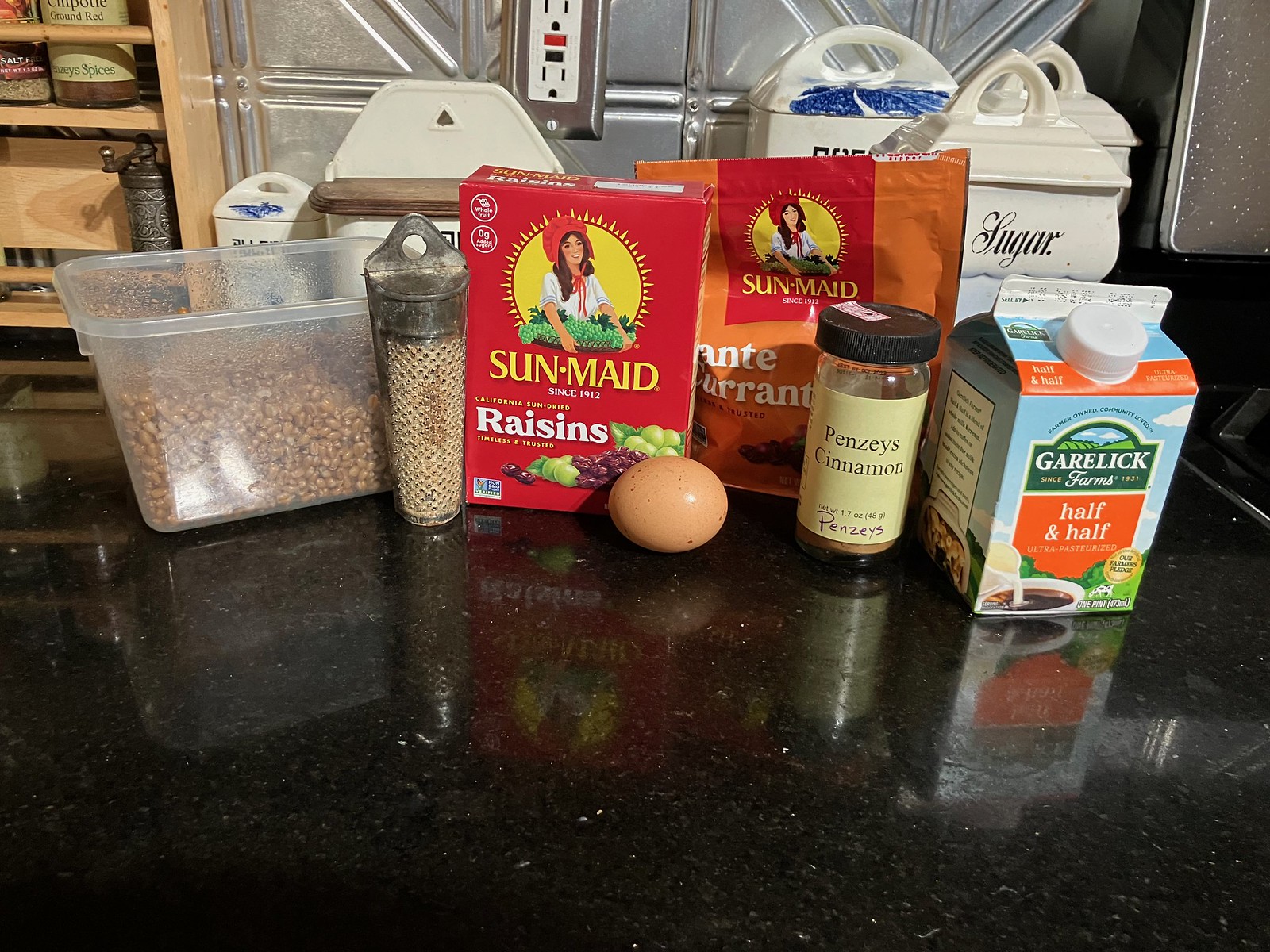
Furmenty IngredientsWheat berries, some form of dairy, spices, dried fruit, eggs, and sweetener.

Cook wheat berries. I rinsed mine and then simmered them in water for an hour until tender. You can also soak them overnight to reduce the cooking time or use a pressure cooker. Let cool. You can do this step a couple of days ahead of time.

When you’re ready to prepare the dish, first soak some raisins or currents (I used both!) in hot water or a bit of booze to plump them up. Cook the wheat with milk or cream (I split the difference and used half & half) until hot, then add in the drained dried fruit and spices (I used cinnamon and nutmeg, but you could use pumpkin pie spice).

Add beaten eggs. The instructions with the video recommended “cooking them off the heat if you like a just-cooked result, or on it if you prefer your eggs scrambled.” I do not like my eggs scrambled, but I wanted to make sure they were cooked, so I tempered them with a bit of the hot milk before adding to the pot and cooking for a bit.

Serve with sugar to taste. My taste is not very sweet, so I didn’t add any. Honey or agave would work too and probably blend better.

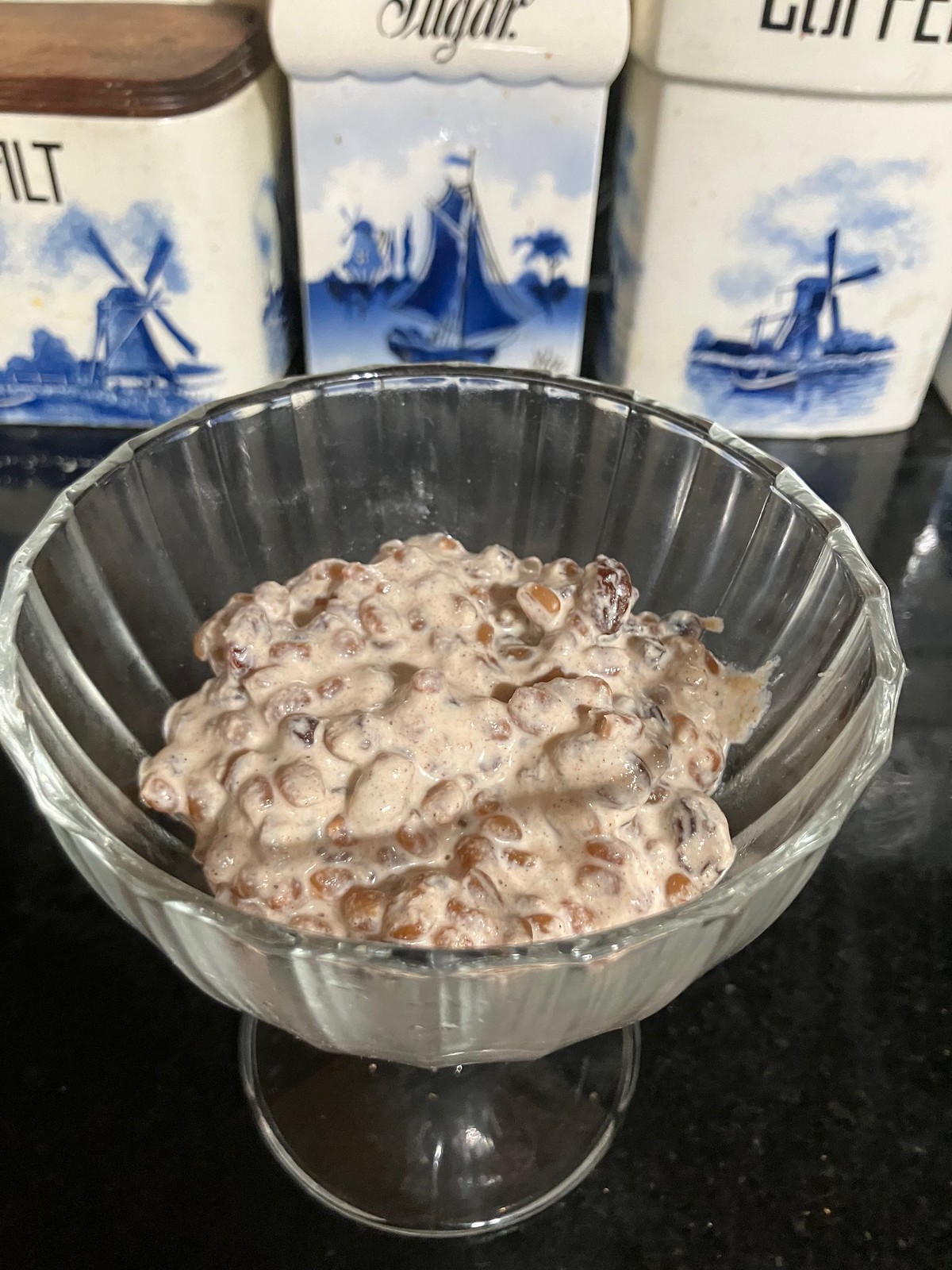
It was very good! Thick and creamy with some chew from the wheat and fruit. I used half the recipe from the video and got a *lot*. I probably could have cut it in half again and still had some leftovers. A couple of days later I added some chopped dried apricots and warmed the remaining frumenty up. Scratch had the brilliant idea of adding a little candied blood orange peel on top. I also had the last of it for breakfast and it was a nice change from my usual oatmeal.

If I made it again (and why not, it was pretty darn easy), I would add other dried fruits and some toasted nuts, maybe a touch of ginger with the spices. Oh, or maybe chopped crystalized ginger.

Furmenty

Here’s the recipe as I made it, adapted from English Heritage.
Furmenty a la Mrs. Crocombe
1/2 lb. wheat berries (about 1 cup)
2 cups half & half (or milk or cream)
2 ounces raisins
2 ounces currants
Brandy (or hot water or rum or wine or other spirits)
1 teaspoon cinnamon
1/2 teaspoon nutmeg
1 egg
Sugar (or honey or agave or maple syrup)

Cook wheat berries as directed until tender. I rinsed mine and simmered in 3 1/2 cups water for an hour. Drain. Reserve until ready to cook.

Pour brandy over dried fruit until just covered. Let soak.

Heat wheat and half & half together until hot. Don’t boil.

Drain fruit and add to mixture with spices. Blend very well to incorporate the spices.

Crack egg into a small bowl and beat well. Gradually add some of the hot liquid while beating further. Pour the tempered egg mixture into the pot and stir well until all is combined and hot. It will thicken quite a bit.

Sweeten to taste and serve warm.

M2These writings and other creative projects are supported by my 19 Patrons. Thank you so much! To become a Patron, go to my Patreon page. Or you can just tip me if you liked this.

Published in: on 16 April 2024 at 2:30 pm  Leave a Comment  
Tags: , ,

In the Kitchen: Washington Pie (1914)

Dear Constant Reader,

It’s been a very long time since I shared a recipe with you all. I have a bunch of cooking videos at The 365 Kitchen Cabinet project and I’ve been sharing them on Patreon, but not here. Sorry about that…

Anyhow, I made Washington Pie. Despite the name, it’s not pie; it’s cake.

I liked it — it was easy to make, used almost entirely pantry ingredients, and tasted good. What’s not to like?

Enjoy!

M2These writings and other creative projects are supported by my 19 Patrons. Thank you so much! To become a Patron, go to my Patreon page. Or you can just tip me if you liked this.

Published in: on 30 January 2024 at 11:26 am  Leave a Comment  
Tags: , ,

In the Kitchen: Hot Spiced Milk (1948)

Dear Constant Reader,

There’s a FB group to which I belong where one person has been sharing daily menus from The Modern Family Cook Book by Meta Givens (1948) for the past couple of years. I even got my own copy of the book to check out the recipes. Then last year I jumped into the game to share Fannie Farmer menus and it’s been fun to compare the two generations of cooking. Some of Meta’s recipes are off-putting — a lot of vegetables covered with white or cheese sauce, a lack of seasoning, plenty of organ meats — but some grabbed my fancy and I’ve given them a whirl.

One of the recipes I tried was Hot Spiced Milk. It was so good that I’ve made it a few times. My cozy winter drink of choice is hot chocolate, so it’s saying something that I like this, sans any chocolate.

You need
IMG_0626butter, coconut, milk, cinnamon, nutmeg, and honey

Hot Spiced Milk
1/4 cup shredded coconut
1 tablespoon butter
4 cups milk
1/2 teaspoon cinnamon
1/2 teaspoon nutmeg
2 tablespoons honey

Melt the butter and brown the coconut in it. Then add all the other ingredients and heat until scalding (180°F). Strain out the coconut and serve. If you want to leave the coconut in, chop finely before browning.

Serves 4.

This works best with whole milk, but there no reason not to use a plant-based milk, if that’s your preference.

I usually use unsweetened coconut, but sweetened coconut will probably brown better. It will also make the drink sweeter, so you might want to adjust the honey.

I suppose you could toast the coconut without any butter, but you’d loose that little bit of extra richness.

It’s lovely on a winter evening with some cookies!

M2These writings and other creative projects are supported by my 17 Patrons. Thank you so much! To become a Patron, go to my Patreon page. Or you can just tip me if you liked this.

Published in: on 20 December 2022 at 3:40 pm  Leave a Comment  
Tags: ,

In the Kitchen: To Make a Cake (1604)

Dear Constant Reader,

[I wrote this in January 2020 and apparently it’s been sitting in my drafts all that time. It’s been well over a year since I shared a historic recipe with you and most of what I’ve been cooking this year is from the 1914 project. I can’t find a picture of the finished cake so you’ll just have to imagine it.]

It has been a while since I did any historic cookery. When our local medieval/Renaissance cookery group was having a joint meeting with a gaming group, that was enough to get me thumbing through my Elizabethan cookbooks. I wanted to bring something that didn’t need any cooking on site and was somewhat seasonal. It’s wintertime, which made me think of fruit and spice cakes.

To Make a Cake
Take a peck of flower, and fower pound of currance, one ounce of Cinamon, half an ounce of ginger, two nutmegs, of cloves and mace two peniworth, of butter one pound, mingle your spice and flower & fruit together, put as much barme as will make it light, then take good Ale, & put your butter in it, all saving a little, which you must put in the milk, & let the milk boyle with the butter, then make a posset with it, & temper the Cake with the posset drink, & curd & all together, & put some sugar in & so bake it.
Elinor Fettiplace’s Receipt Book

Cakes in the 16th and 17th centuries were not much like today’s cake. They were raised with barm, which is the yeast used for making ale, rather than baking powder, which wasn’t invented for a couple of centuries. The results are more like bread than what we think of as cake today. I use yeast with a little beer added for flavor.

The above recipe would make a giant cake, as a peck of flour is eight quarts of flour or about 37 cups. I divided all the ingredients approximately by eight to make a more manageable cake. Since I have no idea how much mace or cloves a penny bought at the time, I just added the spices to my liking.

The big mystery here was these instructions “then take good Ale, & put your butter in it, all saving a little, which you must put in the milk, & let the milk boyle with the butter, then make a posset with it, & temper the Cake with the posset drink, & curd & all together”. My read of it is to take ale and add most of the butter to it. Put the rest of the butter into the milk and bring the milk to a boil. Then add the milk to the ale (a posset is a beverage made with warm milk curdled with alcohol) and add it to the cake mix. Why split the butter like that? I might understand if you worked part of it into the flour and melted the other part, but this baffles me. It all melted when I added the warm milk to the ale. Any thoughts?

The end result is a pleasantly-spiced, not too sweet fruit bread.

4 2/3 cups all purpose flour (I like a mix of all-purpose and whole wheat)
8 oz. currants
2 tsp ground cinnamon
1 tsp ginger
1/2 t mace
1/4 t nutmeg
pinch cloves
2 oz. butter (1/2 stick)
1 cup ale (I used a winter warmer)
1 cup milk
1 packet yeast
1/4 cup sugar

Mix together the flour, currants, and spices in a large bowl. Pour the ale and half the butter into a small bowl. Bring the milk and the rest of the butter to a boil in a sauce pan. Let the milk cool to body temperature (if you put a drop on the inside of your wrist, it should feel neither hot nor cold), add to the ale along with one tablespoon of sugar and the yeast. Mix the rest of the sugar into the dry ingredients.

When the yeast bubbles (about 10 minutes) add the wet ingredients to the dry. Mix until well combined. Knead a few times on a floured surface. Pat the dough into a ball. Grease the bowl and put the dough into it. Cover with a dish towel and let rise in a warm place until doubled.

Punch the dough down and place in a greased pan. I used a 9″ round cake pan. Cover and let rise again.

Bake at 400°F for half an hour. You can sprinkle it with coarse sugar when it comes out of the oven or make a glaze with powdered sugar and rosewater and pour over the warm cake.

M2

These writings and other creative projects are supported by my 16 Patrons. Thank you so much! To become a Patron, go to my Patreon page. Or you can just tip me if you liked this.

Published in: on 22 September 2022 at 10:29 am  Leave a Comment  
Tags: , ,

In the Kitchen: Cherry Clafoutis

Dear Constant Reader,

Dipping my toe back into blogging…

It’s sour cherry season at The Manor again! I tend to share new recipes I try each season, but this is one I make every year. It’s easy and delicious — clafoutis. Technically it’s only clafoutis if you use cherries; with any other fruit it’s flaugnarde.

There are lots of recipes out there. This is the one I’ve cobbled together from a number of sources over the years. It’s more custardy than pancakey. I use other fruit too, especially in the glorious days of early July when I have both sour cherries and peaches. It’s a fabulous combination!

IMG_6324
Sour Cherry Clafoutis, as made at The Manor
2 cups pitted sour cherries (or enough to thickly cover the bottom of your baking dish)
1 tablespoon Kirsch or cognac
1/3 cup sugar
3 tablespoons flour
Large pinch salt
2 tablespoons ground almonds
2 eggs
1/2 cup milk
1/4 cup sour cream or Greek yogurt
1 teaspoon vanilla

Preheat the oven to 350F.

Grease your baking dish. I usually use a glass pie plate, but you could use individual ramekins too.

Arrange the cherries in your baking dish and sprinkle the Kirsch or cognac over them.

Whisk together the dry ingredient in one bowl and the wet ingredients in another.

Whisk the wet ingredients into the dry.

Pour the batter over the cherries and put the pan in the oven for 40-45 minutes or until set in the middle and browned around the edges.

Let it cool just a little. It’s really good when warm (it’s not bad cold either). It will fall a bit as it cools. Makes 8 servings.

M2These writings and other creative projects are supported by my 15 Patrons. Thank you so much! To become a Patron, go to my Patreon page. Or you can just tip me if you liked this.

Published in: on 27 June 2022 at 3:04 pm  Leave a Comment  
Tags: ,

In the Kitchen: Best Ordinary Pottage (1615)

Dear Constant Reader,

Sinister Sarah, a member of my Advisory Committee on Patreon, requested an Elizabethan recipe. (If you’d like to make requests as well, please join the $5 tier). Technically this recipe was published after Elizabeth’s death, but it’s still got a  Renaissance style, rather than a Restoration one. 

therefore to make the best ordinarie Pottage, you shall take a racke of Mutton cut into pieces, or a leg of Mutton cut into pieces; for this meate, and these ioynts are the best, although any other ioynt or any fresh Beefe will likewise make good Pottage: and hauing washt your meate well, put it into a cleane pot with faire water, and set it on the fire; then take Violet leaues, Endive, Succory, Strawberry leaues, Spinage, Langdebeefe, Marigold flowers, Scallions, & a little Parsly, & chop them very small together; then take halfe so much Oat-meale well beaten as there is Hearbs, and mixe it with the Hearbs, and chop all very well together: then when the pot is ready to boyle, skum it very wel, and then put in your hearbs, and so let it boyle with a quick fire, stirring the meat oft in the pot, till the meat bee boyld enough, and that the hearbs and water are mixt together without any separation, which will bee after the consumption of more than a third part: then season them with Salt, and serue them vp with the meate, either with Sippets or without. (Gervase Markham, The English Huswife, 1615)

If you want to see how I cooked this (in 16th century attire!), you can join my Patreon at any level to watch the video.

I used lamb, since mutton is hard to acquire. For the herbs I used endive, spinach, violet and strawberry leaves (from my garden), parsley (also from the garden), & scallions. “Succory” is chicory, but my supermarket didn’t have any. I wanted curly endive, to be closer to the historic sort, but all the market had was Belgian. Although I’ve grown edible marigolds in the past, I didn’t this year. Even herbals of the time period were unclear about exactly what herb “langdebeefe” (ox-tongue) is, so I felt no guilt at leaving it out. Oat meal as used here is meal made from oats, not today’s rolled oats oatmeal. I started with steel-cut oats (since that’s what I could acquire) and ground them fine with a mortar and pestle.

I put the lamb, cut into chunks, and bones into a heavy pot and covered it with water and set it to boil. I chopped the greens fine. There were 4 cups of greens, so I added 2 cups oat meal, according to the recipe. Once the broth had almost come to a boil, I skimmed off any foam, and then added the greens and oats.

Markham says to boil it on a quick fire, stirring, until it’s one-third reduced. I had to keep stirring it as the pottage got very thick very quickly. After half an hour, I called it done and added some salt.

I was expecting a thick soup or stew and what I got was more of a porridge — very solid. Still, it tasted good. It was rather meaty-flavored but also fresh and bright from the greens. I had been concerned about the bitterness of the greens, but cooking mellowed them out. Markham says you can serve the pottage on sippets, pieces of stale bread to soak up broth or gravy. My version had absolutely no liquid to soak up, so I skipped the sippets. I wasn’t thrilled about how dense the pottage turned out, although I really liked the flavor.

The next morning I reheated some for breakfast and decided to add quite a lot of boiling water to thin it out. And that got me thinking about jook, a thick rice soup (thanks to Louise Hung for her recipe!). It’s also made with meat and veggies and grain, but a smaller amount of rice and a lot of liquid. The result is definitely soup and not cereal. I think the proportions of oats to water in the pottage needs to change. The pottage also wants to cook for a longer time on lower heat, mostly covered. 

Here’s what I’d do next time.

Proposed Pottage Reconstruction
1 pound lamb, cut into pieces
4 cups chopped greens (I used 1 1/2 cup each endive & spinach and 1/4 cup each violet leaves, strawberry leaves, parsley, and scallions)
1 cup ground oats
6 cups water
Salt

Cover lamb with water and bring to a gentle boil. If any foam rises to the surface, skim it off. Add greens and oatmeal. Loosely cover pot and simmer over low heat, stirring occasionally. Cook about 1 hour. If mixture gets too thick, add up to 2 cups additional water. Salt to taste.

M2These writings and other creative projects are supported by my 14 Patrons. Thank you so much! To become a Patron, go to my Patreon page. Or you can just tip me if you liked this.
Published in: on 23 June 2021 at 10:57 am  Leave a Comment  
Tags: , ,

In the Kitchen: Carnival Cream

Dear Constant Reader,

One of my friends sent me this mid-century recipe and kind of dared me to make it. So, of course, I did. If you want to see the whole process in living color, become one of my Patrons!

Carnival Cream is a simple frozen dessert, a little bit like ice cream, with a very special ingredient, which I will reveal later.

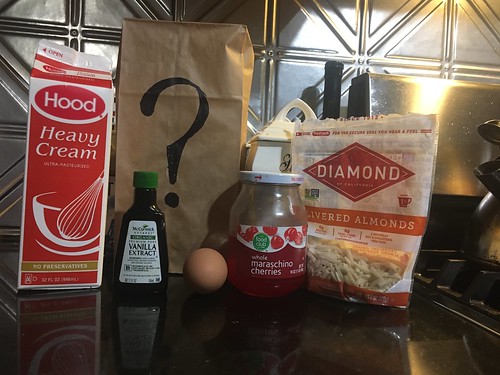
You needIMG_0962

eggs, heavy cream, sugar, vanilla, the Special Ingredient, and maraschino cherries & toasted almonds for topping. (there is actually sugar in this picture — hiding behind the almonds)

Beat the eggs with sugar until thick. Whip the cream until stiff. Carefully fold in the vanilla and Special Ingredient. Fold in the eggs. Pour the mixture into molds and top with chopped cherries and almonds. Freeze until firm.

Isn’t it pretty?

IMG_0972

What did I think? It’s sweet and creamy. It’s also much firmer than ice cream, since there’s no churning. Maybe you could use a spoon if you let it thaw a little, but I bit right into it. The cherries and nuts add some much needed texture. The Special Ingredient provides a subtle, but distinctive flavor. It might not be immediately recognized.

So what is the Special Ingredient?

Ketchup.

Yes, you read that correctly. This was a recipe from Heinz Ketchup.
For a dessert.
Containing ketchup.
You see why I just had to try it.

It’s not as disgusting as you might think. Really. It’s kind of odd, but not terrible. One could probably use sriracha instead of ketchup if one liked spicy things (I don’t) and be rather au courant.

Here’s the original recipe. (I rearranged the order slightly in my video and above for dramatic effect.)

Carnival Cream

From Mrs. Frank Flynn, Philadelphia, Pa.

Whip 1 cup heavy cream until stiff. Fold in 1/4 cup of the world’s best-loved ketchup, Heinz, and 1/2 tsp. vanilla. Beat 3 eggs with 1/2 cup sugar until thick. Fold into whipped cream mixture.

Pour into individual molds or ice cube trays. Sprinkle with 3 Tbs finely chopped Maraschino cherries and 2 Tbs. chopped toasted almond.s Freeze until firm. (Makes 8 to 12 servings.)

M2These writings and other creative projects are supported by my 15 Patrons. Thank you so much! To become a Patron, go to my Patreon page. Or you can just tip me if you liked this.
Published in: on 31 March 2021 at 2:01 pm  Leave a Comment  
Tags: , , , ,

In the Kitchen: Pineapple Salad (1928)

Dear Constant Reader,

It’s my birthday tomorrow and I have a gift for you!

When I made Sub-Gum Chop Suey from The Mandarin Cook Book, I also made Pineapple Salad. It was too weird to pass up! Usually I only share these vintage cooking videos with my Patrons, but thanks to my kind sponsor, Emporium 32, I’m making this little bonus video public! Enjoy!

If you want more like this, consider becoming a Patron. With more Patrons, I can get some better video equipment, like the microphone I clearly need.


Pineapple Salad
Original Recipe
Boil 3 cups bean sprouts in pineapple juice. Cover with mayonnaise dressing, flavored slightly with Chinese sauce. Sprinkle with chopped nut meats and garnish with Kumquats cut in quarters.

Mina’s Version
Simmer 1 cup bean sprouts in 1 cup pineapple juice until tender. Drain and let cool. Blend 3 tablespoons mayo with 1 teaspoon soy sauce and add enough to the bean sprouts to lightly coat. Sprinkle with 1 tablespoon toasted slivered almonds and garnish with citrus sections.

M2These writings and other creative projects are supported by my 15 Patrons. Thank you so much! To become a Patron, go to my Patreon page. Or you can just tip me if you liked this.

Published in: on 18 February 2021 at 4:38 pm  Leave a Comment  
Tags: , , ,