Review: Marinka: From Havana To Burlesque

Dear Constant Reader,

Like the rest of the burlesque world, I was saddened to hear of the death of Marinka, Queen of the Amazons and grateful that she shared the story of her life.
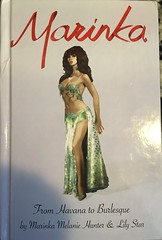
Marinka: From Havana to Burlesque by Marinka Melanie Hunter and Lily Star, 2020.

In this memoir, Marinka is honest about her life, particularly her big secret, which she kept for so long. In her introduction she says “If I had done this when I was 30, it would have been a sensation instead of my story.” I’m certainly glad times and attitudes have changed enough that she felt she could finally be completely honest and tell her whole story without it being lost behind the sensational nature.

Growing up in Havana, as the thirteenth child of wealthy Spanish immigrants, Marinka was different from other children. A fortune teller declared the five-year-old was born under a “different star”.  Marinka’s parents were worried by their youngest’s effeminate behavior. In 1959, when Castro took power in Cuba, Marinka’s parents thought New York City, where Marinka’s godparents lived, would be a safer place for their flamboyant teenager.

Once in New York, Marinka could finally live as she truly was, as a woman. She became acquainted with the underground gay and drag scene. After being declared “the most beautiful drag queen in New York City” at a ball, she was hired as a female impersonator at The Powderpuff Revue and also learned to belly dance. At this time she used the stage name “Sully”.

Very soon she became an exotic dancer. Her agent had dubbed her “Tina Darling”, but she wasn’t comfortable with it. She heard the name “Marinka” and knew that was who she was. She began working in “mixing clubs” (including the Teddy Bare Lounge and Two O’Clock in Boston), where the dancers would sit and drink with the patrons between acts.

One of her tours took her to Ohio and the Toledo burlesque theatre run by legendary performer and impresario Rose La Rose. Rose took one look at the striking beauty and asked why she wasn’t a feature. Marinka didn’t think she had the act or the experience to become a feature, but Rose La Rose thought otherwise. First, Marinka had to return to New York for something very important.

In December 1969, Marinka entered a hospital for the moment she had been dreaming of — gender affirmation surgery, or as she called it then, a sex change operation. A warning here: she describes her surgery and recovery from it in a fair bit of detail. After jumping through a few legal hoops, she was able to update all her official paperwork to reflect who she really was and chose the name Maria Arias. I’m unclear when she started using the name Melanie Hunter.

Marinka’s burlesque career was taking off. She returned to Toledo and Rose La Rose helped her create a feature act and gave her the move that became her signature — “fucking the curtains”. I loved this chapter because it detailed the different sections of a feature’s act.

From there she became a much sought after headliner. She was a regular at the resorts in the Catskills for many years as well as performing overseas. Bob Fosse cast her in All That Jazz  — you can see her in the burlesque club flashback and in the finale — and that led to an appearance in Playboy. More movie work followed, but only as an extra. Unfortunately, Hollywood was uncomfortable with a trans actress and she never could land a larger role. But burlesque loved her and she continued performing.

Marinka had many loves and marriages and her share of heartbreak. Like so many burlesque Legends, she fell in love with some charming men who spent her hard-earned money and resented her work in burlesque. She’s not bitter about them, just sad at how things turned out. She had happier relationships too, including at least one with a celebrity.

The pacing of the book is a little uneven. She’ll spend one chapter on a particular incident and then cover a longer span of time in the next. The last chapter of the book compresses a couple of decades into a few pages, as she moved from Switzerland to Florida to Las Vegas and began to have health issues.

There are many sections of photos, from early headshots (when she was known as Sully) to her appearances at The Burlesque Hall of Fame. There are also candid shots with her friends and family, plus a few press clippings.

As always, I recommend the memoirs of Legends, because it is so important to know our past. This book is useful as a look back to burlesque history, but it also happens to be enjoyable and entertaining. The tone is very conversational and her story moves along smoothly. Most importantly, it’s the very personal story of a woman who always knew who she was.

M2These writings and other creative projects are supported by my 14 Patrons. Thank you so much! To become a Patron, go to my Patreon page. Or you can just tip me if you liked this.

Published in: on 15 April 2021 at 5:04 pm  Leave a Comment  
Tags: , ,

Review: Century Girl

Dear Constant Reader,

Today I have for you a fascinating story of the youngest dancer in the Ziegfeld Follies, told in an equally interesting way.

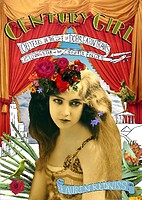
Century Girl: 100 Years in the Life of Doris Eaton Travis, Last Living Star of the Ziegfeld Follies by Lauren Redniss, 2006.

Doris was born in 1904 to a mother, who, her own show biz aspirations thwarted, was determined to make stars of her seven children. When Doris was 7, she and her sisters, Pearl and Mary, made their professional debut in The Bluebird. Adding their little brother Charlie to the cast, the Eaton children toured the country with the show, with Mary and Doris eventually taking the leads. The children were now firmly ensconced in the world of theatre and continued performing.

In 1918 Pearl was in the Ziegfeld Follies and after summer school let out, 14-year-old Doris joined the chorus. Under New York law performers had to be 16 to be in a “musical comedy”, so Doris used the name Lucille Levant until she was old enough. She found her place as a specialty dancer, while Mary became the prima ballerina and Pearl performed in the racier Midnight Frolic. Even brother Charlie did comedy sketches at the Follies with Fannie Brice and W.C. Fields.

Doris began performing in silent films as well. She got married in Hollywood, but was widowed less than a year later at 19. For several years she shuttled between the films of Hollywood and the New York stage. Her mother’s Manhattan apartment hosted all manner of show business luminaries, like George Gershwin and Fred Astaire, on their nights off. Everything was going splendidly for the performing Eatons, until…

…the Great Depression destroyed the lavish shows like the Follies and diminished Broadway. Ziegfeld died. There was no work for performers. Doris was even considering becoming a taxi dancer when a fortunate phone call sent her to Arthur Murray’s dance studio. She became an instructor, then a promoter, and opened the first franchise, in Detroit. She wrote a dance advice column for the local paper and the number of her studios grew. Her brothers helped her run them, but unfortunately, her sisters did not join her. Their stories do not end well.

Doris met her husband, Paul Travis, through her dance studio empire, which she continued to manage, even as the couple ran a turkey farm. Ever the performer, Doris began hosting a weekly social dance show on TV in 1952. Everything was going well until social dancing died out in the 1960s. Doris extricated herself from the business and started over. Again. She and Paul moved to Oklahoma and managed a horse ranch. She went to college and graduated Phi Beta Kappa.

Doris returned to the stage where it all began in 1997. She was invited to the opening of the refurbished New Amsterdam Theatre. Five former Follies Girls attended, but Doris was the only one who could still dance. She performed “Mandy”, a soft shoe number she had danced in 1919, when she shared that very stage with Eddie Cantor.

I said at the start the method of telling Doris’s story was just as interesting as her life. It’s like flipping through a scrap book. Every page is filled with photographs, line drawings, and newspaper clippings, illustrating Doris’s life. The handwritten text wanders through the images of Doris’s long life. It’s probably just easier to show you.

This creative biography pays loving tribute to Doris Eaton’s long life of dance. Much of it is in Doris’s own words, looking back over a century. If you’re only interested in the Follies, that’s section II — the shows, the performers, Ziegfeld himself, and of course, the experiences of Doris and her sisters.

(Affiliate links in this post benefit the American Burlesque Collection, a 501(c)(3) non-profit)

M2These writings and other creative projects are supported by my 14 Patrons. Thank you so much! To become a Patron, go to my Patreon page. Or you can just tip me if you liked this.

Published in: on 4 March 2021 at 2:48 pm  Leave a Comment  
Tags: ,

Review: Bettie Page Fitness Workouts

Dear Constant Reader,

I’ve got a pretty good fitness routine of barre classes, plus the occasional treat of a Toning with Tara session, but I’m always ready to shake things up and try something new. Bettie Page Fitness has created two workout videos, each one inspired by the dynamic poses in Bettie’s photos, as well as her body positivity. The workouts were designed and demonstrated by health coach and fitness expert Tori Rodriguez.

The first video is Total Body Strength & Cardio. It’s a 45-minute fitness routine with three circuits of toning, using weights, plus cardio, and one circuit of core work. The first time an exercise is introduced, its name and a photo of Bettie Page in the pose that inspired it flash on the screen. I admire the creativity in taking a still photo and turning it into an exercise, like interpreting a photo of Bettie with her arms and legs spread as a star jack.

I really liked the counter in the corner to help keep track of reps and that the three participants would do some of the exercises at different levels of difficulty. I do wish the participants were mirroring the moves though. That is, when Tori says “left”, everyone on screen moves their left which the viewer’s right. It can get a little confusing between what you hear and what you see. I know mirroring is harder on the instructor, but it makes a big difference

The second video is Bettie Page Yoga. I confess I’m not generally a yoga practitioner — most of what I know I learned from my mother who is a yoga instructor, so forgive me if I get a term wrong. This is a 40-minute flow, inspired again by the poses of Bettie Page.

At the beginning Tori suggests setting an intention based on one of Bettie’s characteristics, like her confidence or playfulness. The routine is a mix of traditional poses, like downward-facing dog and warrior 2, interspersed Bettie-inspired poses, like low lunge and standing twist. Again, the first time a Bettie pose appears, a photo of Bettie in the pose and the name appear on the screen (the names of the traditional poses are spoken only). Tori throws in some pinup touches, like a “big Bettie smile” or blowing a kiss.

It’s a fun twist on circuit training and yoga if you’re a Bettie Page or pinup enthusiast. Both workouts emphasize body positivity and good form, as well as general health and fitness. Bettie Page Fitness also sells yoga mats and beach towels with Bettie’s (licensed) image for the complete package.

M2These writings and other creative projects are supported by my 15 Patrons. Thank you so much! To become a Patron, go to my Patreon page. Or you can just tip me if you liked this.

Published in: on 24 February 2021 at 2:26 pm  Leave a Comment  
Tags: , ,

Review: Burlesque Undressed

Dear Constant Reader,

One of my Advisor Committee tier Patrons, Sarah V., suggested I review this documentary. If you want some input in my content here, become a Patron!

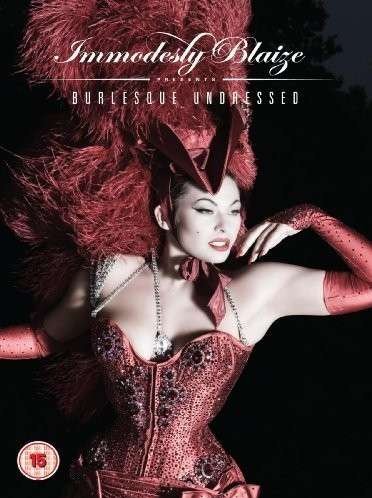
Immodesty Blaize Presents Burlesque Undressed, directed by Alison Grist, 2010.

This is a confection of a burlesque documentary. It’s light and sweet, extremely beautiful, carefully constructed, but ultimately insubstantial, and leaves you hungry for more. There’s some burlesque history, but it’s a lot of short interviews, some really only sound bites, and a great deal of burlesque performance footage.

There are interviews with five Legends, three of whom are no longer with us. You know how I feel about preserving the words and experiences of Legends, so this is a high point. Most of the Legends get to tell a brief origin story, illustrated with photos and footage, and they talk about their careers. (Side note: Scratch escorted one of said Legends to the Showgirl Museum for her interview, so I got a little behind the scenes info at the time.) . 

The film also features half a dozen of the top burlesque performers at the time, discussing their acts and inspirations. However, Immodesty dominates. She talks at length about her experiences in burlesque, often in a glamourous setting or backstage, getting ready for perform or model. More than once she’s interviewed while someone is doing her hair. I wish…

The documentary covers a wide variety of topics — costumes, music, glamour, act creation, what killed burlesque, and more. There are also appearances from a few male experts, mostly British, speaking on art, history, millinery, and showgirl headdresses, but their contributions are relatively brief.

Besides clips from several burlesque acts, including Dirty Martini’s balloon act and Perle Noir’s Josephine Baker tribute, there are a number of full or almost full-length performances, many from The Tease Show. Kalani Kokonuts performs “The Geisha”. Kitten DeVille shimmies and shakes as Marc Almond sings (the filmmakers liked this act so much it appears in the documentary and again during the credits).  Catherine D’Lish bathes in her champagne glass. Michelle L’amour does her Sally Rand tribute. And of course, Immodesty opens and closed the film with, respectively, her giant telephone and her rocking horse acts.

At times it feels like a commercial for Immodesty and The Tease Show, but it’s her project; she can spin it however she likes. And The Tease Show is pretty spectacular, with its high-end acts, gorgeous stage set, and 12-piece live band.

If you’re looking for a documentary about burlesque, either historic or neo-, there are far better ones out there, like Behind the Burly-Q or Exotic World & The Burlesque Revival. If you want to see beautiful burlesque performers doing beautiful things, with a little look backstage and a touch of history, this is a fine watch.

As far as I can tell, Burlesque Undressed is only available on DVD, in PAL format. There’s a short excerpt available here.

(Affiliate links in this post benefit the American Burlesque Collection, a 501(c)(3) non-profit)

M2These writings and other creative projects are supported by my 11 Patrons. Thank you so much! To become a Patron, go to my Patreon page. Or you can just tip me if you liked this.

Published in: on 26 January 2021 at 1:47 pm  Leave a Comment  
Tags: ,

Review: Lady of Burlesque

Dear Constant Reader,

This month celebrates the birthday of the most famous stripteaser, Gypsy Rose Lee. In her honor, I watched Lady of Burlesque, the movie based on her book, The G-String Murders.

Lady of Burlesque, United Artists, 1943.

Barbara Stanwyck stars as burlesque headliner, Dixie Daisy (a change from the book, in which the main character was Gypsy Rose Lee). She’s hit the big time, headlining at the Old Opera House. But not all is perfect; there’s a lot of tension backstage between singer Lolita LaVerne and well, everyone else, and Dixie is fending off the affections of comic Biff Brannigan. Things become even more tense as a haughty Russian princess arrives and takes Dixie’s spot in the show. And then there’s a murder… and another…

The plot is fairly faithful to the book, but the details have been sanitized for the audience’s protection. One of the plot points hinges on the broken toilet in the girls’ dressing room being replaced. No one ever actually says “toilet” and when the replacement porcelain is shown, it’s a sink. The producer’s affair with The Princess is also implied rather than stated.

We never get to see any real striptease on stage; Dixie takes off a fur muff, to reveal a smaller one, but her Edith Head-designed costumes stay firmly in place. During her big song, “Take It Off the E String, Play It On the G String”,  she sings “breaking out in bumps” and there’s an obvious associated move, but the camera focuses only on her face. Cut to Biff in the wings reacting to whatever is happening on stage. Later she does a little chest shimmy; apparently that was acceptable, where bumps weren’t. The Princess does have the outer layer of her costume removed in pieces with a whip. Maybe that was all right because she’s not doing the stripping.

The plot change that I liked best was that when Biff races in to save Dixie from the g-string strangler, she informs him that she had set a trap to catch the murderer and her friend Gee Gee Graham (based on Georgia Sothern) was waiting for her signal. Still, once the murderer is caught we go straight for the romance with Dixie and Biff rushing off to get married. Happy ending!

It’s light-weight fun. I wasn’t so interested in the murder mystery. Both of the murder victims are so unlikeable that it’s hard to care about their deaths and there’s little tension around the police accusations.

However, the on-stage bits are quite entertaining. We get some dance numbers and a bit of comedy, which was just a touch racier than I expected — they did the “pickle persuader” bit and a court room scene. And Pinky Lee, an actual burlesque comic, plays one of the comics. Dixie and the comics perform an “impromptu” dance to cover the sounds of LaVerne and her gangster boyfriend having a noisy fight backstage. There’s also an opening number with chorus girls (fulfilling all the tropes — the bored one, the clumsy one, the show-off, &c.) parading around the stage, to the melody provided by a tit singer, although they never call him that.

It’s nice to see burlesque treated positively and even somewhat accurately, if cleaned up, by Hollywood during the Hays Code years.

Available on DVD, Prime Video, and the Internet Archive.

Affiliate links in this post benefit the American Burlesque Collection, a 501(c)(3) non-profit.

M2These writings and other creative projects are supported by my 11 Patrons. Thank you so much! To become a Patron, go to my Patreon page. Or you can just tip me if you liked this.
Published in: on 25 January 2021 at 11:33 am  Leave a Comment  
Tags: ,

Review: Behind the Burly Q

Dear Constant Reader,

Ages ago I said I was going to review my way through my collection of burlesque DVDs. So far, with a big gap between, I’ve reviewed a movie, an instructional video, and a vintage burlesque film. Time for a documentary!

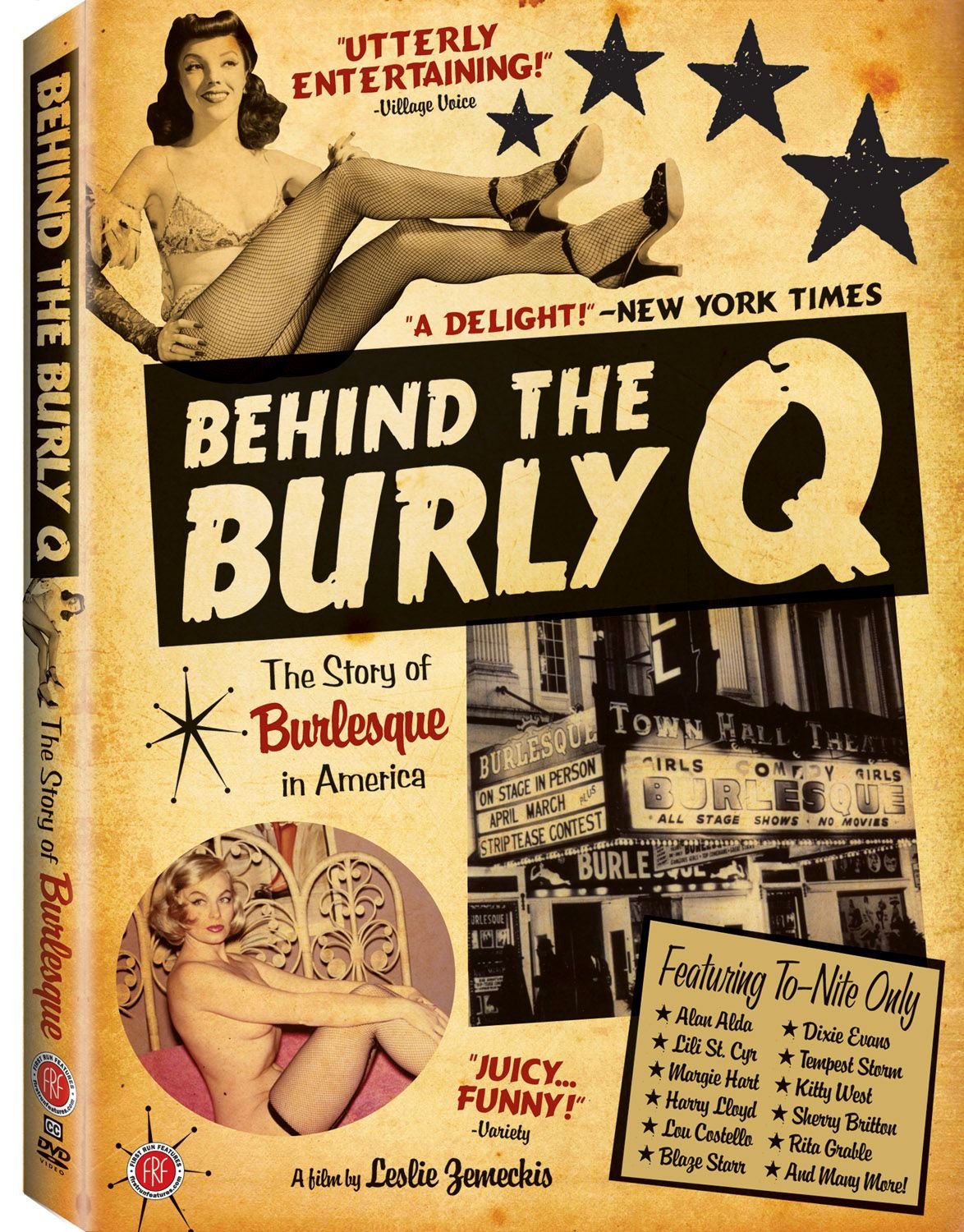
Behind the Burly Q: The Story of Burlesque in America by Leslie Zemeckis (2010)

You aren’t mistaken; I already reviewed Behind the Burly Q. But that was the book. The documentary came first. In fact, it turned 10 this year!

Zemeckis  traveled the country interviewing burlesque performers and others associated with the art or, in some cases, their descendants, to get as full a picture as possible of American burlesque. Seeing the interview subjects and hearing their stories in their own words has an impact the printed page can not match. Zemeckis herself is invisible, allowing the focus to remain on the history. She may be guiding the interviews off-camera, but she’s not a part of them and there’s no obvious agenda other than collecting the stories, where ever they may lead.

The interviews are interspersed with photographs, newspaper clippings, and film footage. Rather than a chronological history of burlesque, the stories are loosely grouped into sections like “Occupational Hazards”, “Too Many Husbands”, or “Big Money”. Of course many burlesque dancers are featured, some well-known like Dixie Evans and Tempest Storm, some more obscure, but the documentary also tells the stories of comics, singers, variety performers, producers, and more.

The history is further fleshed out by relatives of those no longer with us, such as the son of “tit singer” and straightman Robert Alda (actor Alan Alda), Lou Costello’s daughter, Ann Corio’s husband, Lili St. Cyr’s sister (burlesque dancer Dardy Orlando, who was also married to burlesque producer Harold Minsky). Zemeckis also includes a couple of modern day experts, like David Kruh and Kelly DiNardo.

Since the footage was collected, a number of the interview subjects passed away and in the ten years since, we’ve lost even more. With their words and images captured on film, this documentary is a precious record of our past.

M2These writings and other creative projects are supported by my Patrons. Thank you so much! To become a Patron, go to my Patreon page. Or you can just tip me if you liked this.

Published in: on 24 December 2020 at 1:51 pm  Leave a Comment  
Tags: ,

Review: Love Moods/Bedroom Fantasy

Dear Constant Reader,

We have a large collection of Something Weird videos. For those not familiar, these are vintage burlesque films released on DVD. This disc is two shorts, each about 15 minutes, featuring Lili St. Cyr: Love Moods and Bedroom Fantasy.
The first, Love Moods: A Ballet Pantomime (1952) was filmed at Ciro’s, the Sunset Strip nightclub where Lili frequently performed. It was directed by Lilian Hunt, the choreographer and talent agent who discovered Tempest Storm. With the stage covered in elegant furniture, including an elaborate bath tub, you get a great idea of the opulence of Lili’s stage shows.

Lili parades around the stage, occasionally throwing in some dance moves, and pouting for the camera. She directs her longing looks at a photo on her vanity. As she prepares to go out, presumably with the man in the photo, she tries on and removes four glamourous gowns and a negligee, as well as jewelry, furs, and other accessories. The centerpiece of her preparations is her famous bubble bath in her gilded tub.

Her striping is the height of tease. The audience never sees more than the slightest flash of her pasties or g-string. She’s always concealed, behind her dressing screen, her garment, a towel, or her maid’s body.

The film is not in great condition, with a number of small jumps; the worst being when Lili’s second stocking mysteriously appears on her leg while she’s dressing at her vanity.

The second film, A Bedroom Fantasy (1953), is a little more like an excerpt from a burlesque show. It opens with The Folliettes, a mob of chorus girls dancing the cancan with more or less skill. After a minute or two this turns into a stately parade as a singer begins crooning off-stage. Then they become a backdrop for the Duponts, dancers who perform a somewhat comedic duet. The Folliettes reprise their can-can and everyone takes a bow.

Now the curtain opens on the main show. Lili is returning to her boudoir after an evening out. The setting is slightly different from Love Moods — instead of an ornate bath tub, she has a lavish bed on a platform. She slowly and expertly strips out of her evening attire and poses languidly on her chaise before putting on her night attire with the help of her maid (a different maid from the previous short).

She dances and poses and even does some calisthenics (gracefully, of course) before climbing into bed. But then the phone rings and she rapturously listens to a singer “on the phone” as she writhes on the bed and wriggles out of her nightgown. The act ends with her going to sleep.

Of the two, I like Love Moods better. She seemed to be having more fun with it. Also, you get to see more outfits, more teasing and, of course, her signature bubble bath. As it was filmed at Ciro’s, this is probably about as close as we can get to seeing an actually Lili St. Cyr stage performance.

The rest of the disc is filled with trailers for other burlesque films, but I’ll be honest — I haven’t watched them.

The performances by Lili St. Cyr highlight why she was such a popular performer in her day and why her legend lives on today. Few performers today come close to matching her opulence and her grace on stage.

M2These writings and other creative projects are supported by my Patrons. Thank you so much! To become a Patron, go to my Patreon page. Or you can just tip me if you liked this.

Published in: on 8 October 2020 at 2:58 pm  Leave a Comment  
Tags: ,

Review: Brown Skin Showgirls

Dear Constant Reader,

Although I still have a huge pile of books to review, today I’m grabbing the newest addition to my library from the top of the pile.

Brown Skin Showgirls by Leslie Cunningham, 2017.

This slim paperback showcases photographs from Leon Claxton’s Harlem in Havana, a revue with Black and Cuban entertainers that toured with Royal American Shows from 1936 to 1967. Royal American was the carnival with which both Sally Rand and Gypsy Rose Lee toured, and just a few tents away Harlem in Havana also presented striptease as well as Latin and Caribbean dances.

The book is almost entirely photographs with captions, but very little other text other than a short introduction to the history of the show. Some of the stars of the show are highlighted, like The Bates Sisters (including the author’s grandmother), The Cuban Dancing Dolls, and female impersonator Greta “Garbage” Garland. It certainly left me wanting more!

Don’t get me wrong — The photos are absolutely worth the price of admission. Pages and pages of performers on stage (and occasionally off). Performance photos are so much rarer than publicity photos and photos of Black burlesque performers are very scarce. This book is a treasure trove! And you can get a good look at the costumes too.

I was happy to hear that Cunningham is going to expand on the story of Harlem in Havana with the documentary film, Jig Show: Leon Claxton’s Harlem in Havana. It should be out soon (all things depending on the pandemic, of course). I want to learn more about the performers in these tantalizing photographs.

Order your book direct from the author and she’ll sign it for you!

I want to thank Jo Weldon’s NYSB Book Club for arranging for Bebe Bardeaux‘s great interview of Leslie Cunningham about Brown Skin Showgirls, Harlem in Havana, and Jig Show.

M2These writings and other creative projects are supported by my Patrons. Thank you so much! To become a Patron, go to my Patreon page. Or you can just tip me if you liked this.

Published in: on 12 August 2020 at 3:10 pm  Leave a Comment  
Tags: , , ,

Review: Gypsy and Me

Dear Constant Reader,

Not only do I have a pile of books to review, I also have a passel of books I reviewed elsewhere, but not here. Since I’m on a bit of a history kick (I’ll explain why in another missive), here’s Gypsy Rose Lee’s son’s memoir about growing up with America’s most famous stripper as a mother.

Gypsy and Me: At Home and on the Road With Gypsy Rose Lee by Erik Lee Preminger (1984). Also published as My G-String Mother.

Picking up years after Gypsy left off, Gypsy Rose Lee’s only child chronicles his conflicted and often combative relationship with his famous mother. The story begins when Erik was 12 and Gypsy has decided to give up “the act”, the striptease show she’s been doing for decades. Now she needs another source of income.

His depiction is not always so flattering. He shows a Gypsy that was stingy, self-absorbed, and domineering. She was terrified of poverty, despite her frequently lavish spending, and constantly searched for the next thing that would support her. The author paints a flawed portrait of himself as well, honestly relating incidents of his anger, disobedience and petty crime.

Despite all the clashes between them, he loved her deeply and she was a devoted mother. She would take Erik on tour with her because she hated to be separated from him. He would help her set up her act and was even her dresser. She was a terribly hard worker, throwing herself into projects, barely eating and rarely sleeping. He describes her with tea stains on her clothes and cigarette ashes powdering her reading glasses. She was witty and clever in private, as well as in her public image. And she adored animals, sometimes more than people. She was terribly proud of Erik and wanted everyone to know he was her son. She even toured Southeast Asia to entertain the soldiers after Erik joined the Army.

Despite a truly unusual and often difficult childhood, Mr. Preminger is not bitter about his mother, and strives for an honest accounting of a very contradictory woman.

M2These writings and other creative projects are supported by my Patrons. Thank you so much! To become a Patron, go to my Patreon page. Or you can just tip me if you liked this.

Published in: on 30 July 2020 at 4:27 pm  Leave a Comment  
Tags: , ,

Review: Legends of Burlesque, Then and Now

Dear Constant Reader,

I’m catching up on my book reviews! The Burlesque Hall of Fame is usually a chance to meet our Legends in person. However, it’s happening virtually this year. While trying to decide if I should submit something for the on-line showcase (answer — probably not), I was flipping through this book.

Legends of Burlesque, Then and Now presented by Gina Bon Bon and Julie Mist, 2018

This is a collection of photographs of burlesque legends, from their glory days onstage and also from the present day. It’s a large format hardcover book, but with matte paper pages, which make the photos seem slightly muted. Each Legend is featured on at least two, sometimes more, pages of photographs, with a Quick Facts side bar with, generally, their legal names, career span, acts, and prominent bookings or awards. Some have additional brief information and anecdotes. Toni Elling talks about dealing with racism and Kitten Natividad about surviving cancer. Many reveal what they have been doing since they left the stage.

Also included are a couple of people (and a place) who don’t actually qualify as legends, but have been important to honoring the legends and keeping their legacy alive. The place, of course, is the Burlesque Hall of Fame.

The book opens with profiles of some prominent performers (and a couple of lesser known ones) who had passed away, like Ann Corio and Dixie Evans. Sadly, since the book was prepared, a few of the Living Legends are no longer with us. Our legends are a dwindling resource and should be cherished.

This is by no means a comprehensive volume, either in subject or scope. There are just over 3 dozen performers covered, which doesn’t include everyone considered a legend. The information about them is just a tantalizing taste of their stories. There are other books and documentaries that cover more, but this work was created by legends about their fellow legends which gives it an interesting perspective and a bias quite different from works created by those outside the industry.

I had a fantasy of going to BHoF and overcoming my shyness to meet as many of the Legends as I could, but alas, not this year. While we’re unable to gather in person this year, perhaps reach out to your favorite legend and just say thank you for creating the path we follow.

M2These writings and other creative projects are supported by my Patrons. Thank you so much! To become a Patron, go to my Patreon page. Or you can just tip me if you liked this.

Published in: on 30 June 2020 at 2:53 pm  Leave a Comment  
Tags: , ,