Review: Growing Up Naked

Dear Constant Reader,

Scratch got me a copy of Burlesque West: Showgirls, Sex, and Sin in Postwar Vancouver for the holidays, but that’s not the book I’m reviewing. I’ll get to it. Eventually. Early in the book, the author mentioned a book I’d never heard of, I was intrigued, and found a copy. And here it is.

Growing Up Naked: My Years in Bump and Grind by Lindalee Tracey (1997).

Lindalee Tracey began stripping, underaged, in an unspecified Canadian city in the 1970s, a transitional time for burlesque. She worked at Eden with angry, artistic Emma, Ruby who would spread, elegant Yvette who was once on a bill with Lili St. Cyr, and beautiful, bitter Sugar. She discovered the joy and power of dancing on the club stage. She also dealt with backstage jealousies, sleazy management, and a trial for lewdness. After being forced into a humiliating publicity stunt, she left Eden to tour in the U.S. There she discovered some unfortunate truths about Americans, in the industry there and in general.

She returned to Canada in time for the Olympics and found a home in Montreal at the SexOHrama. Some of her colleagues from Eden had also made the move, but their lives and fortunes had diverged from hers. After a while, she began drifting away from stripping to concentrate on her writing. Before she left the business entirely, she founded the Tits for Tots strip-a-thon, which raised both money for a local children’s hospital and the esteem of the participating strippers. Her final project before leaving stripping entirely was to be involved in a feminist documentary, which didn’t quite go as she’d hoped.

Her writing borders on poetic (not surprising, since she also wrote poetry). It’s all present tense, which gives it a sense of immediacy, but it has a misty quality of looking backwards as well. Unlike some other burlesque memoirs, she often looks inward and describes her feelings and emotional experiences, not just events and actions. Her story is interspersed with letters from some of her fans and her own poetry.

One of the aspects I found interesting was the changes in burlesque during the author’s career. When she started in burlesque, features (strippers) were still performing 20 minute sets. Early in her career the author muses on themes and songs for an act. Also, the features never mingled with the audience. It was go-go dancers who hustled drinks for tips. Periodically the go-gos would come on stage for a “paltry” three-song set. Then the go-gos were being brought on stage en masse for what became known as “the meat market”. The features were trying to compete with twenty girls at once (many of whom would “spread”) but also with porn movies being shown in the clubs. Once table dances were introduced, some strippers chose to step down in status to become a go-go for the increase in income via tips. You can see the evolution into the present day strip club.

It’s clear Lindalee loved stripping and what it had been when she started. She felt it made her more, bigger, stronger. She fought constantly against being diminished and demeaned by her employers, the audience, and others who wouldn’t see the power the performers had on stage. When she left, striptease had changed completely and she mourned the loss of what it had been.

Besides her published writings, Lindalee Tracey also made films. At some point, I’ll review her documentary The Anatomy of Burlesque.

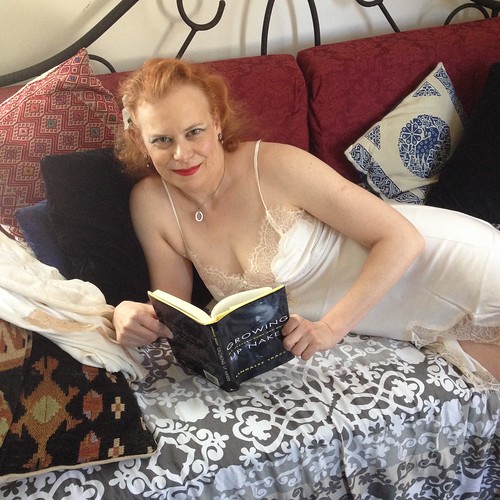
I filmed myself reading a short passage from this book, but only my Patrons can see the video. The rest of you will have to content yourself with this photo.
M2These writings and other creative projects are supported by my 7 Patrons. Thank you so much! To become a Patron, go to my Patreon page.

Published in: on 12 July 2017 at 3:05 pm  Leave a Comment  
Tags: ,

Review: Always Something Doing

Dear Constant Reader,

Another book review from the archives! I originally wrote this review years ago on another platform. I should get back to my current books to review, but this was low-hanging fruit, so to speak.

Always Something Doing: Boston’s Infamous Scollay Square by David Kruh (1999).

Boston has a reputation (rightly so) for being full of Puritans and blue-noses. And, right in the heart of the city was a hotbed of low past-times and pursuits. Always Something Doing (the motto of the Old Howard) is a history of Scollay Square from its very beginnings to the 20th century. Although the square as a location existed before the American Revolution, it didn’t get its famous name until 1838. The Charlestown trolley line that stopped in front of the Scollay’s Building had been using that as the unofficial name of the area.

Although Scollay Square is remembered for seedy entertainment (think of it as the Times Square of Boston), it was a respectable and ritzy area until the mid-19th century when the Brahmans fled for the newly created Back Bay and the Square became more commercial and affordable for the majority of Bostonians, including the influx of Irish immigrants. Besides being a major shopping district, it was full of restaurants and entertainment, including the famed Howard Atheneum. Despite hosting the first American performance of Giselle and other highbrow performances, by the end of the Civil War the Old Howard was presenting more popular entertainment at lower ticket prices.

By the 1920’s Scollay Square was well known as a haven for burlesque. Many of the biggest names, including Ann Corio and Georgia Sothern, played the Old Howard and Sally Keith, tassel twirling queen, was a standard at the Crawford House. Boston had such a great history of burlesque and I’m proud to be a part of that now.

But there’s more than just burlesque to Scollay Square. The book is full of vintage photographs and anecdotes from those who remember the Square well. I was particularly amused by the poor sailor who woke up after a drunken night in the Square to discover a pink elephant tattooed on his butt. Boston has never had another haven for sailors since the Square was demolished.

Scollay Square fell pray to urban renewal when it and the entire West End of Boston were razed in the early 1960’s to make way for the new City Hall and other government buildings. This plan had the side effect of creating the much deplored Combat Zone.

It’s clear the author’s sympathies are with the long-gone lively, sleazy neighborhood of cheap eats, burlesque theatres, tattoo parlors, and photo studios, than with the stark, soulless Government Center that replaced it.

M2

Published in: on 26 January 2017 at 2:20 pm  Comments (1)  
Tags: , ,

Review: Plain Jane to Pinup Queen

Dear Constant Reader,

I know it’s been forever since I reviewed a book! The Boston BeauTease just had a photoshoot and in preparation, I pulled out this book.

Plain Jane to Pinup Queen: Pinup Modeling Workshop in a Book by Bombshell Betty (2008).

This is one of Bombshell Betty’s famed pinup workshops, recast as a book. She give the readers all the basics of how to have a successful photoshoot, illustrated with unretouched photos from her own shoots.

Part one is all about posing and it’s rightly the bulk of the book. Good posing is key to a successful shoot. She covers how to pose in the most flattering way for your figure and how to use props and clothing items so they enhance your pose, rather than hiding you and taking over. She explains why certain poses work better in the medium of photography and how to think of yourself in 2-D. I found the section on facial expressions to be particularly useful, but I’m almost never happy with my expressions.

In the second part, she covers styling, but it’s just a brief overview. After some basic tips for makeup, she covers makeup styles by decade for 1920’s through 1950’s. The section on hair is similar — basic tips on curling and then iconic styles by decade. There’s a very brief section on costume styling by decade. There’s a URL for further resources, but it doesn’t seem to be currently active. If you’re looking for more in-depth help in creating vintage looks, I’d recommend Retro Makeup and Vintage Hairstyling.

The third part is about photoshoots, with sections on how to work with a photographer, what to expect from a shoot, &c. There’s important information on safety at shoots and the does & don’ts of modeling releases. I like the timeline of preparing for a shoot and (or course) the check list of what to bring.

The book wraps up with an cheat sheet of key points for posing and a URL of further resources which sadly seems to be dead. Sic transit gloria Internet…

Obviously a book isn’t going to replace a workshop where the participants are coached and can see the results of their poses on camera, but it’s still a fine resource. It’s directed at the novice model looking for guidance, but it’s also useful for the more experienced pin-up looking to improve her posing skills. It’s out of print, but I’m sure my clever readers can find a copy out there.

M2

Published in: on 12 May 2016 at 1:33 pm  Leave a Comment  
Tags: , ,

Review: My Journey

Dear Constant Reader,

Here’s another review from the archives.

My Journey: Burlesque: The Way It Was by Doris Kotzan (2005).

This is the memoir of burlesque dancer Dolores Rozelle, also known as Bambi Brooks, Bambi Jones, and Joi Naymith. These days she’s know as Bambi Sr., to distinguish her from her daughter, Bambi Jr. Her story well documents the declining days of burlesque in the 1950’s & 60’s, as the shows moved from theatres to nightclubs and the performers went from stars to glorified B-girls. I was particularly interested because she was from Massachusetts. Unfortunately, her run at the Crawford House with Sally Keith was over before it began, since she wouldn’t mix (hustle drinks from the customers). She did work the Casino Theatre and saw Winnie Garret flash the audience.

She met a lot of luminaries of the burlesque world, like Blaze Starr, Carrie Finnell, Zorita, Hedy Jo Star, and Candy Barr, but there are mostly just snippets about each one. During the height of Joe Namath’s fame, she hit upon the gimmick of a football act, billing herself as “Joi Naymith”. At one point, she was booked with that act in Suriname, a Dutch colony in South America and it was an utter dud. Her audiences knew nothing about American football. A lesson for us all when drawing from pop culture for our inspiration…

As with all the other autobiographies of burlesque performers that I’ve read [at the time I originally wrote this], it is in desperate need of an editor (probably more than most). Ms. Kotzan does not have a great writing style. Her tone is very casual and more than a little rambling. In fact, it feels more like a transcript of an oral history than a memoir. It’s mostly a random collection of stories and thoughts with little logical order. Each chapter title is a town where she performed, and it might be sort of vaguely chronological (with lots of divergences), but it’s hard to tell and there is no organization other than that. My biggest gripe is the truly atrocious punctuation: randomly sprinkled commas, erratic capitalization, and an egregious and often incorrect use of quotations marks. It made me want to whip out my red pen.

There are some gems that make it worth plowing through. When performing at a club in a dry area of Kansas, she got paid more than she expected, she was told she got a commission on steaks. Normally the dancers had to hustle drinks, not meat! The same club held church services Sunday morning. One of her bookings, in Western Massachusetts, required that her costume be weighed at the end of her act. In Las Vegas (New Mexico, not Nevada), the audience showed their appreciation by flinging silver dollars at her.

Although the author is not a polished writer, she was a burlesque performer and her memories and stories are valuable to our understanding of our history.

M2

Published in: on 11 March 2015 at 3:04 pm  Leave a Comment  
Tags: , ,

Review: Best Assets & Rock Bottom

Dear Constant Reader,

New review! I recently subjected myself to the “Burlesque Booty Workout” DVDs and this is what I found…

Best Assets and Rock Bottom by Gal Friday and Peekaboo Pointe (2013)

Each DVD follows the same format. There’s a stretching warm-up, then 3 segments each teaching a couple of burlesque moves which are good for toning your bum, each set of moves is followed by a 10-minute workout using those moves, plus others. You can also select the continuous 30-minute workout of all three workouts. Each disk ends with a toning workout from one of the instructors. On “Best Assets” that’s a Pilates-based core & leg workout (with a little upper body works) from Peekaboo and on “Rock Bottom” it’s a squats routine with Gal.

The instructors trade off teaching the individual moves, but they both do the workout, with one taking the lead. Sometimes the other one offers a side view which can be really helpful to see what your backside is supposed to be doing. They wear cute go-go outfits with spangly sneakers to add some burlesque appeal to the bumping & grinding workouts.

However, the toning workouts are all business. Gal’s has a lot of teaching about the different kids of squats. Peek’s is 24 minutes (yes, I was watching the clock) of pure ass-kicking. I enjoyed both and will probably incorporate aspects of each one into my usual fitness routine.

There’s quite a bit of overlap between the two DVDs with a couple of the same burlesque moves being taught on both disks. However, despite the repeated instruction, the workouts associated with those moves are very different. Also, there are moves that are taught on one disk, but then used in a workout on the other. If you do “Best Assets” first, you’ll learn some moves that appear in the “Rock Bottom” workouts, but not in its instructional sections.

Although the workouts are mostly focused on hips & glutes, there are still some moves for the upper body (stripper pushups, anyone?). Most of the workouts are done standing, but there’s some floorwork too, so you might want a yoga mat.

I would have liked to have had a cool down as well as a warm up, ’cause I was sweating by the end. A little less chitchat during the workouts would also be nice. There was a little teaching during some of the workouts, which slows everything down and I didn’t want to stop moving. Lastly, I do wish the 2 DVDs were completely independent of one another or had been packaged as a 2-disk set. I bought both of them, but someone who only bought “Rock Bottom” might be lost when the moves taught on “Best Assets” came into play.

The production values were very good, which I have come to expect from World Dance New York projects. I think these workouts were a lot of fun, a good workout, and you’re going to get very familiar with the butt isolation. Trust me.

M2

Published in: on 23 April 2014 at 3:39 pm  Leave a Comment  
Tags: , ,

Review: Carnival Strippers

Dear Constant Reader,

It’s Wednesday! How about a book review. I know it’s been so long, but I had reviewed every burlesque book in the library at Stately Babydoll Manor. We’ve acquired a few new books for the Library and I’m getting back in the habit of reviewing them.

Carnival Strippers by Susan Meiselas (1976).

A visit to an antiquarian book fair turned up this long out-of-print volume of photography. The price tag was somewhat daunting, but it tells an important story of burlesque and Scratch was able to haggle a bit for it and another book I’ll review later.

I know there’s a fantasy that burlesque was and still is all champagne and rhinestones. And we modern performers certainly like to perpetuate it. This book bluntly puts that to the lie. In the early 70’s burlesque was spiraling downward, still hanging in there, but well beyond the glory days. One of the lowest venues for the burlesque dancer was the carnival girl show. The work was hard and paid poorly. They traveled all summer, living in trailers, until the season was over. Most of the dancers stripped to full nude and allowed the audience members to grope them. There was an expectation that they would offer the “lunch counter” — sit on the edge of the stage and have cunnilingus performed on them by the audience. And there was an assumption that they would turn tricks as well (some did, some didn’t).

Meiselas traveled with carnivals from 1973-1975, photographing the denizens of the girl shows and recording stories and conversations. Other than an introduction from the photographer, the book’s text is entirely transcriptions of those recordings. The photos are untitled, so it’s unclear if the subjects of the photos are also the subjects of the accompanying transcription.

The photographs are gritty and occasionally grainy and the text frequently disturbs. The photographer does not pass judgement, merely records what she sees and hears. She gives a certain dignity to the dancers, shown in varying stages of dress, on stage and off. Even the “lunch” shots are documentary rather than titillating. Few subjects even acknowledge the camera; most look too tired or busy to bother posing. There’s a poignancy to the shots of the naked dancers waiting backstage, playing cards, drinking beer, smoking, napping. Then add the text about the degrading treatment by the audience or how the dancer needs to be drunk or stoned to perform (or be performed on) and the reality of their lives is painful.

The second section of the book is entitled “Portraits” in which the performers do pose for the camera and the accompanying stories are longer and more intimate. There are even a couple of poems (anonymously authored). All the dancers tell how they got into the girl show: one began in burlesque, another is part of a family that runs the show, some had nowhere else to go. Some seem content with their choices, some are clearly miserable and trapped. Lena’s story is dated over the course of several months and it’s heartbreaking to watch her evolution from “I’m gonna strip till I get on my feet” to “girl shows are absolutely the worst thing anybody could ever do” to “they want to get up there and lap your pussy and you get a feeling of exultation because you’re looking down at a bunch of animals at your feet”.

Susan Meiselas writes “Like the show, the book represents coexistent aspects of a phenomenon, one which horrifies, one which honors. If the viewer is appalled by what follows, that reaction is not so different from the alienation of those who participate in the shows.” I think this is the key to the collection. The dancers are in a horrific place, but the camera honors them, showing the dignity as well as the degradation.

It’s important for all burlesque performers to know that this is a part of our heritage too. Our sisters in shimmy aren’t just the glittering headliners, our beloved Legends, but these women too, taking it off show after show, town after town for the worst kind of audience. And let us be thankful we don’t have follow in their footsteps.

M2These writings and other creative projects are supported by my Patrons. Thank you so much! To become a Patron, go to my Patreon page. Or you can just tip me if you liked this.

Published in: on 15 January 2014 at 2:47 pm  Leave a Comment  
Tags: , ,

Review: Blue Ribbons & Burlesque

Dear Constant Reader,

Despite being so close to finished with this reviewing project, I bought another book. I couldn’t help it — I’d just been to a local fair.

Blue Ribbons and Burlesque: A Book of Country Fairs, by Charles Fish (2003).

In 1969 and 1970 Charles Fish photographed local fairs in his home state of Vermont. Years later he complied them into this collection of images and reminiscences from himself and people who were involved in the fairs. The folks he interviewed also helped identify the subjects of the photographs (who were occasionally themselves). The book examines animals as objects of beauty (prize cows), strength (ox pulls), and speed (horse racing), wanders down the midway to the games, rides and food, views the midget car race track, and at last visits the girlie shows.

Despite “burlesque” being in the title, it’s just one short chapter with about 2 dozen photos of the exteriors of the shows. The anecdotes were interesting — a woman turned away from a show came back with her hair under her hat and dirt smudged on her face, looking enough like a man to get in. But the information is generally pretty thin. If you’re really interested in carnival girl shows, read Girl Show instead.

Although it was charming to read, I can’t recommend it as a burlesque book. There’s too little on the topic to be worth it.

One more review down. If I don’t buy any more books, there are only FIVE left!

P.S. The fair I went to had no girl show, although there was a “live” mermaid.

Published in: on 11 July 2012 at 9:18 am  Leave a Comment  
Tags: , ,