Review: “…A Kind of Life.”

Dear Constant Reader,

What a snowy Wednesday! How about a book review? Today’s book is continuing in the vein of Carnival Strippers, but it’s set in Boston!

“…A Kind of Life.”: Conversations in the Combat Zone by Roswell Angier (1976).

The Combat Zone* was the section of Boston where the adult businesses moved after Scollay Square was demolished. Washington Street between Boylston and Kneeland Streets was the home of peepshows, adult movie theatres, bookstores and venues such as the Teddy Bare Lounge, The Pilgrim Theatre, the Naked I with girls, girls, girls. Some of our Legends remember performing in those clubs and theatres.

These days the Combat Zone is pretty cleaned up, although there are a few hold-outs (particularly on LaGrange Street, once notorious for the streetwalkers).

Like Susan Meiselas, Angier took photos in the 1970’s of performers and others associated with The Combat Zone and accompanies the photos with quotes. His photos are taken on-stage, back-stage and on the street, all neatly captioned with the subject’s name (if known), location, and year. He also does an in-depth study of two performers: Melanie and Coty Lee. He seems to have a lot of affection for all these performers.

For me the real selling point of the book, beside that it captures of Boston burlesque history, is a portrait of Tiffany Carter opposite one of Hedy Jo Star.

Some of the text is the author’s own and it’s opinionated and a bit crude. I was struck by a bit in his introduction that specifically mentions burlesque, when he’s comparing “strippers” and “showgirls”:

The differences between the two are subtle and possibly specious. But to women who are in the business, the distinction is an important one. In part, it has to do with age. Strippers are often older women in whose memories burlesque is still very much alive, or younger women who have picked up the extravagant style of the old queens. They are real cockteasers. Showgirls, who tend to be younger, are less melodramatic. They get just as naked, but they are less genital. Their sexuality is polymorphous and familiar, a kind of aura. You can tell showgirls from strippers, sometimes by their stage names: Jeri, Deirdre, Melanie, Coty Lee; and on the other hand, Devil’s Delight, Satan’s Angel, Blaze Starr, Tempest Storm, Honeysuckle Devine. The effects they are calculated for are miles apart.

An interesting perspective, which is contradicted by some of the performer’s quotes. The 70’s seem to be a time of transition for our industry and I’m interested to learn more.

M2
* One of my tag lines is “The Ivy League mind in the Combat Zone body”, but only particular audiences get the reference these days.

Published in: on 5 February 2014 at 4:30 pm  Leave a Comment  
Tags:

Review: Carnival Strippers

Dear Constant Reader,

It’s Wednesday! How about a book review. I know it’s been so long, but I had reviewed every burlesque book in the library at Stately Babydoll Manor. We’ve acquired a few new books for the Library and I’m getting back in the habit of reviewing them.

Carnival Strippers by Susan Meiselas (1976).

A visit to an antiquarian book fair turned up this long out-of-print volume of photography. The price tag was somewhat daunting, but it tells an important story of burlesque and Scratch was able to haggle a bit for it and another book I’ll review later.

I know there’s a fantasy that burlesque was and still is all champagne and rhinestones. And we modern performers certainly like to perpetuate it. This book bluntly puts that to the lie. In the early 70’s burlesque was spiraling downward, still hanging in there, but well beyond the glory days. One of the lowest venues for the burlesque dancer was the carnival girl show. The work was hard and paid poorly. They traveled all summer, living in trailers, until the season was over. Most of the dancers stripped to full nude and allowed the audience members to grope them. There was an expectation that they would offer the “lunch counter” — sit on the edge of the stage and have cunnilingus performed on them by the audience. And there was an assumption that they would turn tricks as well (some did, some didn’t).

Meiselas traveled with carnivals from 1973-1975, photographing the denizens of the girl shows and recording stories and conversations. Other than an introduction from the photographer, the book’s text is entirely transcriptions of those recordings. The photos are untitled, so it’s unclear if the subjects of the photos are also the subjects of the accompanying transcription.

The photographs are gritty and occasionally grainy and the text frequently disturbs. The photographer does not pass judgement, merely records what she sees and hears. She gives a certain dignity to the dancers, shown in varying stages of dress, on stage and off. Even the “lunch” shots are documentary rather than titillating. Few subjects even acknowledge the camera; most look too tired or busy to bother posing. There’s a poignancy to the shots of the naked dancers waiting backstage, playing cards, drinking beer, smoking, napping. Then add the text about the degrading treatment by the audience or how the dancer needs to be drunk or stoned to perform (or be performed on) and the reality of their lives is painful.

The second section of the book is entitled “Portraits” in which the performers do pose for the camera and the accompanying stories are longer and more intimate. There are even a couple of poems (anonymously authored). All the dancers tell how they got into the girl show: one began in burlesque, another is part of a family that runs the show, some had nowhere else to go. Some seem content with their choices, some are clearly miserable and trapped. Lena’s story is dated over the course of several months and it’s heartbreaking to watch her evolution from “I’m gonna strip till I get on my feet” to “girl shows are absolutely the worst thing anybody could ever do” to “they want to get up there and lap your pussy and you get a feeling of exultation because you’re looking down at a bunch of animals at your feet”.

Susan Meiselas writes “Like the show, the book represents coexistent aspects of a phenomenon, one which horrifies, one which honors. If the viewer is appalled by what follows, that reaction is not so different from the alienation of those who participate in the shows.” I think this is the key to the collection. The dancers are in a horrific place, but the camera honors them, showing the dignity as well as the degradation.

It’s important for all burlesque performers to know that this is a part of our heritage too. Our sisters in shimmy aren’t just the glittering headliners, our beloved Legends, but these women too, taking it off show after show, town after town for the worst kind of audience. And let us be thankful we don’t have follow in their footsteps.

M2These writings and other creative projects are supported by my Patrons. Thank you so much! To become a Patron, go to my Patreon page. Or you can just tip me if you liked this.

Published in: on 15 January 2014 at 2:47 pm  Leave a Comment  
Tags: , ,

Review: Embellishments

Dear Constant Reader,

Vote for The Boston Babydolls for “Best Theatre Group” and B.A.B.E. for “Best Dance Classes“!

Buy your tickets to The Teaseday Club on July 9th in my name! I’ll do something nice for all my supporters!


Embellishments: Constructing Victorian Detail by Astrida Schaeffer (2013)

Inspired by an exhibit at the University of New Hampshire Museum, which she curated, Ms. Schaeffer presents a number of the elaborate Victorian gowns from the museum’s collection. The book focuses on 10 gowns, beautifully photographed, dating from the 1870’s to 1909. There are many close-up photos showing details of those gowns and others to illustrate the embellishment techniques used.

So where’s the burlesque in all this? Ms. Shaeffer doesn’t only show the embellishments used, she explains how to do them! With clear instructions and diagrams she shows the reader ruching, pleats, ribbon work, binding, piping, cord & braid work, and appliqué. The possibilities for your own costumes are endless! There is more to embellishment than just rhinestones (shocking, I know…).

I got my copy through Astrida’s Kickstarter campaign, but you can buy yours direct from the author at ShaefferArts. And if you ever need a custom mannequin, she’s your gal!

M2

Published in: on 3 July 2013 at 10:26 am  Leave a Comment  
Tags: ,

Review: My Face for the World to See

Dear Constant Reader,

It’s been quite a while since I had a burlesque book to review. I was quite excited to see this first edition for sale at The Expo.

My Face for the World to See by Liz Renay (1971).

The first and only time I saw Liz Renay was at the Miss Exotic World weekend in 2006 in Las Vegas. She was carried onto stage on a palanquin born by scantily clad men, in a spectacle worthy of Cleopatra (orchestrated by Grant Philipo, I later learned). In her sultry voice, she said “I’m Liz Renay, rhymes with play”. She made a bit of an impression, let us say.
Opening Night : Liz Renay(Photo by Chris Blakeley)

In this memoir Liz writes of her origins as an artistic child in a fundamentalist family in rural Arizona. She longed for more and attempted to escape with teenaged marriages and motherhood. With her third marriage she moved to New York and became a high-fashion model. When that marriage ended disastrously, she needed a job that would let her take care of her kids during the day. She chose to become an exotic dancer. It was then that she met a number of upstanding Italian-American gentlemen and the seed of trouble was planted.

After winning a Marilyn Monroe look-alike contest, Liz decided to become a movie star and moved to Hollywood. Her New York “friend”, Cappy, made sure she connected with his buddy, mobster Mickey Cohen. Everything was going splendidly at first. Liz had many movie and tv offers and her art was selling well in New York.

Then the federal government swept in and forced her to testify about her relationship with Mickey Cohen. The scandal ruined her Hollywood career and made it impossible for her to work in any industry. She was repeatedly harassed by the authorities and her morals came under question. Eventually she found herself in prison.

According to Liz, she was gorgeous, smart, tough, desirable, and talented. If anything was her fault, it was that she was too trusting and kind-hearted. Everyone was out to get her for her friendship with and loyalty to Cohen. But, you know what? Her story is such an easy and entertaining read, that you’ll forgive more than a little self-aggrandizement.

As to actual burlesque content, it’s a bit thin. The first chapter describes a night in the 52nd St. clip-joint where she became a mob darling. Later she writes of her beginnings in burlesque, including the costume she cobbled together from lingerie & ribbons and the sheet music she gave the band without ever having heard the song. Despite that, what a surprise, she was a hit. The book doesn’t mention her later career, post-prison, or performing with her daughter, Brenda in a mother/daughter strip act.

To close the story, here’s a photo of Jo Weldon at this year’s Burlesque Hall of Fame weekend, wearing a cape from Liz Renay’s estate. (photo by Derek Jackson)

M2

Published in: on 12 June 2013 at 1:12 pm  Leave a Comment  
Tags:

Review: Queen of the Air

Dear Constant Reader,

I recently received an advance reviewer’s copy of a new book, available in June. Since it’s about the circus, which is one of those topics sort of related to burlesque, I thought I would tell you a little about it.

Queen of the Air: A True Story of Love and Tragedy at the Circus by Dean Jensen (2013).

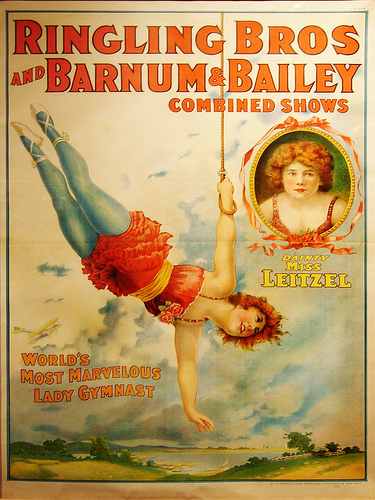
Born in 1891, Leopoldina Alitza Pelikan was destined to be a circus performer. Her grandparents and father ran small traveling circuses in Eastern Europe and her mother was a star trapeze artist. She began performing on the trapeze as a child and soon rose to stardom, as “Leitzel, Queen of the Air”, performing throughout Europe and for the Ringling Brothers’ Barnum & Bailey circus in America.

She performed on the trapeze, but her claim to fame was the Roman rings. Her specialty was one-armed planges: using a single ring for support, she would rock her body back and forth until she could fling her legs over her head, making a complete revolution around her right arm. Despite dislocating her shoulder with every flip she would execute a hundred or more at every show.

Alfredo Codona was also born into a circus family, in Mexico. He was also a trapeze artist, but as a flyer. When his sister, Victoria, a tight- and slackrope walker, was noticed and hired by The Ringling Brothers in 1909, Alfredo came along as a bonus. At 16 Alfredo was stunningly handsome, but he only had eyes for the diminutive Leitzel. She only let him court her clandestinely for the season and they went their separate ways.

Possibly to win over Leitzel, Alfredo became obsessed with perfecting The Triple, 3 somersaults in a row. This move, known as the Salto Mortale, had killed many trapeze flyers, but he refused to give up. It took him ten years to finally conquer it and it brought him stardom.

In 1928 the two great aerialists married. As the book promises, theirs was a turbulent story of love and tragedy, which I will not spoil.

The book alternates between the lives of the two performers, as they were only together late in their careers, which creates a bit of a disjointed narrative. Although the author based the book on interviews with people who knew the two personally, many details are so vivid that I suspect a fair amount of fictionalization. I found the book as a whole to be a little weak. However, I’m still interested in reading the author’s previous work, The Lives and Loves of Daisy and Violet Hilton: A True Story of Conjoined Twins.

There are only four photographs in the ARC, although, according to the publishing information, there will be 27 black & white photos in the final book. I can’t complain too much about the lack of illustration as the book cost me nothing and I got to read it months before the masses.

So, where’s the burlesque? Allow me to tell you.

It involves Leitzel’s mother, who has a pretty tragic story of her own. Nellie Pelikan was an equestrienne and acrobat in her family’s circus from the time she was five years old. Her family fell on hard times and she was “apprenticed” (really, sold) to Willie Dosta, a Scottish strongman with a single-wagon circus. He employed the twelve-year-old Nellie for one season before returning her to her family heavily pregnant.

Just weeks after she gave birth to Leitzel, Dosta came back to take Nellie for another tour and he trained her to be a trapeze artist. As La Belle Nellie, the aerialist, she was a hit, bringing fame and fortune to the tiny circus. After her third tour, playing ever bigger and better venues, Dosta returned her to her family to deliver a son. Shortly thereafter, she was freed from this abuse, but I’ll let you read about that yourself.

After years of stardom under the big top, La Belle Nellie reinvented herself as “Zoe, the Aerial Venus”. She entered with a lace parasol which was then suspended from the ceiling. Hanging from the handle by her teeth, she disrobed completely (or maybe to fleshings). With this act, she played all the best circus theatres in Europe and even had an extended engagement at Coney Island. I’m hoping her picture might be among the ones missing from my copy.

I’m recommending this for aerialists and circus buffs who really should know the story of these two great aerial performers. If you’re just in this for the burlesque, don’t sweat it.

M2

Published in: on 1 May 2013 at 2:42 pm  Leave a Comment  
Tags:

Review: Literary Rogues

Dear Constant Reader,

Literary Rogues: A Scandalous History of Wayward Authors by Andrew Shaffer (2013).

I was introduced to the works of Andrew Shaffer when Naked Girls Reading did a nationwide event tied to the launch of his book Great Philosophers Who Failed at Love. The Boston chapter was fortunate enough to have an appearance by the author himself. We were surprised and delighted to learn of a thank you in the acknowledgements of his new book and decided it was only right to include a selection in our next salon (little did we know at the time that it would be the last).

Literary Rogues follows a similar format to Great Philosophers: short, entertaining profiles of bad boys (and girls) of literature, focusing on said bad behavior. The book proceeds chronologically from the Marquis de Sade through The Romantics, The Decadents, The Lost Generation, The Beat Generation, and on to Gen X. There’s lots of drugs, drinking, sexual shenanigans, mental illness, and general misbehaving from some of the greatest writers in western literature. Many of the stories end in suicide — intentional or gradual.

The book is well researched, with a section of endnotes to prove it, and a selected bibliography for further reading. Lest the dread word “research” frighten you off, the writing is light and conversational and the stories both funny and horrifying. Shaffer makes no excuses for his subjects’ behavior, but nor does he moralize. His commentary is frequently irreverent, but he never belittles the talents of the writer in question.

I think of this as a good nightstand book, a chapter or two a night is a nice treat before bed. And you’ll probably want to look up the works of some of these talented, troubled writers.

M2

Published in: on 20 March 2013 at 3:35 pm  Leave a Comment  
Tags:

Review: Loie Fuller

Dear Constant Reader,


Please vote for The Boston Babydolls every day!


Today’s book is not about burlesque, but a dancer who inspired one of the Boston Babydolls.

Loie Fuller: Goddess of Light by Richard Nelson Current & Marcia Ewing Current (1997)

Loie Fuller (née Marie Louise Fuller in 1862) was stage struck from a very early age. It’s said that at 2 years old she unexpectedly joined the recitation group at church and lisped her way through “Now I lay me down to sleep”. She strived for stardom as an actress and singer, but it wasn’t until she turned to dance that her fortunes turned. She took a popular music hall dance style — the skirt dance — and turned it into a dramatic swirl of fabric, dubbed the Serpentine Dance.

008_4After a lukewarm reception in the US, Loie took her dance to Paris in 1892 and became a sensation. La Loïe, as the French quickly dubbed her, mesmerized audiences with her dances of flowing fabric, highlighted with colored light. In some of her dances she manipulated the folds of fabric with long sticks, creating the form of a butterfly, a flower, rippling waves. In “Le Lis du Nil” she was draped in 500 yards of silk.

When theatres were still using gas footlights and limelight, Loie took advantage of the new electrical arc lights for her performances and created her own colored gels to get just the right effect. Sometimes she danced on a platform of glass, lit from below, and used mirrors in some of her dances. She took advantage of new technologies, projecting images on her draperies with magic lanterns and later, making moving pictures,

at-the-music-hall-loie-fuller-1892Her swirling form was a hallmark of Art Nouveau and many artists depicted her, on paper and in sculpture, including Rodin and Toulouse-Lautrec. She inspired fashions in clothing, jewelry, and home decor. She can also be given credit for paving the way for modern dancers, like Isadora Duncan (in whose career she took an interest), and Fokine’s Ballets Russes.

Loie FullerMany of her tours and other ventures were mismanaged and lost money, despite her critical acclaim. By all accounts she was charming, generous, and childlike. Loie was constantly in debt and relied on her many friends to help her out. She wrote a hasty memoir which was eventually published in English as Fifteen Years of a Dancer’s Life, With Some Account of her Distinguished Friends.

To give you an idea of the serpentine dance, here’s a montage of films shot during Loie’s lifetime. I don’t know if the dancers include Loie herself, students of hers, or just imitators. The colored footage was hand tinted, frame by frame.

So, where do we come into this? After Betty Blaize saw dancer Jody Spurling present a program inspired by Loie Fuller, she saw the possibilities for using huge swirls of fabric to captivate and tease. She got a vast quantity of silk and sewed herself a cape à la Loie.

Her first act “Lost at Sea” involved a slideshow telling a tragic love story projected onto her costume as she danced.

“Someone to Watch Over Me” was originally done behind a large Venetian blind, to give the audience a voyeuristic thrill and create a film noir look. Later, we used lighting effects to give the same atmosphere without having to worry about sightlines.

bbd-31

Unlucky in Love, February 2012 (Photo by Chris McIntosh)

In “Snowfall” Betty appeared in a blizzard made from tiny points of light, and then an actual blizzard of paper snow falling from the ceiling.


M2

Published in: on 27 February 2013 at 4:07 pm  Leave a Comment  
Tags: ,

Review: Retro Makeup

Dear Constant Reader,


Please vote for The Boston Babydolls every day!

And while you’re doing that, please also vote for Jennifer Pelland for Best Author. She is a science fiction writer (and belly dancer), author of the novel Machine & the short story collection Unwelcome Bodies, and her fiction has appeared in numerous anthologies. She’s lost the Nebula award twice (once to Harlan Ellison), so let’s stop that nonsense. Besides, what’s that Lehane guy done lately?


Retro Makeup: Techniques for Applying the Vintage Look by Lauren Rennells.

I’m very happy with Vintage Hairstyling: Retro Styles with Step-by-Step Techniques, so I was pleased to see Ms. Rennells had a new book. Once again she has produced a book full of fabulous photographs and step by step instructions. Retro Makeup contains information about all the basics of applying makeup, like contouring, grooming brows, and lining lips, and information on the tools of the trade. There’s even a section on the best lipstick colors for your skin tone.

Her scope is the 1920’s through the 1950’s. There’s a great deal of historical information on makeup styles and cosmetics. You’ll learn about tanning, war-time makeup rationing, and why the most popular shade of powder was called “Rachel”. Not only is there a guide to applying false lashes, she shows the appropriate style for each decade. The book is peppered with photos of vintage cosmetic packaging and tools. The beauty fad sidebars are fun — will rouged earlobes ever come back into fashion?

The decade by decade chapters highlight brow and lip shapes as well as hallmark colors. There are only a few “looks” in each chapter, which may be initially disappointing, but it’s really an excuse for experimentation. Makeup is so intensely personal, dependent on skin coloration and face shape. There’s more than enough instruction for the reader to make up her own face in a historically accurate way that flatters her.

M2

Published in: on 20 February 2013 at 10:07 am  Leave a Comment  
Tags: ,

Review: Vintage Hairstyling

Dear Constant Reader,

Here’s your daily reminder to nominate The Boston Babydolls for Best Burlesque. You can vote once per day per email/IP address. Thank you.

I’ve run out of burlesque books to review, so I’m trying non-burlesque, but related books for a bit.

Vintage Hairstyling: Retro Styles with Step-by-Step Techniques, 2nd Edition by Lauren Rennells (2009).

I bought the first edition of Vintage Hairstyling when it first came out and was quite happy with it. When the author asked for feedback for a second edition, I jumped at the chance, especially since she was offering a copy of the new version as thanks.

The first edition was the best book on retro styles around, head and shoulders above the once-much-sought-after Daniela Turudich book. Lauren Rennells shows how to create hairstyles using modern equipment like curling irons and velcro rollers. Even a hair dunce like myself was able to produce some great looks. With clear and beautiful photographs she demonstrates the styling basics, like finger waves, victory rolls, and pin curls before turning you loose on a vast array on styles, growing ever more challenging as you move deeper into the book. As an added bonus there is a section on finishing touches, like hair ornaments, makeup, and nails.

The second edition has even more details on the basics. I notice she added steam rollers and soft rollers to the arsenal of equipment. She has extended her time period and included some ’50’s and even ’60’s hairdos (with the popularity of Mad Men how could one not). I was particularly pleased to see that the hairdo staple, the French Twist, was taught as a stand-alone ‘do before being used as the basis of other styles, like “Beehive” and “Golightly”.

Some of the styles from the first edition have been rewritten. “Film Noir”, a style I liked, but hadn’t tried because it involved numerous wet-set pincurls, has been redone using velcro and soft rollers. She did edit out a couple of hairstyles, like “Casino Owner’s Wife”, from the first edition, so that volume will be staying on my bookshelf. She has introduced some new techniques, like working with fake hair and making marcel waves, and has expanded the “extra” information.

I do have one gripe with this book. It’s has a very attractive design and a lot of lovely photographs, illustrating each technique or style step-by-step, as promised. But it’s a poor workbook. It doesn’t lie flat while one is styling one’s hair. The perfect binding makes it look like a “real” book, but sometimes I wish it was spiral bound, so I could have it open on my vanity while my hands are busy with curling paraphernalia and pins.

M2

Published in: on 6 February 2013 at 3:01 pm  Leave a Comment  
Tags: ,

Review: striptease

Dear Constant Reader,

Here’s your daily reminder to nominate The Boston Babydolls for Best Burlesque. You can vote once per day per email/IP address. Thank you!

striptease by Libby Jones (1967).

This slim volume is a gem. Subtitled “The one ‘How To’ book no woman should be without”, it covers all the basics a budding stripper could want in a mere 80 pages and boasts of “step-by-step, fully illustrated instructions by one of the most famous practitioners of the art, Libby Jones”. Published in 1967, it has the aesthetic of the era. There’s just something about the typeface of the headers that says “groovy” to me.

Ms. Jones starts off with, as promised, step-by-step instructions for stripping out of specific garments (gloves, dress, chemise, stockings, garter belt, bra, and panties). Each garment section is accompanied by line drawings showing how to remove it. Best of all is that each one is a convenient 2-page spread, for easy reference. Remember what I mentioned about the aesthetic? The illustration for “the dress” shows a maxi-dress with an empire waist with a floral slip (“the chemise”) worn underneath.

After you’ve learned to take it off, come “The Actions”: tassel twirling (the instant gratification method), breast bounce (a way of faking pectoral control a la Carrie Finnel or Donna Denise), shimmy (quivering the bum), bump (which “isn’t really one of life’s classiest gestures”), grind, floorwork, lunge, walks, and props (a pillow and earrings). All are again illustrated and each one is only on one or two pages. There are a couple of different floorwork poses and three walks, from coy to aggressive. I was quite thrilled to see some underutilized props. Now I’m inspired to try an earring remove — it could be quite seductive.

There’s even a section for making your own g-string and pasties. Remember, in 1967 there was no Etsy. ; ) The techniques are remarkably similar to the ones many people use today — if it ain’t broke…

The remaining 20-odd pages are on “beauty”. There are toning exercises for all parts of the body, like “firming and developing the bust”, “slimming the hips and buttocks”, and “reducing thick ankles”. Lastly, there are make up tips, such as conturing the face, making up eyes and lips, and “beauty hints”. Much of this section makes me think of the Virginia Slim’s motto, because we have come a long way.

I like it, part because it is a good how-to (the stripping part), and part because it is a window into its time period.

That’s the last burlesque book on my shelf! Do you have any suggestions for what I should review next?

M2

Published in: on 30 January 2013 at 2:14 pm  Leave a Comment  
Tags: