Review: Burlesque {and the New Bump-n-Grind}

Dear Constant Reader,

Before we get to the book review, I wanted to remind you that we have a Kickstarter campaign to help fund our tour this summer. There are some really fun gifts! I’m waiting for someone to go for the big one… dinner at Stately Babydoll Manor, prepared by Scratch and served by the Boston Babydolls.

Burlesque and the New Bump-n-Grind by Michelle Baldwin (2004).

I believe this was the first book written about the neo-burlesque movement and is certainly still the one most people reach for when they first discover burlesque. Michelle Baldwin (aka Vivienne VaVoom) looks at the origins of the new burlesque while paying tribute to its roots. She starts with a brief history of burlesque and some of the major historical influence on modern burlesque.

The rest of the book is devoted to neo-burlesque. She looks at its history, evolution, and influences. It’s peppered with profiles of industry leaders. Baldwin also explores costumes, styles, philosophy of performing, the audiences. There are photographs throughout, many taken in performance. The list of on-line resources might seem a little dated, as there is so much more out there now. Please note that this is not a book about performing burlesque, for that you need The Burlesque Handbook.

A lot has happened in burlesque since this book was published, but it remains the top book on the subject.
Published in: on 6 June 2012 at 11:48 am  Leave a Comment  
Tags:

Review: The Golden G-String

Dear Constant Reader,

For a change, here’s some burlesque fiction.

The Golden G-String by Dusty Summers (2002).

Mercedes, Dallas, and Jesse are all dancers at the Primadonna in Texas. All three of them will be competing in The Golden G-String contest in Las Vegas, hoping for a role in a major motion picture, or at least more fame and fortune. But most of the book is about the choices these women make, in their careers and in their personal lives.

Jesse is only a peripheral character, escaping an abusive relationship early in the story and only making brief appearances until they all arrive in Las Vegas. We primarily follow Mercedes, the heroine, and Dallas, who makes bad decisions. The contest itself, the climax of the story, only takes up a few chapters and the ending feels a little abrupt.

Dusty Summers worked in the industry for years and her insider knowledge shows. The book may be fiction, but the descriptions of clubs, acts, and costumes are clearly grounded in reality. I was particularly taken with a section where Mercedes is booked into a “mixing club”. Her job there is less about dancing and more about drinking with the customers. Veteran dancers Wendy and Suzette teach her how to look like she’s drinking bottle after bottle of champagne without actually swallowing a drop.

Dusty has a nice way with character creation. All of the characters, even the minor ones, have distinct personalities. And she treats her settings similarly well. You’ll have a clear picture of what burlesque was like in a certain era when you read this story.

Published in: on 30 May 2012 at 10:30 am  Leave a Comment  
Tags:

Review: Burning the Gaspee

Dear Constant Reader,

Today’s book has nothing to do with burlesque, but it was written by someone with whom I’ve shared the stage many a time.

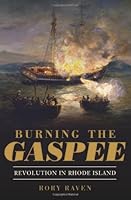
Burning the Gaspee: Revolution in Rhode Island by Rory Raven (2012).

Rory Raven is a mentalist. He will read your thoughts, bend your silverware, and generally blow your mind. He’s also a historian, specializing in the state of Rhode Island. His latest book is on an incident during the pre-Revolutionary tensions between Great Britain and the American colonists. You may know of the Boston Tea Party and the “shot heard round the world”, but outside of Rhode Island, the burning of the Gaspee is probably not familiar.

In 1772, under cover of darkness, a group of Rhode Island colonists rowed up to the British schooner Gaspee, angry with the captain’s harassment of colonial ships, which, admittedly, were smuggling goods. The Gaspee had run aground, unsuccessfully chasing a ship suspected of smuggling, and was helpless until the tide came in. The captain was shot, the crew bound and removed from the ship, and the ship itself burned to the waterline.

The book reveals the events leading up to the incident and the aftermath and the colorful characters involved on both sides of the conflict. It’s a short book, completely focused on this one act of colonial rebellion that opened the door to out & out revolution. Personally, I’m quite interested in maritime history, so I enjoyed reading about the smuggling and vice-admiralty courts. There was even an appearance by the Rose — I spent some time on the replica Rose, so I’m quite fond of her in either iteration. (here’s proof — I’m the one in the white hat — but I digress).

If you are interested in local history or the American Revolution, do check it out.

Full disclosure: I received a copy of the book for contributing to the Kickstarter campaign to defray the cost of licensing images.

Published in: on 23 May 2012 at 2:21 pm  Leave a Comment  
Tags:

Review: Queen of Burlesque

Dear Constant Reader,

Queen of Burlesque: The Autobiography of Yvette Paris by Yvette Paris (1990).

Yvette Paris was a Times Square stripper in the bad old days between the death of classic burlesque and the birth of neo-burlesque.

She started as a fill-in stripper, just because she wanted to see if she could. After a little while, performing as The Minx, she decided her gimmick would be old fashioned burlesque: evening gown, gloves, rhinestone and boas to a bump & grind soundtrack. She was a hit. She decided she’d proven she could do it, so she quit after only a few weeks.

Financial necessity brought her back to the stage, as a go-go dancer. It was hard work, often under hostile conditions. Frequently she feared for her safety. It wasn’t all misery– there are some amusing stories, but they are fewer than the scary ones. When she finally quit dancing, she tried modeling, but she wasn’t making enough to keep her husband from working two jobs. She went back to stripping.

This time she was a gold-star stripper with her old-style burlesque act. The owner of the Harmony Burlesque theatre loved it so much he gave her the title “Queen of Burlesque”. Unfortunately, she couldn’t dance burlesque all the time — girls cycled through the clubs to keep the audiences coming back for new material. In the mean time, she worked as a “booth baby” in a peep show. She later found success as a model and a Marilyn Monroe impersonator.

This was to be part of Prometheus Books series of “sexual autobiographies” about people “whose lives are stigmatized by society”. In this vein, she discusses her thoughts on homosexuality, prostitution, porn, drugs, and other controversial topics.

Published in: on 9 May 2012 at 12:36 pm  Leave a Comment  
Tags:

Review: American Rose

Dear Constant Reader,

Today I review the last of my books about Gypsy Rose Lee.

American Rose: A Nation Laid Bare: The Life and Times of Gypsy Rose by Karen Abbott (2010).

Ms. Abbott attempts to strip away the mythology Gypsy created about herself as immortalized in her autobiography and the musical based on it. As well as combing through archives, Ms. Abbott interviewed the two then-living people who knew her best, Gypsy’s son, Erik Lee Preminger, and her sister, June Havoc. Gypsy portrayed her mother as eccentric and driven and the musical turned her into the quintessential stage mother. In American Rose she is revealed to be dangerously unstable and shown to have committed murder more than once. Deceptions abound from the very beginning of Gypsy’s life — she was originally named Ellen June, but a couple of years later her mother gave the name to her baby sister.

The chapters of the book skip around in chronology, starting at the peak of Gypsy’s career, then jumping back to her childhood, then to a chapter on Billy Minsky, then back to 1940, then a return to vaudeville days. It can be a little confusing and is the biggest criticism of most reviews. When Ms. Abbott gets into her subjects’ heads and writes from their perspective, she tends towards the overly dramatic and veers into the realm of fantasy. She’s best when quoting directly from her sources.

I won’t say it’s an enjoyable read, because the portrait she paints is sometimes so horrible that it’s hard to believe either Hovick sister survived their childhood and it’s not surprising that Gypsy grew up, as has been said, allergic to the truth.

Now, there’s at least one more book about Gypsy out there that I’m aware of, Robert Strom’s Lady of Burlesque: The Career of Gypsy Rose Lee, but I don’t have it yet (hint, hint).

Published in: on 2 May 2012 at 12:02 pm  Leave a Comment  
Tags: ,

Review: Stripping Gypsy

Dear Constant Reader,

After reviewing Gypsy last week, I thought I would continue the theme and review a book about Gypsy.

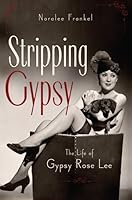
Stripping Gypsy: The Life of Gypsy Rose Lee by Noralee Frankel (2010).

Ms. Frankel want to strip away (pun intended) the fictions Gypsy created and find the real woman under all the layers. One of her strong interests is Gypsy’s politics, although that’s not the bulk of the book. A lot of Gypsy’s childhood (which can be found in Gypsy) is skipped to concentrate on the events that shaped her personality. This biography has a fair amount of information about Gypsy’s husbands and lovers (she ends her memoir before her first marriage). She longed to be a legitimate entertainer, but Hollywood feared the wrath of the censors and wasted her talents on screen. Because of her left-leaning views she was labeled a Communist and advertisers were urged to drop their sponsorship of her radio programs. She wanted to be taken seriously as an author, but was constantly overshadowed by her history as a stripper. There’s a constant feeling of desperation for success. The author states that the more she learned about Gypsy “she came to interest me more and I came to like her less.” It’s about accurate.

Published in: on 26 April 2012 at 12:28 pm  Leave a Comment  
Tags: ,

Review: Gypsy

Dear Constant Reader,

Our readings at Naked Girls Reading at the Expo made me realize that I have several books on Gypsy Rose Lee that I still need to review.

Gypsy: Memoirs of America’s Most Celebrated Stripper by Gypsy Rose Lee (1957).

Most people are at least a little familiar with Gypsy’s story: her childhood in vaudeville where she was ignored in favor of her more talented younger sister, her ambitious mother, and her success in burlesque. Her own account is a must read for any burlesque performer or fan. There have been several biographies of her written since (some of which I’ll review) and to truly appreciate them, her words should be read first.

Gypsy is a very funny lady. She often writes about things in a humorous way so that it’s not immediately apparent how awful they are. She doesn’t judge, just lays the facts out in a way that you can’t help but see how crazy her mother was. She only recounts her story until she went off to Hollywood, but her son picks up her story in his book Gypsy and Me: At Home and on the Road With Gypsy Rose Lee.

The play based on this book was subtitled “A Musical Fable” and in many ways the book is a fable too. This was Gypsy’s chance to rewrite history a little and make sure she was the star. Research shows she downplayed some incidents and omitted others entirely. It may not be entirely how it happened, but she felt it made for a better story and is therefore more true.

Published in: on 17 April 2012 at 3:44 pm  Leave a Comment  
Tags: ,

Review: Woman to Woman

Dear Constant Reader,

I’ve just acquired some new books, so I have to step up the reviewing. At the moment I have more than a dozen books to review — and some of them are the ones that have been in the library the longest!

“Woman to Woman: Ann Corio and the Rehabilitation of American Burlesque.” by Julie N. Vogt, PhD (2010).

I met Julie Uberblonde at the Great Burlesque Exposition of 2010 and we chatted about her doctoral dissertation about Ann Corio. She had some strong opinions about some popularly held beliefs of burlesque history. I was hopeful that she would eventually publish her dissertation as a book for more general audiences. It was a shock to learn that she died this past December. So, it was a little bittersweet to read her dissertation, knowing that there are so few academically researched books on burlesque.

Her main topic is on the creation of Ann Corio’s style of burlesque as a brand and marketing it to women. However, she also uses Ann Corio as a focus to delve into a critical study of burlesque, as a performance art and as a business. Along the way, she provides a review of the existing literature and she dispels some burlesque myths, a number of which Ann Corio appears to have created.

There’s a lot of information and some excellent research, but I’ll be honest — despite the topic, it’s still a doctoral dissertation and parts of it get a bit thick with academese. I’m pretty fluent in academese, so I was able to mine the gold. And there’s a lot of it.

Dr. Vogt’s death was a terrible loss for her family, friends, and students, and also for the study of burlesque.

Published in: on 5 April 2012 at 1:41 pm  Leave a Comment  
Tags:

Review: This Was Burlesque

Dear Constant Reader,

The highlight of the costume exhibit I’m curating at the West End Museum is several costumes worn by Ann Corio in her show This Was Burlesque, courtesy of her niece. In preparation for creating wall text, I’ve been rereading the book that accompanied the show. It seemed like high time to review it. A special thanks to my friends Teresa & Jeff who gave us this autographed copy one New Year’s Eve.

This Was Burlesque by Ann Corio (1968).

Ann Corio was one of the biggest burlesque stars in the Golden Age of Burlesque, especially in Boston. She played the Old Howard frequently and was much beloved of Harvard students. She claimed other colleges referred to her as “Harvard’s baby”, but she was definitely known as “Her Majesty, The Queen”. After her career in burlesque she turned to acting on stage and in B-movies, but just couldn’t forget about burlesque.

In 1962 she and her partner Michael Iannucci opened This Was Burlesque in New York City. A retrospective of comedy, striptease, and chorus girls, it ultimately played all over the country for almost 30 years. It was filmed by HBO in the 70’s, but the VHS tapes are hard to find.

Fortunately, we have Miss Corio’s book. She writes a light history of burlesque as one who was there through most of it. She perpetuates some burlesque myths and creates some new ones, but this is hardly an academic tome. She presented burlesque as cleanly and gently as possible to an audience who wanted something a little naughty, but not too threatening.

The book is illustrated with photographs from her show and as well as historical burlesque performances. There’s a strong emphasis on comics, especially ones who started in burlesque and went on to fame in film and television. She includes a number of scripts for comic sketches.

The book is out of print, but can be found at used book dealers without too much difficulty.

Published in: on 28 March 2012 at 2:37 pm  Leave a Comment  
Tags:

Review: The Happy Stripper

Dear Constant Reader,


Vote for the Boston Babydolls! Voting closes tomorrow!


The Happy Stripper: Pleasures and Politics of the New Burlesque by Jacki Willson.

I think I met the author at the after-party for The Immodest Tease Show in London back in 2006, but I’m not 100% sure — there were a lot of people there. But that’s neither here nor there.

Ms. Willson became interested in exploring the display of women’s bodies in a post-feminist world after seeing a piece of performance art involving striptease. She wonders if burlesque can be both sexy and subversive. Although the performers are putting their bodies on display, are they also fully empowered? Her focus is the examples of Ursula Martinez (performance artist), Immodesty Blaize (UK burlesque superstar), and Dita von Teese (no introduction necessary).

The book is quite academic and densely informative. I suspect it’s was originally the author’s dissertation. It’s not so much about burlesque as an art form but as the background for discussing the social implication and political ramifications of stripping. To really get the most out of this book, it’s helpful to know something of the different waves of feminism and the major players in each.

The focus is predominantly UK-centric, although she does use some US and Australian sources. The bibliography is exhaustive. If you’re looking for a light read on neo-burlesque, this isn’t it. If you’re interested in delving into the philosophies of stripping and feminism, this is your book.

Published in: on 14 March 2012 at 12:12 pm  Leave a Comment  
Tags: